About Me

My photo
Pilgrim, priest and ponderer. European living in North East England. Retired parish priest, theological educator, cathedral precentor and dean.
Showing posts with label compassion. Show all posts

Saturday, 6 July 2019

Assisted Dying: “Compassion is not a Crime”


Three years ago this month I watched my mother die. It was brutal for her and for me. She had recently been admitted to a care home following a short spell in hospital. A few weeks before, she had still been living at home in her ninety-fourth year, glad to have retained her independence for so long.

It was becoming clear that the end would not be far off. Like any son, my hope for my mother was that it would be quick, dignified and free of pain. But the reality turned out to be none of these things.  When she lost consciousness, the presumption was that death would soon follow. But it didn’t. She clung on to her life for a full two days, contorted by a pain the morphine administered by the medical staff seemed unable to assuage. I sat with her in the darkness through her last night with my memories and my prayers while she cried out in distress. Next day the morphine ran out, so I was dispatched to the hospital pharmacy to get some more. While I was gone, she died. 

The previous week in the hospital, she had asked the young doctor who was looking after her, “why can’t you give me something to help me cross this final threshold?” He replied, gently, “no, I can’t do that, but when the time comes for you to make that journey, we won’t get in the way”. She knew that he had no choice about his answer. She accepted it and didn’t argue the point. She knew that he had her best interests at heart. But she also knew that prolonging her life by not intervening to bring it to an end was not really about living at all. It was simply prolonging her dying. To her and to me, this was heartless.

My mother had long been an advocate of voluntary euthanasia. I found this out by chance one day when I was rummaging around the upper levels of a bookcase in the living room. There I came across a publication that bore the intriguing imprint EXIT. I asked her about it. She told me she believed that there were circumstances in which to choose to die was not only permissible but responsible. What circumstances, I wanted to know? Terminal illness for one thing, she said. Or the loss of your mental or physical faculties. Or any situation where your quality of life would be so diminished that death was preferable. I now think she had the Nazi death-camps in mind, in which members of her family had perished.

I can’t have been more than about twelve when we had that conversation, but I recalled it as I sat by my mother’s death bed. And I wondered what could be said for a law that prevented her from being relieved of her suffering had she chosen in advance, as she assuredly would, that in these desperate circumstances she would want her life to be terminated. I wondered why anyone would think that my mother’s pitiful condition during this ordeal was a good way to die, a dignified and compassionate way to bring a long human life to its close.

I could rehearse the ethical and theological objections to assisted dying and euthanasia, of course. I had (still have) every sympathy with those who argue that reverence for life must underlie all our decisions about palliative care and what we used to call the end of life pathways on which terminally ill patients were set. In all things there must be the imperative to “do no harm”. I understand the risks inherent in changing the law, the abuses that could follow bad legislation, the fear that the right to die could slide into a duty to die on the part of elderly people who could come to feel they had outstayed their welcome on this earth. 

But there’s another side to this. For one thing, at a time when every moment of human life can be, and is, managed by decisions we make for ourselves, including life’s beginnings by planning whether and when to give birth, it seems artificial to exempt life’s ending from this good and wise decision-making. Indeed, we don’t do this - in a case like my mother’s, every aspect of care in the final days and hours is highly managed until the end comes. But not the end itself. Yet in the face of terminal illness and the collapse of our mental or physicality capacity, not to be permitted to make a free and informed decision about bringing our life to a close is to subvert an aspect of our human responsibility to make moral choices. We make decisions about our healthcare throughout our lives, advised by professionals we trust. Why should the ultimate decision, the awesome choice whether to go on living or to die be denied us?

But a pastoral theologian wants to go further. It seems to me that this is fundamentally a matter of loving your neighbour as yourself or, as the Golden Rule has it, to treat others as we would have them treat us. We do not want to see other people suffer. We do not want to suffer ourselves. Contrary to how the Christian tradition is sometimes presented, there is surely no virtue in pain per se, which is why people of faith don’t regard relieving suffering as somehow frustrating the will of God. On the contrary. To alleviate suffering wherever we find it is an act of love and compassion that is motivated by the very same reverence for life that is often invoked against assisted dying. 

This week Parliament has once again been debating assisted dying. This debate will not be concluded any time soon. And it is right not to rush to conclusions, for these are matters literally of life and death. But I’d like to think that the churches’ contribution to it would not be implacable a priori opposition. I believe as a matter of Christian ethics that legislation could be enacted that would allow people - if they chose - to be spared the kind of suffering I watched my mother go through in her final hours. In an important book, Professor Paul Badham* considers the arguments for and against assisted dying in the light of biblical, theological and ethical considerations. He also presents evidence from places (such as the Netherlands, Switzerland, the State of Oregon) where the law permits assisted dying. He concludes that there is a Christian case for it that needs to be taken seriously. Which is why I support the Campaign for Dignity in Dying in pressing for legislation that will permit it in this country. As they say, “compassion is not a crime”. 

Sitting with my mother as she lay dying, while being profoundly aware of my own helplessness was not what brought me to this conviction. I had come to it long before that. But my belief about a principle had now acquired a personal dimension. What she suffered at the end of her life was in no way what she would have wished, in no way what I or anyone else who cared for her could have wanted. We ought to be allowed to be spared such an end. All our pastoral instincts surely point in that direction. It’s often pointed out that we are kinder to our pets when they reach the end of their lives than we are to our fellow human beings. Are we not of (even) more value than they?

It’s true that in all things, l’homme propose, Dieu dispose. We don’t know how we are going to die. But as I grow older I find myself echoing the petition in the Litany that we may be protected from a sudden catastrophic death. How much better to die peacefully, and whatever the poet says, to go gently into that good night. How much better to allow the artistry with which we have tried to shape our lives to help shape our deaths too, to the extent that is possible. This is what assisted dying is about, in the settings I’ve described.

So for myself, I hope to be able to make the decision while I am of sound mind to ask, if I need it, to be helped across that final threshold with dignity and grace, in the presence of those who love me and before my God who I trust will help me to pray, “Father, into your hands I commend my spirit”.

*Paul Badham, Is There a Christian Case for Assisted Dying? Voluntary Euthanasia Reassessed (SPCK, 2009).

Thursday, 20 April 2017

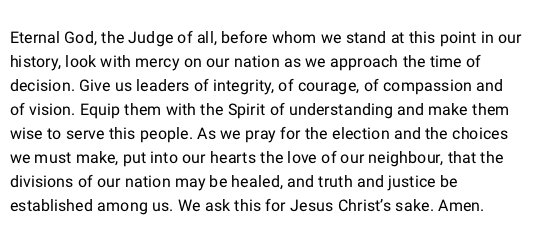
Praying for the Election


I've posted this prayer today. As a person of faith, I believe that everything we human beings do, we do before God. So it's important that we pray for the forthcoming general election. Let me try to explain what I mean - and what I don't mean when I say this.

I know that the Church of England has also issued a prayer today. It's fine as far as it goes. It asks that we the electorate may have wisdom at election time, be protected from despair, cynicism and false utopianism, and help make politics "a noble calling that serves the common good of all". I especially like that last bit. And I like the appeal to integrity as we cast our vote. G. K. Chesterton once said that the problem with elections was not that only half the electorate voted, but that only half the elector voted: half-heartedly, without real conviction, not really believing that elections make a difference.

But we make our prayers too narrow by false limits of our own (apologies to Father Faber for misquoting his famous hymn). We should be more ambitious as we lay the issues of this election before God. It's the outcome that matters, not simply the process that leads up to it. And while we mustn't turn prayer into a kind of spiritual manipulation motivated by party politics, I think we can agree that we should crave leaders who are principled, embody healthy values and who will have the courage to make decisions that will put them into practice. Hence my use of words like integrity, courage, compassion, vision, truth, justice, the love of neighbour and the healing of division in our nation - surely a top priority for everyone in public life right now. The Seven Gifts of the Spirit that are set out in the messianic portrait painted in Isaiah 11 might be a good place to begin exploring what we look for in our leaders: this was the text in my mind when I alluded in the prayer to "the Spirit of understanding".

No doubt we won't all agree about what these values and virtues mean in practice. But I believe that to pray with integrity about the kind of nation we want to be also commits us to debating with integrity during the election campaign. The lack of it was what many of us lamented during the EU referendum campaign. To descend to empty slogans (or, to quote Chesterton again, the "easy speeches that comfort cruel men") is to devalue what we mean by democracy. An election debate means listening carefully, evaluating evidence, discerning good arguments from bad, and not personalising matters of principle. (So please let's stop referring to Theresa May as "the vicar's daughter" - she deserves to be heard in her own right as a responsible adult woman, not someone who is still being defined by her father, however good a priest he no doubt was.)

Above all we need to be committed seekers after truth. A good election is one where we don't cling to old political tribalisms, some of which have clearly had their day. On the contrary, we need to take the trouble to think for ourselves as grown-ups who are privileged, in a way not open to everyone in our world, to be able to take part in a democratic election. To listen, to think and to debate in this respectful way is, I want to say, an act of discernment. It asks the question, where might the voice of wisdom and truth be detected amid the babble of human voices that clamour for our attention? Where might we even hear the voice of God? Discernment and prayer are close relatives.

I'm not saying it's easy. Discernment never is. The word diakrisis literally means "making a judgment", coming to a mind. The weighing of arguments, the ability to place them in a larger context, the capacity to inquire what theological or ethical issues might be at stake all demands wisdom, effort and good deal of perseverance. But if we care about our nation and the human family of which we are part - if indeed, we are not only good citizens of the UK but also, in the best sense, citizens of the world (sorry, Mrs May!), then discernment is precisely what we are called to practice in the next few weeks. Amid the clamour of earthquake, wind and fire, we need to listen out for the still small voice. Not just for our own sake, the nation's sake or the world's sake, but for God's sake too.

This is where prayer comes in. If we are people who pray, our concerns will already be engaged towards those who represent us in Parliament and the other institutions of which we are part. But now, as we get ready to make political choices that will have far-reaching consequences, it's especially a time to focus on our common life, and pray for wise and principled leaders who will cherish just, compassionate and humane values. We need to pray for the destiny of our nation as it searches for its place in a changing world order.

Prayer isn't (or shouldn't be) a way of getting God to orchestrate events our way. Nor is it a binary spiritual exercise ("answered" or "not answered"). It's more subtle than that. I believe it is a genuine and heartfelt desire to bring the affairs of the nation into the orbit of God's love and care, to acknowledge that all life is dependent on him, and that we are ultimately accountable to him as our Judge. It is a joyful affirmation that out of his love for the world, God is passionately concerned for the welfare of all peoples. Self-interest doesn't come into it - or, shall we say, ought to become as enlightened as possible by our love of God and our neighbour. Perhaps the best prayers are those that spring not from desperation but from gratitude and that are built on the central petition of the Lord's Prayer, "your kingdom come".

Even if you are not a religious person who habitually prays, maybe you could still think about the forthcoming election in this kind of way? Can we agree to practise "mindfulness" together over the next few weeks and try to raise the tone of the debate? Maybe we can make common cause with everyone of good will who wants to play a part in shaping a healthy ecology of mind and heart during the campaign? Perhaps we can encourage one another to entertain the idea of a more generous political discourse that rises above tired, simplistic formulae and genuinely tries to listen and understand?

There are two direct benefits of thinking about and praying for the election in the way I've suggested. The first is to revitalise our imagination about what is possible, what our society could become. The other is to help us learn the lesson of humility. Our politics could really do with generous helpings of both.

Friday, 10 February 2017

A Syrian Ready to Perish: a plea to the Prime Minister

I've tweeted an open letter to the Prime Minister in 138 characters. Here it is:

@ I beg you, as a Christian, remember the . Please reinstate our promise to care for 3000 child refugees.

I don't need to explain the background. This week the Government quietly announced that it was closing the "Dubs Amendment" Scheme under which the UK had undertaken to welcome lone child refugees from camps on the European mainland. Lord Dubs had suggested a figure of around three thousand refugees. The UK has to date received 350.

If anyone thought that with headlines about Brexit and President Trump, it was a week to bury bad news, they were mistaken. There has been an outcry from people of every political persuasion (or almost every - perhaps someone will tell me if UKIP has associated itself with this chorus of protest). At one level, there is something very un-British about going back on your word - which is what we all assumed it to be. In particular, refugee children who are hiding where the Calais Jungle used to be had their hopes raised and then cruelly dashed. It was heartbreaking to read about some of them in The Guardian recently.

My tweet appealed to Mrs May on two grounds: her memory and her religious principles.

Remember the Kindertransport is an invitation to recall how Britain responded the last time there was a refugee crisis in Europe on this scale. This was in the late 1930s when the scale of Nazi persecution of Jews in Germany and central Europe was at last recognised for what it was. Lord Dubs was himself rescued as a six-year old Jewish boy in German-occupied Czechoslovakia. In 1939 he boarded one of the famous "Winton Trains" which, thanks to the late Nicholas Winton, brought Czech refugees from almost certain death to safety and a new life in Britain. Thanks to the Kindertransport, ten thousand Jewish children were saved from the death camps and came here to the UK. They had their lives and futures given back to them. It is forever to Britain's credit that our country offered asylum to these youngsters.

I've blogged before about my own family's history, how my Jewish mother, then a teenager in northern Germany, was rescued from the Nazis in 1937 and made her home here in Britain. So I owe everything to this country's act of generosity to people who were desperate. If it were not for that, I wouldn't be here. I am sure the Prime Minister is as proud of that courageous decision as I am thankful for it. In the light of it, three thousand of the world's most helpless, vulnerable children does not seem a lot to ask of a nation that is so privileged. So I am begging Mrs May to reverse this week's announcement, and for the sake of being true to a history of British compassion in the face of need, do the right thing.

What is that "right thing"? This is where Mrs May's religious principles come in. As is well known, she is a committed Christian woman who attends her local church whenever she can. (I'm not going to invoke her upbringing as a daughter of the vicarage - it's her living faith I'm interested in today.) So I've appealed to her "as a Christian". Because the Judaeo-Christian scriptures are full of injunctions to care for the people who most need help - the destitute, the desperate, the economically dependent such as orphans and widows, and most strikingly, those whom the texts call the strangers who are in our midst. Add to that Jesus' impossible requirement that we should love our enemy and we see how exacting it is to live out of this faith tradition.

Where does this ethic of universal compassion come from? It's derived from the nature of God himself. A noble passage one of the books of the Torah tells us that "the great God, mighty and awesome, who is not partial and takes no bribe, executes justice for the orphan and the widow, and loves strangers, providing them with food and clothing" (Deuteronomy 10.17-18). So while Israel is the particular people of the covenant that is given the teaching we call Torah, Yahweh's concern and care are nothing short of universal. This is the essence of the monotheistic faiths of Judaism, Christianity and Islam. It's a perversion of them to narrow the scope of God's mercy in any way.

But the Torah's appeal to care for the "stranger" is not grounded only in the character of Yahweh. The appeal is also to Israel's own history. "You shall also love the stranger, for you were strangers in the land of Egypt" the passage in Deuteronomy goes on to say. In other words, if you won't show kindness out of imitation of the God you worship, at least show it for the sake of being true to your own memory of having been aliens yourselves. "A Syrian ready to perish was my father" is how the King James version of the Bible translates a saying later on in the same book (Deuteronomy 26.5), "a wandering Aramean" says the contemporary translation. Imagine it - the people of God were born of a Syrian parent! We can't escape the resonances for our own time when we read those words.  Mrs May must have heard them in church hundreds of times.

These two appeals to memory and to religious faith are combined in another book of the Torah: "You shall love the alien as yourself, for you were aliens in the land of Egypt: I am the Lord your God" (Leviticus 19.34). It's extraordinary to see how in the Hebrew Bible, showing compassion is not, or not only, a matter of duty. It springs out of love. Indeed, to care for the refugee or resident alien is "just" a special case of the universal command found in the same chapter of Leviticus, that we must "love your neighbour as yourself". People sometimes imagine that when Jesus commanded this in the Sermon on the Mount, he was announcing some dramatic new insight into what God requires of us. It's true he filled out these words in ways that no doubt arrested his hearers. But the words themselves come directly from the Hebrew Scriptures. It's an inescapable requirement of our faith. We may wish the Bible didn't make it quite so explicit. But I'm afraid it does.

Who am I to remind Mrs May of all this? I'm sure she knows it better than any of us. Hence my appeal to her Christianity as well as her memory. But the comma in my tweet is meant to be a trifle ambiguous. I beg you, as a Christian, remember the . In other words, I who am doing the begging am a Christian too. It's the Christian faith we hold in common and rejoice to affirm together that ought to make this conversation possible. But in a crisis, my Christianity is under scrutiny just as yours is.  How we respond to the most vulnerable people in the world tests us all in demanding ways. Part of that scrutiny is to shine a light on our biblical interpretation and social theology. The Archbishop of Canterbury and other church leaders have recognised this by registering their dismay at the Government's decision to resile from the Dubs Amendment. 

I tweeted yesterday that to turn back on our promise would be unBritish, unEuropean, inhumane and unChristian. So in the name of this nation's history, and in the name of the compassion that the great world faiths inspire us to show, I reiterate my plea to Mrs May. Please will you show principled leadership and reconsider? Please will you reinstate this country's commitment to do what it promised? Please will you enable our nation to act with big-heartedness and integrity and do what we can to help at a time of such great need? And maybe save Syrians, among others, "ready to perish"?