About Me

My photo
Pilgrim, priest and ponderer. European living in North East England. Retired parish priest, theological educator, cathedral precentor and dean.
Showing posts with label humility. Show all posts

Friday, 31 January 2020

Thoughts on Brexit Day

This is one of the hardest days of my life. 

Brexit Day feels like a kind of dying. Born as I was of mixed parentage, to a native German mother married to a British father, I belong as much to continental Europe as I do to England. I am equally at home on both sides of the English Channel, the North Sea and the Irish Sea. From my earliest memories, Europe formed me, shaped me, made me aware. When this country chose to join the European Community in 1973, I had a sense of homecoming. I believed I saw the hand of God in this.

So to walk away from the European Union as a member state is a source of real grief. It’s not simply turning our back on one of the greatest projects of peace and reconciliation the world has ever seen. It’s not only giving up the economic, research and cultural benefits our belonging has brought us, the security and influence that come from pooling our sovereignty. Nor is it merely (!) collaborating in the pursuit of justice and human rights, and taking action together to address the climate emergency. Though all these things matter very much to all who care about the future of our world.

No, for me it’s very much a sentient, intangible, and I need to say, spiritual, matter. It’s to do with my personal history as well as our national history. My father was a Londoner, an Anglican by origin, while my mother an assimilated Jewess from the Rhineland who fled the Nazis and found refuge in this country. You’ll see why the idea of a Common European Home, a family of peoples and nations bound together for the sake of the common good, exerts such a powerful hold on my imagination. That Brexit should be happening in the week of Holocaust Memorial Day makes our departure feel especially poignant. 

********

But what of today?

Brexit is perhaps the biggest rite of passage our nation is experiencing in our lifetimes, at least for those of us born since the last war. Which makes it a rite of passage for all of us who are citizens of the UK, and all who are citizens of EU27 countries who are living among us. (And, let’s not forget, for millions of people across the EU who care about Britain, love us British, and wanted us to stay.) 

Anthropologists warn us that we take risks when we cross thresholds. They are liminal places where landscapes shift, and roles and relationships change. At times of transition we can become disorientated. Questions are put to us about our direction of travel, emotions are heightened. We can find ourselves sad at the thought of what we are leaving behind, afraid of what lies ahead, perplexed, angry, longing to have reached the other side and find our feet on solid ground again. Every crossing over is a kind of bereavement - like my recent retirement or my mother’s death soon afterwards. We are never the same on the other side. 

This goes a long way towards explaining why our national psyche has felt so turbulent recently, why feelings of people on both sides of the Brexit debate have run high. We are still in this liminal phase. It’s too early to say how our international relations, domestic politics, trading arrangements and societal networks will settle down after this convulsion. And for some, their personal relationships too. Whatever we are destined to become, Britain will not be the same after Brexit. None of us will.

If you’re a regular reader of this blog, you’ll know why I believe Brexit could damage Britain irreparably. What will be lost could well, probably will, outweigh the gains. So I admit I’m despondent about how our country is going to fare during the rest of my lifetime. Yet we should have the best aspirations for our country that we can. I argued in a recent blog that Brexit could be good for us if it taught us to take a more realistic view of ourselves as a nation. I said we need to lay aside exceptionalism as if we were “special”, and learn to understand our place in the world as no longer a great imperial superpower but as an ordinary, middle-ranking country like scores of others. There’s no question of putting the “Great” back into Britain. Of all the unlovely slogans associated with Brexit, that self-aggrandising myth of pride is the most poisonous. I believe we badly need to learn the grace of humility. And that, of course, is a profoundly spiritual task. 

*******

And with humility goes the desire “not to be served but to serve” and to love our neighbour as ourselves. We don’t have any choice about this if we are serious about Christianity. How we look after the neediest people in our midst, be they of our race and faith and nationality or some other, is the acid test of our faith. How we care about peoples beyond our own shores is the plumb line against which our humanity is to be measured. To me, the EU was - still is - one of the noblest projects ever devised on our continent to put the virtues of love of neighbour and service of the other into practice in our relationships as nations. It grieves me more than I can say that Britain has chosen to walk away from these covenants of mutual self-giving. 

So it’s all the more important that after Brexit, we resist the temptation of isolation and throw ourselves all the more energetically into being a good neighbour to all the nations alongside which we live on this increasingly fraught, congested planet. Are we capable of this? Do we have a strong enough collective desire for it, the spiritual, moral will? Or will self-interest win out in the end? I really don’t know. I’m fearful if I’m honest. Nothing I’ve heard in the last three years is reassuring me that Britain will be a better, kinder, more principled country after Brexit than it was before. 

I wish I could be hopeful. But today fills me with anxiety and foreboding. It has sapped what belief I had that our nation, inspired by our history, our instinct for law, justice and common sense, our traditions of courage, fairness and hospitality, could through a great act of the imagination rise above our self-serving agenda and look beyond ourselves in some new, life-changing way. This protracted debate could have been an opportunity for us to engage seriously with questions of identity, nationhood and our collective self-understanding as a people facing a choice between alternative destinies. Instead of which we locked ourselves into the strident rhetoric endlessly rehearsed during the referendum campaign, “What’s best for Britain? Take back control! Britain first!” When what we should have been asking is, “What does Britain have to give so that we may all work together for the good of our continent and our world?”

In fact, “what’s best for Britain” is whatever will make for our truest flourishing as the nations and peoples of the United Kingdom. And flourishing means a lot more than the economy, trade and the cost of living. I’m depressed on this 31st day of January that we never succeeded in putting at the heart of the Brexit agenda, who are we as a nation? What does it mean to be a Good Britain, if not a Great Britain? How can we become a more humane society? How can we be a better neighbour to the nations of our continent and beyond? How can we collaborate more effectively in facing the perils confronting our world?  These questions are not only the agenda of practical politics. They belong to the collective human soul. And therefore, they are questions of ultimate concern. What’s best for Britain is what matters most to God.

********

I ask myself more personal questions too, today.

I began by saying that Brexit felt like a kind of dying, a severing of what I’d experienced as a positive, benign, life-affirming relationship. When politicians speak of our divorce from the EU, they are invoking a powerful metaphor. There are good divorces and painful ones, divorces of velvet and of barbed wire. We must hope that ours will be one of the kinder ones. But I every divorce involves hurt, the recognition that a relationship of loyalty, good will and trust has died or is in the process of doing so. That’s how I’m experiencing it right now. Don’t tell me I might feel differently tomorrow or in a month or two when the dust has settled. Today is all I have to go on. The dust makes it hard to see. 

The image that’s been in my mind ever since the referendum result has been that of exile. I’m well aware that for many, Brexit feels like the opposite of that, a homecoming, a resurrection even. Again, I can only reach into my heart and speak of what I find there. Desolation may seem a dramatic word. But it accurately describes what its literal meaning expresses, which is the sense of being alone, solus. Mystical theologians played on the way that word sounds as though it belonged to the vocabulary of the solum or soil. You could say that desolation is the forlorn experience of being severed from your native soil, just as consolation is to be reconnected, joined back, to it. When the Jewish exiles by the waters of Babylon cried out, “how can we sing the Lord’s song in a strange land?” (Psalm 137), their lament was called out of the bleakest desolation, disconnection and disorientation they had ever known as they reimagined their existence on unknown soil.

I’m not saying that most of us will experience an exile as painful as that, though for UK citizens living in the EU and EU27 citizens living in the UK, the consequences of Brexit may well be bitter indeed. But for me at any rate, today does invoke an echo of that Psalm as I find myself amputated against my will from so much that I loved and valued. The Hebrews were severed from all that had given their lives shape and meaning - their land, their temple, their institutions, their monarchy, their homes. Without these givens, they had to renegotiate life on a new set of terms. It’s clear from the prophets that it was a bewildering experience. After today I shall have to renegotiate life without the constants of my European Union citizenship. And especially the sentient environment that has been part of life simply because of my being a citizen of an EU member state. It’s hard to describe when it’s as pervasive as the air I breathe. But maybe you recognise that sense of connection to my own continent through the hard-won bonds of peace and friendship and everything else this time of gifts has brought.

********

I said earlier that I wish I could be hopeful. Abraham, the scriptures tell me, “hoped against hope”. The exiles would indeed learn to find hope again, one day. But it took time. The psalm of lament would be their bitter cry for many days to come. They would need to learn the hard way not to trust voices that made easy speeches about an imminent brighter future against the evidence of history and the instincts of their own spirits. It’s too soon for me to speak of hope today. I need to be as present as I can to this disappointment, this journey of exile, try to find what meaning in it that I can. I won’t pretend it’s going to be easy. As I’ve said, this is one of the hardest days of my life.

But I want as a Christian citizen to do what I can to serve the common good. I may be at odds with what Britain has become as a result of Brexit, but it is still the country of my birth and upbringing. I owe it my love and loyalty. I want to do what’s in my power to help heal our divided nation and recover a sense of common purpose. Yet in just the same way I shall never stop thinking of myself as a European, a citizen of the continent that has so shaped my personal history and my understanding of what it means to be me. I owe love and loyalty to Europe too. Not least because by lifting my sights beyond my own nation’s shores, the EU taught me how to take the first steps towards becoming a citizen of the world, a child of God’s worldwide human family. 

I’m done raging against this “dying of the light”. So I ask myself, is some transformation possible? Could this exile that I do not want to contemplate, this parting of friends, become a grace-filled pilgrimage in time? Who knows? Only by setting out will I begin to glimpse what this journey could become. I dare not call it hope just now. But if I can’t find hope at this moment, can I perhaps hope to have hope again one day? For the nation I mean, and for the world, as well as for myself? On Sunday, the First Sunday after Brexit, the church celebrates Candlemas. We light candles to honour the Holy Child who came into the world as a light for all the nations, who makes us glad because God is among us. This Kindly Light will teach me to walk this unfamiliar landscape and travel safely across it.

“Hope to have hope.” I can live with that for now. One step enough for me. 


Tuesday, 13 August 2019

The Benefits of Brexit

Yes, you read that correctly. I want to write about the benefits of Brexit. It may be news to you that there could be any. Or at least, that I might imagine so. Am I losing my head?

I don't think so. For the avoidance of doubt, I've not changed my mind about Brexit. I believe it to be a disastrous decision for the United Kingdom. If you've been following this blog, you'll know that I've rehearsed the arguments ad nauseam. To me, it makes no sense either economically or politically. It cuts across the idea that I imagined was becoming mainstream opinion, that we are better off together than alone, that a world in which we collaborate to tackle the threats we face is more likely to be one in which we all live more safely and at peace with one another, care more effectively for the poor and vulnerable, share our resources in combating the climate emergency, and have more likelihood of flourishing. Pooling our sovereignty gives us leverage to achieve what is beyond the reach of any of our peoples separately. To me as a Christian, this comes down to loving our neighbour as ourselves. The best future for our world is based on relationships and community, not on isolation and self-interest.

I've not changed my mind about any of this. If anything, I believe in these (to me) self-evident benefits of EU membership more strongly than I ever did, the more I listen to the spurious arguments against them.

It's these very arguments, in fact, that lead me to think that Brexit could bring benefits after all. I have two in mind. The lesser benefit would be for the UK finally to rid the EU of the burden we have become to it. When you are a thorn in someone else's side, the kindest thing to do is to remove yourself from a relationship that is giving the other party so much grief. We don't deserve the longsuffering patience our European friends have shown to us British since 2015. And they don't need, and never needed, our foot-dragging, curmudgeonly, resentful attitude towards them as the EEC and then the EU, our reluctance ever to become fully-fledged Europeans who pull our weight in this family of nations.

The greater benefit would be that Brexit, hard or soft, would provide a response to David Cameron's endlessly repeated mantra before the referendum campaign, when he tried to renegotiate the UK's EU membership. "What's in it for Britain?" he kept asking, "What's in it for us?"

Here's my answer. What Brexit would (will?) achieve is quite simply to make it clear beyond any doubt that the UK has now become a very ordinary, very average, unexceptional middleweight nation. It no longer has a special role in the world, or at least a role that's any more special than any other nation. It has lost any credible claim to exceptionalism. It is one nation among many, better than some, not as good as others, a middling kind of power in global politics and economic strength that can expect to be overtaken in terms of influence, wealth and political clout by a dozen other nations in the next few decades.

Why would this be a benefit to Britain?

Simply because it would require us to pursue a more modest way of being in the world. From being a significant world power with enormous moral influence and reach across the globe, and with a strong sense of a unique British destiny, we would have to become used to a less exalted, more humble role such as we have not been had since at least the eighteenth century. We would have to learn to know our place.

All this would pose something of a spiritual and moral crisis for the United Kingdom. For if we were to learn true humility, it would require us as a nation to become a great deal more self-aware, more spiritually and emotionally intelligent, than we have been during this decade. It has been a national embarrassment to watch ourselves behaving as if we were suffering from some kind of corporate psychotic episode, a collective nervous breakdown. It's been instructive, if cruel, to read the commentary on Brexit in the overseas media, and see ourselves as others see us. We have become a source of bafflement even to our allies, and of scornful ridicule to our enemies. Brexit has already demonstrated its capacity to humble us in the sight of others. And this can only increase as the clock ticks down towards Hallowe'en and, as seems increasingly likely, we crash out of the European Unon without a deal.

The biblical and classical stories of what we tend to call a "fall" are essentially about how peoples, nations and individuals have to face the truth about themselves as a result of some tragic flaw or misplaced hubris, when grasp exceeds reach and we are toppled from some place of privilege or pride. This seems to me to be the crisis we are reaching in Britain. A crisis is literally a "judgment", and implicit in the idea of "fall" is that of nemesis, just deserts that are reaped not as a result of some external intervention but because of what we do to ourselves through our own presumption, how decisions and their consequences draw out of ourselves a hitherto unguessed potential for self-harm if not self-destruction.

In the case of Brexit, I think we can ascribe a good deal of this to the naked self-interest (not to say self-importance) that has dominated the EU debate for years. Instead of asking how our membership could benefit other members of the Union, all that has seemed to matter to us has been our own profit. And as the gospel says, if we strive to gain the whole world, we put at risk our own soul. This, I fear, is the condition Britain is reaching, may already have reached. Brexit has driven us to the brink of spiritual, ethical and moral bankruptcy. Appeals to collaborate for the sake of social justice, peace-making, security, the environment and the welfare of the most needy members of our society fall on increasingly deaf ears. The clamour is "do or die", Brexit at all costs, deal or no deal. If ever a nation was suffering a nervous breakdown that clouded judgment and common sense, this is it.

Which is why I'm reluctantly coming to the view that Brexit may actually be necessary if we are to come to our senses and be healed of this craziness. Could it be that to learn to see ourselves as a rather ordinary offshore island could be good for the national psyche? Could it be that this fall from perceived privilege could give us back our soul?  Could it be that the sheer shock of Brexit teaches us lessons we are incapable of learning in any other way. that it could bring us to our senses? I'm thinking of the prodigal son who lost everything in his far country, and only then began to find himself again and make the long journey home.

"He that is down need fear no fall; he that is low no pride" wrote John Bunyan in Pilgrim's Progress. I wonder what this quintessentially English writer would say to the Britain of the twenty-first century. I think he would tell us that humility is the first lesson we need to learn if we are to become truly wise and, in any sense that ultimately matters, truly great in our moral stature and spiritual character. St Benedict, patron saint of Europe, says the same which is why he devotes so much space to humility in his Rule. It's a principle we have forgotten in the shrill politics of our time. If "righteousness exalts a nation", then humility is the first step to it.

I'm resigned to Brexit now. I shall continue to resist it by any means possible, especially in its no-deal incarnation. But in my waters, I don't believe it can be avoided. I won't deny that I feel unutterably despondent about the prospect of waking up on All Saints Day no longer a citizen of the European Union. But something in me says that this could be a profoundly important moment in the history of our nation. If, after 1 November, we begin to experience buyer's remorse and ask ourselves, as I think we are likely to, "how on earth could we have committed such a foolish act?", it could lead to a new seriousness in public life that restored truth-seeking to the place it ought to have occupied all along. It could be a kind of conversio.

If that in turn helped foster a more realistic self-understanding on the part of the nation, a more sober perception of our place in the world, an altogether more humble view of ourselves and our destiny, that would have to be a good thing, wouldn't it? And if we were to find ourselves more free of our historic ambitions for power, hegemony, growth, influence and wealth, it might just bring about our capacity to become the best selves we have it within us to be. It would put us back on the path of healing and reconciliation after years of bitter division, help us be at ease with ourselves once again. That would be a vocation worth pursuing. We might well be a sadder nation, but I think we would be a better and a wiser one.

The hectoring, relentlessly upbeat Brexit rhetoric of Boris Johnson and his government doesn't encourage me to think that this will happen very soon. But in the longer term, under a leadership that is less in thrall to romantic notions of past greatness, and more realistic in scanning horizons and responding intelligently to events, change might be possible. And then we shall need to apologise - to our European neighbours whose friendship and trust we have abused, and to the people of Scotland and Ireland in particular who will find it hard to forgive the English for the forces of disintegration that we have unleashed. Indeed, saying sorry and meaning it is always important evidence that we have learned from our mistakes and can begin to tell the truth about ourselves once more.

Which is what humility, recognising our ordinariness and knowing our place are all about.

Thursday, 20 April 2017

Praying for the Election


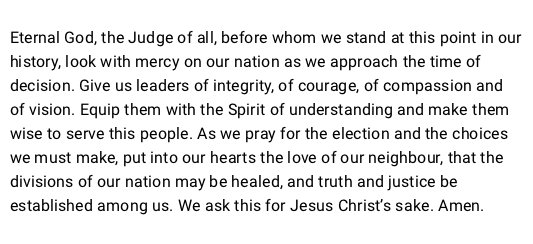
I've posted this prayer today. As a person of faith, I believe that everything we human beings do, we do before God. So it's important that we pray for the forthcoming general election. Let me try to explain what I mean - and what I don't mean when I say this.

I know that the Church of England has also issued a prayer today. It's fine as far as it goes. It asks that we the electorate may have wisdom at election time, be protected from despair, cynicism and false utopianism, and help make politics "a noble calling that serves the common good of all". I especially like that last bit. And I like the appeal to integrity as we cast our vote. G. K. Chesterton once said that the problem with elections was not that only half the electorate voted, but that only half the elector voted: half-heartedly, without real conviction, not really believing that elections make a difference.

But we make our prayers too narrow by false limits of our own (apologies to Father Faber for misquoting his famous hymn). We should be more ambitious as we lay the issues of this election before God. It's the outcome that matters, not simply the process that leads up to it. And while we mustn't turn prayer into a kind of spiritual manipulation motivated by party politics, I think we can agree that we should crave leaders who are principled, embody healthy values and who will have the courage to make decisions that will put them into practice. Hence my use of words like integrity, courage, compassion, vision, truth, justice, the love of neighbour and the healing of division in our nation - surely a top priority for everyone in public life right now. The Seven Gifts of the Spirit that are set out in the messianic portrait painted in Isaiah 11 might be a good place to begin exploring what we look for in our leaders: this was the text in my mind when I alluded in the prayer to "the Spirit of understanding".

No doubt we won't all agree about what these values and virtues mean in practice. But I believe that to pray with integrity about the kind of nation we want to be also commits us to debating with integrity during the election campaign. The lack of it was what many of us lamented during the EU referendum campaign. To descend to empty slogans (or, to quote Chesterton again, the "easy speeches that comfort cruel men") is to devalue what we mean by democracy. An election debate means listening carefully, evaluating evidence, discerning good arguments from bad, and not personalising matters of principle. (So please let's stop referring to Theresa May as "the vicar's daughter" - she deserves to be heard in her own right as a responsible adult woman, not someone who is still being defined by her father, however good a priest he no doubt was.)

Above all we need to be committed seekers after truth. A good election is one where we don't cling to old political tribalisms, some of which have clearly had their day. On the contrary, we need to take the trouble to think for ourselves as grown-ups who are privileged, in a way not open to everyone in our world, to be able to take part in a democratic election. To listen, to think and to debate in this respectful way is, I want to say, an act of discernment. It asks the question, where might the voice of wisdom and truth be detected amid the babble of human voices that clamour for our attention? Where might we even hear the voice of God? Discernment and prayer are close relatives.

I'm not saying it's easy. Discernment never is. The word diakrisis literally means "making a judgment", coming to a mind. The weighing of arguments, the ability to place them in a larger context, the capacity to inquire what theological or ethical issues might be at stake all demands wisdom, effort and good deal of perseverance. But if we care about our nation and the human family of which we are part - if indeed, we are not only good citizens of the UK but also, in the best sense, citizens of the world (sorry, Mrs May!), then discernment is precisely what we are called to practice in the next few weeks. Amid the clamour of earthquake, wind and fire, we need to listen out for the still small voice. Not just for our own sake, the nation's sake or the world's sake, but for God's sake too.

This is where prayer comes in. If we are people who pray, our concerns will already be engaged towards those who represent us in Parliament and the other institutions of which we are part. But now, as we get ready to make political choices that will have far-reaching consequences, it's especially a time to focus on our common life, and pray for wise and principled leaders who will cherish just, compassionate and humane values. We need to pray for the destiny of our nation as it searches for its place in a changing world order.

Prayer isn't (or shouldn't be) a way of getting God to orchestrate events our way. Nor is it a binary spiritual exercise ("answered" or "not answered"). It's more subtle than that. I believe it is a genuine and heartfelt desire to bring the affairs of the nation into the orbit of God's love and care, to acknowledge that all life is dependent on him, and that we are ultimately accountable to him as our Judge. It is a joyful affirmation that out of his love for the world, God is passionately concerned for the welfare of all peoples. Self-interest doesn't come into it - or, shall we say, ought to become as enlightened as possible by our love of God and our neighbour. Perhaps the best prayers are those that spring not from desperation but from gratitude and that are built on the central petition of the Lord's Prayer, "your kingdom come".

Even if you are not a religious person who habitually prays, maybe you could still think about the forthcoming election in this kind of way? Can we agree to practise "mindfulness" together over the next few weeks and try to raise the tone of the debate? Maybe we can make common cause with everyone of good will who wants to play a part in shaping a healthy ecology of mind and heart during the campaign? Perhaps we can encourage one another to entertain the idea of a more generous political discourse that rises above tired, simplistic formulae and genuinely tries to listen and understand?

There are two direct benefits of thinking about and praying for the election in the way I've suggested. The first is to revitalise our imagination about what is possible, what our society could become. The other is to help us learn the lesson of humility. Our politics could really do with generous helpings of both.

Saturday, 12 March 2016

Britain, the End of Empire and the EU

I enjoyed a free day in London today. It's my home city but it's only when you move away that you really appreciate all it has to offer. And so much has changed since I left London in 1968 to go to university, never to live there again.

Inevitably my mind is full of the EU referendum at the moment. So I welcomed the prospect of a few hours away from the cyber-campaign I'm involved in through "Christians for the EU". But it's fascinating how you make connections all the time. I hadn't planned them - honest! "They just growed."  I began the day at Tate Britain to see an exhibition that's on at the moment called Artist and Empire. After that, I took a boat down the Thames from Millbank to Greenwich to visit the Royal Naval Hospital. Finally I went to the National Maritime Museum. 

First, the exhibition. If you're British, it's bound to be uncomfortable and challenging to revisit your history like this. I have a son in law who lectures in post-colonial history and he has helped me to look at Britain's past as a former world power in new ways. As I gazed at maps and works of art celebrating the big events of empire, I remembered an occasion years ago when I found I was being questioned in the same way. That was when I walked the Freedom Trail in Boston (which by the way every UK citizen who visits New England should do if they can). The discomfort was increased by the presence of "stolen art" in the exhibition: indigenous artefacts that were chosen precisely to underline the point that the erstwhile trophies of empire once so cherished are nowadays subject to huge debate about who they truly belong to and where they should be held. 

Most of this was a world away from Europe. Europeans featured in the exhibition mainly as fellow-colonialists, all part of this huge, now discredited project, of exerting power across the globe and exporting "western" values to every continent on earth. But Europeans also featured strongly as enemies of the British, especially the French and Spanish. In three different places along the Thames today, I've seen pictures of the death of General James Wolfe who seized Québec from the French in 1759. The exhibition showed how European wars have been acted out all over the world from Tudor times to the 20th century, a vast displacement activity in which millions of people were dragged to their deaths in conflicts that were never their own. 

The demanding but necessary process of bringing an end to empire inevitably puts questions to the United Kingdom of today. What kind of nation are we now, and what are our values as a people? That's the point of an exhibition that has been carefully curated to explore what imperial history means in a post-colonial environment. And all the time I was finding myself framing my own questions about this history, not only as a British citizen but as a European as well. So from an EU point of view, what might we say about the UK's contemporary geopolitical setting and its global role in the 21st century? 

My first and obvious thought was: how hard it is for a world player like imperial Britain to lose an empire and to accept that it has dropped down to being just a middle-ranking power among many others. It calls for real national humility to do this with dignity. It requires an act of grace not to harbour nostalgic longings for an age when so much of the world map was coloured pink, and when Britannia ruled the waves. As I disembarked at Greenwich, I could see up the Blackwall Reach to the original site of the East India Docks. At the exhibition, and again at the Maritime Museum I saw and learned much about the East India Company that became an immensely powerful colonial institution. The grandeur of Wren's Royal Naval Hospital is an eloquent symbol of a navy the like of which the world had never seen and would never see again. The converted warehouses that line the Pool of London, now smart apartments and expensive shops and eating houses, are the visible footprints of a trading power that reached to the ends of the earth. 

The bustling Thames, London's great artery of military and economic power, is a good place to reflect on a proud past. What's left of it all now? you ask yourself. Yet even if the UK is no longer a global power, it still has great global influence. The English language is one example of its reach all over the world. Our financial institutions are another. In the arts, culture, sports and in the academy the UK is a world class player. We can be justly proud of the achievements of the British people down the centuries and today. 

But let's remember that even in global politics we continue to count as heavyweights. Not on our own. That is never going to be possible again, nor should we harbour such ambitions for ourselves. Through our pooled sovereignty in the EU, we are still a force to be reckoned with alongside our continental partners. What's more, other EU nations look to us to take a lead in safeguarding the hard-won peace of Europe. This is one of the reasons why they do not want us to leave. In a world as febrile as ours is now, we can't afford to sit loose to our security. Alliances like the European Union, bound together by treaty, matter more and more today. It may be scaremongering to speculate that the only world leader who would welcome Brexit is Vladimir Putin who could - it's conjectured - take advantage of an EU weakened by the UK's departure. Who can say? I'm not an expert so I'm simply echoing strategists who have written about the new threats Brexit could pose at a time when the Cold War may no longer just be a matter for the history books. 

So here's what I have come away from today thinking. Our imperial past ought to have given us the capacity to think geopolitically about our future. When you've been a world power, you've seen the planet in a different way. Yes, you've exerted power in it, practised domination over it, subdued it, exploited it, stolen from it, all the evils we rightly condemn in the colonial project. The galleries that focus on the Atlantic slave trade at the National Maritime Museum are a sobering reminder of an ineradicable and shameful era. And even where Britain brought culture, language, a legal system, industrialisation and religion, these were far from being unambiguous benefits as historians always point out. History should drive us to our knees - not in gratitude but repentance. 

However, the legacy of empire ought to be that we don't lose sight of the big picture. The Thames is lined with the evidence of Britain's ability to think and imagine beyond its own shoreline. And that is sorely needed now, more than ever. For me, the European Union is one instance of how, today, a modern nation state like ours finds its proper place in a family of peoples who are committed to seeking one another's welfare, what theologians call the common good. To leave the EU would not only expose Europe and ourselves to threats we can't altogether foresee, whether in world trade or security.  It would represent a collapse in our vision of Britain, a narrowing of our horizons, a betrayal of everything that once enabled our islands to play such a disproportionately large role in world affairs. It's a cliché to say that it would probably lead to the cul-de-sac we call Little England. But I fear it would. 

Christianity says that greatness happens as we put others before ourselves and become not masters but servants, becoming one of "the least". That calls for humility, the virtue I drew attention to earlier. I think a good story can be told in this way: that at the end of empire, UK has had to learn how make the transition from domination to something like humility and service. I believe that despite its difficulties, we've done it with grace and integrity, and without loss in of what makes us British. The EU gives us a place to belong where we can not only flourish and be at ease with ourselves, but learn as a nation what it means not to be served but to serve. In that way we can yet make a lasting contribution to humanity. 

You can follow Christians for the EU on FaceBook or on Twitter @Xians4EU.