
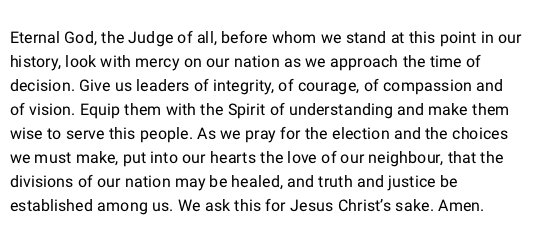
 I've posted this prayer today. As a person of faith, I believe that everything we human beings do, we do before God. So it's important that we pray for the forthcoming general election. Let me try to explain what I mean - and what I don't mean when I say this.
 I know that the Church of England has also issued a prayer today. It's fine as far as it goes. It asks that we the electorate may have wisdom at election time, be protected from despair, cynicism and false utopianism, and help make politics "a noble calling that serves the common good of all". I especially like that last bit. And I like the appeal to integrity as we cast our vote. G. K. Chesterton once said that the problem with elections was not that only half the electorate voted, but that only half the elector voted: half-heartedly, without real conviction, not really believing that elections make a difference.
But we make our prayers too narrow by false limits of our own (apologies to Father Faber for misquoting his famous hymn). We should be more ambitious as we lay the issues of this election before God. It's the outcome that matters, not simply the process that leads up to it. And while we mustn't turn prayer into a kind of spiritual manipulation motivated by party politics, I think we can agree that we should crave leaders who are principled, embody healthy values and who will have the courage to make decisions that will put them into practice. Hence my use of words like integrity, courage, compassion, vision, truth, justice, the love of neighbour and the healing of division in our nation - surely a top priority for everyone in public life right now. The Seven Gifts of the Spirit that are set out in the messianic portrait painted in Isaiah 11 might be a good place to begin exploring what we look for in our leaders: this was the text in my mind when I alluded in the prayer to "the Spirit of understanding".
No doubt we won't all agree about what these values and virtues mean in practice. But I believe that to pray with integrity about the kind of nation we want to be also commits us to debating with integrity during the election campaign. The lack of it was what many of us lamented during the EU referendum campaign. To descend to empty slogans (or, to quote Chesterton again, the "easy speeches that comfort cruel men") is to devalue what we mean by democracy. An election debate means listening carefully, evaluating evidence, discerning good arguments from bad, and not personalising matters of principle. (So please let's stop referring to Theresa May as "the vicar's daughter" - she deserves to be heard in her own right as a responsible adult woman, not someone who is still being defined by her father, however good a priest he no doubt was.)

I'm not saying it's easy. Discernment never is. The word diakrisis literally means "making a judgment", coming to a mind. The weighing of arguments, the ability to place them in a larger context, the capacity to inquire what theological or ethical issues might be at stake all demands wisdom, effort and good deal of perseverance. But if we care about our nation and the human family of which we are part - if indeed, we are not only good citizens of the UK but also, in the best sense, citizens of the world (sorry, Mrs May!), then discernment is precisely what we are called to practice in the next few weeks. Amid the clamour of earthquake, wind and fire, we need to listen out for the still small voice. Not just for our own sake, the nation's sake or the world's sake, but for God's sake too.
This is where prayer comes in. If we are people who pray, our concerns will already be engaged towards those who represent us in Parliament and the other institutions of which we are part. But now, as we get ready to make political choices that will have far-reaching consequences, it's especially a time to focus on our common life, and pray for wise and principled leaders who will cherish just, compassionate and humane values. We need to pray for the destiny of our nation as it searches for its place in a changing world order.
 Prayer isn't (or shouldn't be) a way of getting God to orchestrate events our way. Nor is it a binary spiritual exercise ("answered" or "not answered"). It's more subtle than that. I believe it is a genuine and heartfelt desire to bring the affairs of the nation into the orbit of God's love and care, to acknowledge that all life is dependent on him, and that we are ultimately accountable to him as our Judge. It is a joyful affirmation that out of his love for the world, God is passionately concerned for the welfare of all peoples. Self-interest doesn't come into it - or, shall we say, ought to become as enlightened as possible by our love of God and our neighbour. Perhaps the best prayers are those that spring not from desperation but from gratitude and that are built on the central petition of the Lord's Prayer, "your kingdom come".
Even if you are not a religious person who habitually prays, maybe you could still think about the forthcoming election in this kind of way? Can we agree to practise "mindfulness" together over the next few weeks and try to raise the tone of the debate? Maybe we can make common cause with everyone of good will who wants to play a part in shaping a healthy ecology of mind and heart during the campaign? Perhaps we can encourage one another to entertain the idea of a more generous political discourse that rises above tired, simplistic formulae and genuinely tries to listen and understand?
There are two direct benefits of thinking about and praying for the election in the way I've suggested. The first is to revitalise our imagination about what is possible, what our society could become. The other is to help us learn the lesson of humility. Our politics could really do with generous helpings of both.
