About Me

My photo
Pilgrim, priest and ponderer. European living in North East England. Retired parish priest, theological educator, cathedral precentor and dean.
Showing posts with label truth. Show all posts

Sunday, 23 June 2019

The Next Prime Minister: why character matters

This post is not about Boris Johnson. Well, not directly.

But recent events have posed sharp questions for those who are standing as candidates to become the next prime minister, and for the electors who will decide. Does it matter what kind of person you are, or only what policies you promote? Is your private life relevant to your public role, or should we mind our own business when it comes to salacious headlines about the personal conduct of people in prominent leadership positions?

I have a lot of sympathy with the idea that we have a right to a private life. The intrusion of print and broadcast media into our privacy is in many ways a distasteful thing, fuelled as it often is by a deafening clamour of online voices. I've spent my working life in public roles as an ordained priest in the Church of England. In no way is this comparable to being a politician, though when you are a cathedral dean, you necessarily find yourself the focus of public attention. It’s not always welcome. For example, a few years ago I found myself embroiled in a contentious debate about a local football manager who had (in my and many people's opinion) espoused a version of fascism. I protested that football supplies key role models to the young and fascism ought not to feature among them. I was subjected to shedloads of abuse from people who cared only about their club's footballing success. My personal origins (regarding my German-Jewish mother) were invoked in a stream of abusive forum comments I was foolish enough to look at. It was uncomfortable to say the least even though I had not said or done anything I later regretted.

Yet it seems to me that when you take up a leadership role in public life, you do in an important way renounce the privileges of a private life most people take for granted. Let me speak about the world I know best, the Church of England. At this time of year, men and women are being ordained across the country. I shall be speaking to a group of them in a week's time. The ordination season is always a joyful, but also a solemn, thought-provoking time not only for the candidates themselves but for the whole church. It asks us reflect on the kind of public ministry that is needed in today's and tomorrow's church if it is to flourish and serve the nation and its peoples as well as it can.

In the ordination service the Bishop asks this question of the candidates. Will you endeavour to fashion your own life and that of your household according to the way of Christ, that you may be a pattern and example to Christ's people? To some, that could feel intrusive. What right has the church to ask this? What has my personal life, still more that of my household, got to do with my fitness to lead and serve in the church? Surely that is purely a matter of charism, aptitude and skill?

Well, not entirely. What the ordinal is getting at is the exemplary nature of leadership. As all the textbooks tell us nowadays, good leadership is about much more than strategic aims and smart objectives. It's as much about what you are as what you do and how you perform. It pays equal attention to how you embody and live out the values of your institution to those towards whom you have the responsibility of oversight. Words like virtue and character are used a lot. Some senior leaders in politics and business have said that they keep a copy of The Rule of St Benedict on their desks to remind them what this great book from 1500 years ago teaches about the virtues needed in a good leader such as the abbot of the monastery.

The fact is that people (not just church people) regard clergy as "exemplary" Christians and human beings. To the public, it's not simply what priests and bishops say but what they do that counts. We may balk at that, protest that clergy are ordinary men and women who as fragile and broken as everyone else. The last thing we should do is put them on pedestals. And of course, that's right. Except that it ignores the dynamic that is going on when leaders hold public office. As soon as they step into an official role, they attract projections and transferences that invest them with hopes and expectations that can be almost numinous, invested with a kind of sacred quality.

I preached at an ordination last year on John the Baptist's words "I am not the Messiah" and said I'd have them emblazoned on the robes of every new clergy man or woman! But you can't deal with messianic projections so easily. Unconsciously people want leaders to be their messiah. And as far as clergy are concerned, they certainly want the ordained to be model Christians, "a pattern and example" whom they can emulate. So when clergy fail by catastrophically undermining the gospel values they stand for, it is shocking. Priests who abuse children, for example.

Something like this is going to be true of leaders in every institution - public, private or voluntary. And where an organisation's values feature prominently in its public presentation of itself, its leaders are bound to be subject to particular scrutiny. This is where churches and political parties perhaps have something in common because they are value-driven. Political leaders are looked to as much for their values and personal authenticity as for strategic direction and policy-making. This doesn't mean they won't fall below their party's standards from time to time. But when they do in non-trivial ways, that becomes a matter of legitimate public concern. Is this person all they say they are? Are they as trustworthy in their personal life as in their public role? Is there a consistency of values and behaviour across the whole of their persona?

I can only say that these questions have been central to my self-understanding as a priest in my years of public ministry. I have made mistakes, let people down, disappointed their proper expectations of what a priest should be, fallen short of my own standards for my personal as well as my public life. In some ways, letting myself down is harder than anything else as I look back - not being consistently my best self in that "inner room" as Jesus calls it, the place where people can't see who and what I truly am. I have tried (and am still trying) to learn that in some respects, what goes on in secret really is the business of the people I've been called to serve and lead. I don’t mean we should condone nosiness or prurience: there is a line to be drawn between what it’s appropriate for people to know about my personal or family life and what it isn’t. But if others have a legitimate concern about the consistency of my professional and personal life when measured against values I publicly represent, that isn’t prurience. That’s caring for the church’s welfare - and mine too.

Thinking about the election of the next prime minster, I recently tweeted the seven Nolan Principles of Public Life. This isn't the first time I've mentioned them in my blog. The government website tells us that "the 7 principles of public life apply to anyone who works as a public office-holder. This includes people who are elected or appointed to public office, nationally and locally. The principles also apply to all those in other sectors that deliver public services.They were first set out by Lord Nolan in 1995 and they are included in the Ministerial code".

The Principles (which I think are worth a capital letter even if the website doesn't) are: selflessness, integrity, objectivity, accountability, openness, honesty and leadership. These are the seven standards - maybe we should call them virtues - to which everyone in public life should aspire. They set out what we should properly expect of those who undertake public roles. In public sector organisations leaders are required to sign up to them formally. I wonder why we don't ask church leaders to do the same. Because they describe behaviours as well as aspirations, they seem to me to apply to the personal as well as the professional "character" of leaders. In ancient Greek, a character was literally a text or design that was stamped on wax, thus transmitting the essential quality of the original pattern. It's a good metaphor of the way we are formed (or should be) by the values and virtues of the institutions we belong to and lead.

Which is why it's relevant to ask the candidates for one of the highest offices in the land whether they are committed to these Principles. In an article in today's Observer, Simon Tisdall draws on David Miliband's Fulbright Lecture to ask why world leaders these days can get away with lying with impunity. Do we in the UK not want our own leadership to be free of mendacity, to believe that truth is fundamental to good leadership, not merely truth about facts (though that is important) but truth-seeking and truth-telling as essential personal qualities? That's what's at stake in this election.

And when the dramas of someone's personal life hit the headlines, we need to ask what it means to have signed up to values like integrity, openness and honesty? Electors have a right to know about the character of the candidates who are competing for their votes. They have a right to explore whether their professional and personal ethics are rooted in the same set of values. You shouldn't trumpet "family values" if you are cavalier in the way you treat your own family. Questions at hustings about these things shouldn't be shouted down. We need to be assured that the man who will lead this nation is free of hypocrisy, and displays the qualities that make him worthy of our confidence. He needs to be an exemplary human being whom we can respect, emulate and even admire.

Perhaps integrity is the controlling value of the seven Principles. It has the connotations of completeness where disparate parts are brought together, integrated into a single whole. Beati quorum via integra est says the Latin translation of the opening verse of Psalm 119, "Happy are those whose way is pure". Purity means being "single-pointed", having one focus for life in all its aspects. It's not a matter of being a perfect leader, still less a messianic one. What's required is consistency in anyone who aspires to leadership, to be emotionally intelligent, self-aware enough to be in touch with his own humanity with all its flaws. We need him to be integrated, to be one single person, not two or more depending on the audience.

We need him to be good enough to trust.

Saturday, 27 April 2019

Janet Baker - In Her Own Words

Occasionally you watch something on television that you know will stay with you for a long time to come. Maybe even for a lifetime. That's a big claim to make for a broadcast. But a recent BBC Four documentary for me falls into that extremely rare category of "outstanding". It's
Janet Baker - In Her Own Words.

She had, as everyone knows, one of the greatest mezzo-soprano voices of the twentieth century. I say "had" because, to the consternation of her audiences (though for the best of reasons that she explains in the programme), she decided to retire from professional performance thirty years ago when she was just 56. She had already retired from the operatic stage a few years earlier. I won't rehearse her life story. Her autobiography Full Circle, an appearance on Desert Island Discs and above all this TV documentary tell it all - or at least, the bits she is willing to share in public for she is, as she herself acknowledges, a very private person.

We all have our favourite Baker recordings. Among mine are her Mahler songs, her Wagner Wesendonck Lieder and her Brahms Alto Rhapsody which we had played at my beloved grandmother's funeral and which had us all in tears. Two discs stand out above all, for me. The first is her radiant performance of Bach's solo cantata 82 Ich Habe Genug, recorded in 1966 with Yehudi Menuhin and the Bath Festival Orchestra. Although it originated as a bass cantata, I can only ever hear it in my mind as Janet Baker sings it, with an insight, a sensitivity and what I can only call a degree of personal commitment that are second to none.

My other favourite from a vast discography is her legendary recording of Elgar's Dream of Gerontius made with Sir John Barbirolli in 1964 (on my disc, linked with her equally legendary performance of the Sea Pictures). For many of us, that version of Gerontius will always be the definitive one. I learned to love Elgar's masterpiece through this recording which we bought when my wife was singing it (in the alto chorus line!). We had not long been married. Janet Baker was the soloist in that concert at the Sheldonian Theatre in Oxford - 1975, I think. I'd never heard the work before, and it came as a revelation that was life-changing for a quondam evangelical confronted with the catholic spirituality of John Henry Newman and Edward Elgar. There's so much deep magic in Barbirolli's classic recording, and not a little of it is due to Janet Baker's rapturous performance as the angel, especially in those marvellous closing pages of the oratorio. Who wouldn't willingly be lowered into the cleansing waters of purgatory if we were sung to like that?

But you don't need to know any of this to enjoy, and be inspired by, this substantial TV documentary. It's beautifully made. Janet Baker is 85 now, but she comes across as a woman of extraordinary dignity and nobility of character. During much of the conversation, the focus is on her face as she sits in an upright chair squarely facing the camera. She makes a lovely portrait, a bit like a late painting of Rembrandt. To me her features, animated, strong but tender, disclose a personality that is finely wrought over a long lifetime, radiating a deep wisdom that comes from living the reflected life. She has a wonderful way with words, by which I mean not simply her fluency, her charm, her gentle irony and her self-deprecation, but the insights with which even the most straightforward of her observations and reminiscences seem to be charged.

You feel that she conceals as much as she reveals, and you honour that. This is a respectful documentary. But she tells us more about herself in this programme than we have heard before. Not so much the facts about her career as the meaning they have carried for her. Early on, she speaks candidly about her childhood memory of the death of her much-loved elder brother from a heart condition. One morning she was told that he would die that day. She was sent down the road to play with her friends. Coming home in the early evening, her parents and she went upstairs and stood round his bedside until the end came. Her mother turned to her and said: "You're all I've got now". Baker goes back to this memory more than once in the broadcast: not surprisingly, it proved a defining moment in her life. She says that she carried the burden of being there to look after her mother from that moment onwards, how it made her into someone who was fundamentally serious about life as she put it. The programme shows her singing the Farewell from Purcell's Dido and Aeneas at the Glyndebourne Festival in the 1960s. It is achingly beautiful. You wonder how it could be done with such intensity not only of musicianship but of human feeling. When we know about the loss she had to bear in childhood, we understand where it comes from. "She could not sing something that was not deeply understood by her" says one of her colleagues.

There is so much that is deeply moving in this programme: in the quotations from Janet Baker's sublime musical performances, in the tributes of her colleagues and friends, and most of all, the awareness and humanity with which she speaks about herself and her life. Towards the end she muses about growing old, suffering, mortality and death. She speaks about how old age is a kind of withdrawal, a turning away from hectic involvement in the world, how important self-acceptance, truth-telling and solitude have become. You glimpse something of her vulnerability. She is realistic about approaching the end, about the necessity of dying. You don't see her as she speaks. Instead, you are treated to a beautiful sequence of images of the sea, the waves lapping the shore as if to say: dying is, or ought to be, a homecoming, a safe landing after the hazards and ordeals of travelling the ocean of human existence.

And all the while, we hear her sing the last of the five Rückert-Lieder by Gustav Mahler, Ich bin der Welt abhanden gekommen.

I have died to the world's turmoil,
And now I rest in a silent realm!
I live alone in my own heaven.
In my love, and in my song!


I can't tell you how poignant it is, perhaps especially when you are conscious yourself of growing old. When the song has ended, we see her turning tenderly to her husband next to her, whose carer she has been since his stroke, touching his hand, as if to say, yes, Mahler speaks the truth, doesn't he? And then her own tears come, and the camera does not flinch from them, because somehow they gather up the meaning of this extraordinary, and beautiful, human life.

"It is a difficult thing to be a singer" she says. "But it's a far more difficult thing to be a human being." The spirituality, if you like, that runs through this broadcast is something very special indeed. It's worth the licence fee by itself. It won't be on the iPlayer for ever. Watch it while you can. Have tissues to hand.

Friday, 4 January 2019

Farewell Facebook. Sort Of.

There's something faintly narcissistic about discussing social media on social media. But I guess we all do it if only to try to understand why, if it has, social media has become such a pervasive part of our lives.

Six years ago when I was still finding my feet in this strange new world I wrote a blog about Twitter. A week is a long time in social media, let alone six years. But I don't think I'd change anything much, other than acknowledge that the character limit is now 280, not 140 as it used to be in the (good) old days. I tried out these Twelve Principles of Responsible Tweeting on a conference I once addressed on the subject of wisdom and pastoral care. They went down well.

At about the same time as a Durham University colleague told me I'd enjoy Twitter (how right she was), my children persuaded me to reactivate my Facebook (henceforth FB) account so that we could all keep in touch, resuscitate old friendships, share holiday snaps and discuss what we'd had for breakfast. Always compliant, I did as they asked. I enjoyed interacting with people I hadn't seen for years as well as making new friends (whatever we think online "friendship" means). I learned a lot from links people posted to broadcasting, newspapers and journals, enjoyed their photos and was often inspired by their blogs.

But I never cared for FB in quite the way I took to Twitter. Twitter was elegant, disciplined and smart. I loved its minimalism - not so minimalist now. FB sprawled without limit (and by heaven don't some people take advantage of that). Twitter was amazingly simple to use, FB labyrinthine in the complexity of its settings (some of which I don't get to this day). But what irritated me most, and still does, is the gossipy world view it often endorses. The endless fripperies, the studied triviality that was once mercifully confined to the privacy of personal relationships are now on view for all the world (well, all our friendship worlds) to see.

It's not that lightening up isn't a very good thing. We should cultivate humour, laughter, lightness of touch, a sense of the absurd. We all need to do it, myself included - ask my family! But somehow, FB seems to inflate it. And that's true at the opposite end of the spectrum as well, where serious commentary (of which there's a great deal on FB - don't misunderstand me) often descends into rudeness, vitriol and rage. The more words I have, the more I can indulge myself in front of the ever-willing audience with which I share my echo-chamber. In that respect, Twitter's tightness imposes some controls. Yes I know that 280 characters, precisely because of that limit, can curtail nuance, inhibit subtlety, make words sound sharper-edged than they are meant to be, offend where no offence was intended. And if you want to abuse someone, Twitter is ideal for it. It will get you noticed. No medium is perfect. But perhaps I've said enough to explain why I've not found FB comparable to Twitter which, most of the time, has been source of enlightenment, stimulus and pleasure.

Social media holds up a mirror to both our best and our worst selves, and to the shades of grey in between which I suppose account for ninety-five percent of ordinary life. The mirror, if it's telling the truth, won't make us look any better than we really are, or worse for that matter. But the question is, precisely what "truth" are we talking about when we gaze dispassionately at the image of ourselves that we portray on social media? I find that an intriguing question to which I don't really know the answer. Some of us want to promote the image of the clown or humourist, others the sage with profound wisdom to impart. Some aspire to be the angry prophet, some the witty flaneur. There's the friend who cultivates triviality in order to subvert (or just take their mind off) the serious stuff out there in the real world or in cyberspace. And there's always the one who wants to be the cleverest person in the room. God forbid any of us might crave that reputation.

To some extent, these caricatures tell both truth and lies. We're all of us tempted to construct false selves online, create the public or semi-public persona we want others to see, may even want to see ourselves. When we draft our social media profile and select images to go with it, what governs those decisions? Some devote a good deal of time to thinking about it, others take a devil-may-care attitude. I suppose personality type has a lot to do with it, as well as the roles we have in our work or public life, and how social media can enhance or detract from them. And all this assumes that we do lhave regard for truthfulness and integrity online so that what you see is, to a greater or lesser extent, what you you get. I assume that everyone who reads this blog believes that this ought to matter to us. But even if it does, it’s easy to deceive ourselves about what the gap between how others see us and what we truly are. That’s no different from everyday life of course. But on social media, as some have found to their cost, that gap can be fatally magnified.

I have to admit that FB is not altogether the life-enhancing medium I thought it might be. But I won't have it said that social media is intrinsically destructive or bad. It's morally neutral, like the invention of the printing-press or telephone, radio and television, all of which were said at the time successfully to corrupt minds and hearts, especially those of the young. Like any communications medium, the internet is only a tool - a hugely powerful one, but a tool for all that. What any tool does is simply to broaden the scope of our capacity for good or evil. As I've said, it's as good or as bad as we are. So the important question to ask always is, how can we make it better for others and ourselves, put wholesome, positive, wise messages out there to help combat so much that's negative and deleterious and bad?

All of which I've written as a way of telling FB friends that I've decided to change the way I use this platform. Hitherto I've posted a lot of stuff about theology, culture, social affairs and politics on my timeline as well as link to some of the best writing on those or other topics that I've come across in my reading. But I've come to think that maybe FB isn't the best medium for doing this, at least not for me. Someone told me, in the nicest possible way but quite firmly, to lighten up on other people's timelines (and there I was, thinking I'd made a helpful contribution to the discussion a friend had begun in a new year's post). Maybe they were trying to tell me that FB isn't the right tool for this sort of thing, or more likely, that I just wasn't using it properly. However, the effect was to make me feel as though I'd lobbed a hand-grenade into the kindergarten playground. Over-sensitive? Maybe. Even probably. But it had the intended effect of making me think about my use of social media.

So I've reached a decision about FaceBook. It's not to suspend my account - at least, not yet (as for closing it down permanently, how to do that has baffled some of the world's greatest minds). But I've decided to use FB purely for social interaction rather than the political, social and theological debates I've been engaging in for the past few years. I'm going to restrict that kind of content to Twitter, and keep FB for what I guess it was meant to do all along, enjoying the fun-stuff with family and friends and sharing more personal joys and sorrows as appropriate. And, I hope, continuing to enlarge the circle of human relationships, some deep, some more casual, that social media is good at promoting. So I've changed all my privacy settings from public to friends only and drastically reduced what anyone can see of my life online.

In some ways it's felt bleak to do this. But it's not the parting of friends, just a new year rearrangement of the digital homes we are inhabiting. I know many of us will go on meeting up on Twitter where lively debates about everything under the sun will continue. And let me emphasise that I'm speaking only for myself and my experience. We each have to come to our own conclusions. But there's no denying that I'll miss many of you in all sorts of ways when it comes to the often controversial discussions we've had and all that I've learned from you.

I'll give it a few weeks to see how it works out. With the public exposure about its policies and practices that it's had in recent weeks, FaceBook's own hour may be coming, though it's too soon to tell if we're on board a sinking ship. It's entirely possible that events conspire to make all of us question the wisdom of continuing to associate ourselves with FB and be manipulated, as we seem to be, by the vast amounts of information it holds about us, and by the inscrutable algorithms that govern what happens to it (and to us).

When Sherlock Holmes was heading for his last encounter with Professor Moriarty at the Reichenbach Falls, a meeting he believed could only end in the deaths of them both, he told Dr Watson that he did not think he had ever used his powers of detection other than for the welfare of humanity. I’ll make the more modest claim that on FB, I’m not aware that I’ve ever intended to harm or diminish anyone else, however much we may have disagreed or been passionate about the causes we believe in. That of course is no defence if I’ve hurt anyone or damaged their reputation. But as I say a sort of farewell, I can at least say that I’m sorry. That feels important just now.

Monday, 23 July 2018

Vicky's Book

I've just finished reading Vicky Beeching's memoir Undivided: Coming out, becoming whole, and living free from shame.

It's a remarkable book, and an important one. Vicky is known across the conservative evangelical world as a song-writer and performer. Her songs have been sung in mega-churches in the Bible belt of the USA where she lived and worked for several years. After much personal struggle she accepted her sexuality and came out as a gay woman. She immediately incurred the wrath of the constituency she had served faithfully for so long. It entailed not only a spiritual and emotional crisis but an economic one too, for evangelical Christian music was not only her love but her livelihood.

This book is Vicky's story and her apologia. It will have taken real courage to write, just as it took real courage to come out in the first place. I guess that the journey of coming out almost always entails greater or lesser ordeals, or at least the threat of them. So much depends on how your family, friends and community view same-sex relationships. When you are immersed in the environment of conservative religion, still more when you are a public figure in that world, the hazards are infinitely greater. Here's one response on Vicky's Twitter account today that gives a flavour. Vicky you don’t appreciate how vile, debasing and degrading your vision of Jesus is. The gospel is inclusive of those who hear and respond to the call, turning from their selfish, sinful ways, giving up all for Him. The church is meant to be exclusive, keeping out sin and sinners. I don't quote it with any pleasure. You have to wonder what kind of Christianity that Tweeter is following.

So the first thing I want to do is to salute Vicky's bravery in writing so candidly. She has been subject to shedloads of abuse on social media and in hostile reviews that no-one should have to put up with. This book has been written out of a great deal of personal anguish and pain. Those who don't see human sexuality as Vicky now does need at least to respect the integrity out of which she writes and the personal cost to her of doing so. When we hear another person's story, what we do not do is to rush to judgment as some are doing. Rather, we learn to listen empathically, try to understand what has motivated her, even ask the question, could it be that we need to think again about our assumptions and maybe see things differently?

This is where a narrative approach to personal life can be so illuminating. In the book, we overhear Vicky negotiating the spiritual and theological dimensions of her emerging identity as a gay woman. As a Christian formed within evangelicalism, her integrity necessarily demanded that she take the scriptures with the utmost seriousness, as well as examining her conscience before God. For me, the truth-seeking aspects of her book are among the most moving. In the spiritual tradition, conversio is never a once-for-all decision. It's a lifelong habit of "turning round", re-orientating ourselves to the light and grace of God, always seeking "truth in the inward parts" of ourselves. At its best, this is what the journey of personal discovery and awareness, "coming out" if you like, should mean. Vicky exemplifies this beautifully.

It's not that she makes a strikingly original contribution to the church's understanding of homophile relationships. She doesn't set out to, though as a theologian in her own right, Vicky comments on some of the more contentious biblical texts that are quoted in the debate about homosexuality. She also offers analogies from history that show how the church has at times radically re-evaluated its traditional stances when it comes to, for example, the inclusion of uncircumcised gentiles, the place of the earth in the solar system, slavery, and the role of women in the church's leadership. But the major contribution she makes is to invite us as readers to venture inside Vicky's personal spirituality and thought world. That's a cherished place where we need to tread carefully and respectfully as we consider how to respond. For we are accompanying her on what is possibly the most fraught journey any of us ever have to undertake, that of not only searching for and discovering who we are, but learning how to speak about it before others.

This is what makes Vicky's book more than mere memoir. I want to describe it as a necessary act of witness. That word means pointing to the fundamental truth that belongs to the story we tell. I used the phrase truth-seeking earlier. Witness is about truth-telling. It always has a public aspect to it, the assumption being that where truth is at stake, we bear witness before other people to what we have seen and heard. The lived experience is the thing. No doubt Vicky will have "borne witness" to her Christian faith hundreds of times at the evangelistic events she has taken part in. That's a privileged but often costly thing to do, for it involves declaring who we really are. Now she has had to learn what for her has proved an even more costly way of bearing witness that entails disclosing another, hitherto concealed, dimension of her persona. I come back to her integrity and bravery once again, in being willing to tell us: "this is who I am under God".

But Vicky is doing more than bearing witness to the importance of personal integrity in human life. The book is a plea to all Christians, especially conservative evangelicals, to revisit their attitudes to LGBTQ+ people. The visceral hatred exemplified in some of the interactions quoted by Vicky ought to have no place in any community of faith that wants to live according to New Testament principles. Differences there will always be, "good disagreement" as we are learning to call it. But always with respect, courtesy and above all, charity. We ought to have learned the hard way by now that discrimination is always a sin against the image of God in humanity. The book bears witness to necessity of honouring that truth in the church. We all subscribe to it. But as Vicky makes painfully clear, living out that aspiration is another matter entirely.

What do I take from the book? Two things especially. The first is how damaging it can be for LGBTQ+ people to suppress their identity for fear of what others will think of them. It's entirely understandable, and Vicky's story explains why. But the damage can be extremely hard to put right and can take a lifetime. She writes about the experience of shame in relation to affection and intimacy. The sexual dimension of this is something I understand well from my own formation as a teenager within conservative evangelicalism. But in Vicky's case her denial of her sexuality was also associated with distressing mental and physical illness that required specialist intervention. It's shocking that even in the so-called enlightened societies of the west, there are still suicides among the young due to the shame they feel about their sexuality or the public disapproval they experience. Vicky's book will help young Christian readers conflicted by their own sexuality not only to befriend it but to discover how the vision of radical inclusion as "beautiful, restorative, and life-giving" is truly transformational.

The second thing I take from the book is how urgent it now is for the churches to affirm same-sex relationships publicly and embrace equal marriage. Some have already done so, but not yet the Church of England. I last blogged about this in early 2017. It's not just a question of how we as a church welcome and embrace our LGBTQ+ brothers and sisters and celebrate their covenanted relationships. It's about how we become a genuinely inclusive church that recognises and honours the God-given humanity of every person. I believe that the C of E will in time recognise and celebrate equal marriage among its laity and clergy, just as it came round to accepting contraception and the remarriage of divorced people in the twentieth century. I hope that this time, however, we do better than merely "come round to accepting" same-sex relationships. I hope that we shall want to affirm them generously and gladly. My hunch is that there is now a majority among the active membership of the C of E who want to press for change. Let's hope it happens in our own lifetimes.

Thank you Vicky for your courage and candour in writing, and for the rich gift of your personal and spiritual experience. Thank you for a book that has helped me see things more clearly. You are part of the movement for change in our church. May it happen quickly.

Thursday, 20 April 2017

Praying for the Election


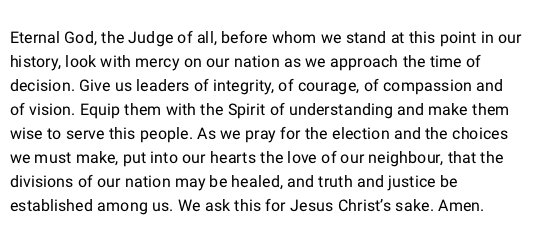
I've posted this prayer today. As a person of faith, I believe that everything we human beings do, we do before God. So it's important that we pray for the forthcoming general election. Let me try to explain what I mean - and what I don't mean when I say this.

I know that the Church of England has also issued a prayer today. It's fine as far as it goes. It asks that we the electorate may have wisdom at election time, be protected from despair, cynicism and false utopianism, and help make politics "a noble calling that serves the common good of all". I especially like that last bit. And I like the appeal to integrity as we cast our vote. G. K. Chesterton once said that the problem with elections was not that only half the electorate voted, but that only half the elector voted: half-heartedly, without real conviction, not really believing that elections make a difference.

But we make our prayers too narrow by false limits of our own (apologies to Father Faber for misquoting his famous hymn). We should be more ambitious as we lay the issues of this election before God. It's the outcome that matters, not simply the process that leads up to it. And while we mustn't turn prayer into a kind of spiritual manipulation motivated by party politics, I think we can agree that we should crave leaders who are principled, embody healthy values and who will have the courage to make decisions that will put them into practice. Hence my use of words like integrity, courage, compassion, vision, truth, justice, the love of neighbour and the healing of division in our nation - surely a top priority for everyone in public life right now. The Seven Gifts of the Spirit that are set out in the messianic portrait painted in Isaiah 11 might be a good place to begin exploring what we look for in our leaders: this was the text in my mind when I alluded in the prayer to "the Spirit of understanding".

No doubt we won't all agree about what these values and virtues mean in practice. But I believe that to pray with integrity about the kind of nation we want to be also commits us to debating with integrity during the election campaign. The lack of it was what many of us lamented during the EU referendum campaign. To descend to empty slogans (or, to quote Chesterton again, the "easy speeches that comfort cruel men") is to devalue what we mean by democracy. An election debate means listening carefully, evaluating evidence, discerning good arguments from bad, and not personalising matters of principle. (So please let's stop referring to Theresa May as "the vicar's daughter" - she deserves to be heard in her own right as a responsible adult woman, not someone who is still being defined by her father, however good a priest he no doubt was.)

Above all we need to be committed seekers after truth. A good election is one where we don't cling to old political tribalisms, some of which have clearly had their day. On the contrary, we need to take the trouble to think for ourselves as grown-ups who are privileged, in a way not open to everyone in our world, to be able to take part in a democratic election. To listen, to think and to debate in this respectful way is, I want to say, an act of discernment. It asks the question, where might the voice of wisdom and truth be detected amid the babble of human voices that clamour for our attention? Where might we even hear the voice of God? Discernment and prayer are close relatives.

I'm not saying it's easy. Discernment never is. The word diakrisis literally means "making a judgment", coming to a mind. The weighing of arguments, the ability to place them in a larger context, the capacity to inquire what theological or ethical issues might be at stake all demands wisdom, effort and good deal of perseverance. But if we care about our nation and the human family of which we are part - if indeed, we are not only good citizens of the UK but also, in the best sense, citizens of the world (sorry, Mrs May!), then discernment is precisely what we are called to practice in the next few weeks. Amid the clamour of earthquake, wind and fire, we need to listen out for the still small voice. Not just for our own sake, the nation's sake or the world's sake, but for God's sake too.

This is where prayer comes in. If we are people who pray, our concerns will already be engaged towards those who represent us in Parliament and the other institutions of which we are part. But now, as we get ready to make political choices that will have far-reaching consequences, it's especially a time to focus on our common life, and pray for wise and principled leaders who will cherish just, compassionate and humane values. We need to pray for the destiny of our nation as it searches for its place in a changing world order.

Prayer isn't (or shouldn't be) a way of getting God to orchestrate events our way. Nor is it a binary spiritual exercise ("answered" or "not answered"). It's more subtle than that. I believe it is a genuine and heartfelt desire to bring the affairs of the nation into the orbit of God's love and care, to acknowledge that all life is dependent on him, and that we are ultimately accountable to him as our Judge. It is a joyful affirmation that out of his love for the world, God is passionately concerned for the welfare of all peoples. Self-interest doesn't come into it - or, shall we say, ought to become as enlightened as possible by our love of God and our neighbour. Perhaps the best prayers are those that spring not from desperation but from gratitude and that are built on the central petition of the Lord's Prayer, "your kingdom come".

Even if you are not a religious person who habitually prays, maybe you could still think about the forthcoming election in this kind of way? Can we agree to practise "mindfulness" together over the next few weeks and try to raise the tone of the debate? Maybe we can make common cause with everyone of good will who wants to play a part in shaping a healthy ecology of mind and heart during the campaign? Perhaps we can encourage one another to entertain the idea of a more generous political discourse that rises above tired, simplistic formulae and genuinely tries to listen and understand?

There are two direct benefits of thinking about and praying for the election in the way I've suggested. The first is to revitalise our imagination about what is possible, what our society could become. The other is to help us learn the lesson of humility. Our politics could really do with generous helpings of both.

Sunday, 10 January 2016

Gay Anglicans and the Primates' Meeting: the open letter

I've signed an open letter that is published today. You have probably heard about it in today's news. More than 100 people, described in the press-release as 'senior Anglicans', have written to the Archbishops of Canterbury and York ahead of the Primates' Meeting this week. Here it is in full. 

Your Graces,

We the undersigned ask you, our Archbishops, to take an unequivocal message to your meeting of fellow Primates next week that the time has now come for:

- Acknowledgement that we, the Church, have failed in our duty of care to LGBTI members of the Body of Christ around the world.  We have not loved them as we should, and have treated them as a problem to be solved rather than as brothers and sisters in Christ to be embraced and celebrated.  We have made them feel second-class citizens in the Kingdom of God, often abandoned and alone.
 
- Repentance for accepting and promoting discrimination on the grounds of sexuality, and for the pain and rejection that this has caused. We, the Church, need to apologise for our part in perpetuating rather than challenging ill-informed beliefs about LGBTI people, such as the slanderous view that homosexuals have a predisposition to prey on the young.

We understand that the Primates come from a variety of contexts with differing ways of interpreting the Scriptures, but we urge you to be prophetic in your action and Christ-like in your love towards our LGBTI sisters and brothers who have been ignored and even vilified for too long.  

Please be assured of our prayers for you at this time, and that the world will know by our words and actions that everyone who is baptised into the faith is of equal value in our Lord Jesus Christ.

Yours sincerely

This isn't the first time I've blogged on same-sex relationships. But at the risk of repeating myself, I wanted to say something about why I've signed. It's for three reasons, all of which will, or ought to, be self-evident to Christian people, whatever their theological stance and whatever their sexual orientation.

First, I've signed because the church must be a place of truth. It follows the One who proclaimed himself as the Truth that would set us free. The truth of human sexuality is often hard to speak about because it is so complex. The discovery of my sexual identity is a lifelong task, and a God-given vocation. In cultures where same-sex relationships are not approved of, and gay people experience pressure or even persecution, truth-telling is driven underground. (Even in the west, gay teenagers often find it extraordinarily difficult open about their sexuality in the face of peer-pressure that is suspicious or hostile.) Sex is intended to be one of life's joyful mysteries, but the church has often debased it through suspicion or fear into a sorrowful one. It's vital that the church models a society that is open and unafraid in its take on human sexuality, acknowledging the consensus of serious research into same-sex attraction, challenging what the letter calls 'ill-informed beliefs about LGBTI people', and celebrating the truth of each cherished man or woman's sexual giftedness. This is a profoundly theological task that our church leaders must not evade.

Secondly, I've signed because the church must be a place of justice and equality. The treatment of homosexual people in many countries around the world is an offence to our sense of what is fair and right. At the very least, the honouring of human dignity and the recognition of difference should be a matter of ordinary courtesy. But Christians should aspire to an altogether bigger vision of how we should treat one another as made in the image of God. It is to me a matter of outrage that Christian churches anywhere in the world should collude with attitudes that are at best discriminatory and often very much worse where gay people are concerned. No primate would tolerate them if they stemmed from racism. A generation ago, many of us were hard at work endeavouring to make sure that women could take their place alongside men in the ministry of the Church of England. That too was a matter of justice because good theology always has a finely-tuned conscience. And while I am keenly aware that the idea of an 'inclusive church' can offend Christians in other more conservative parts of the world, and could also alienate people of other faith traditions, especially Muslims, it cannot be right not to act justly merely because of our fears. Our letter calls on the Primates to act according to what are surely their best instincts for a world that is more equitable and fair.

Thirdly, I've signed because the church must be a place of compassion and love. The Quakers (who have often been a long way ahead of the C of E in matters of justice, including their acceptance of homosexual people) are known as the Society of Friends. This is how St John sees the church gathered in the upper room, where disciples are set fee to love one another in a way that echoes God's eternal love for them. Human pain and suffering have a particular claim on our compassion. And we shouldn't make any mistake about the suffering and pain many gay people around the world experience. I include in this gay clergy and other ministers in the Church of England who, in an ecclesiastical culture perceived to be hostile, live in real fear of being found out. The Primates have a special responsibility to make sure that our churches are communities of hospitality and friendship that do not collude with hypocrisy. They, we all, have that calling because this is how God himself is always reaching out towards each of us. It's a great deal harder to act hospitably than to uphold simple binaries that banish the non-approved from acceptance. This truly is 'tough love'.

I hope that this letter will not come across as trouble-stirring or polemical. It's meant to be firm but eirenic in tone. It would be great if it helped give the Primates confidence as they debate human sexuality, if it helped them to know that every step they take, however tentative, towards changing entrenched attitudes and welcoming gay Christians into their communities will be warmly and gratefully supported. The first step, maybe, is to recognise that just as with female ordination, there will be differences of view among the Primates and this needs to be respected. (I'm not sure that it altogether is, yet.) As Justin Welby has said, in grown-up communities there must always be room for 'deep disagreement'. 

But our letter is looking for much more than this. We're looking for a deep change of hearts and minds. We use the word 'repentance'. That's undeniably a strong word, but nothing is less is called for in the face of any great wrong we have committed. I am pretty confident that in decades to come, we as churches shall be saying we are deeply sorry for the way we have mistreated and oppressed gay people in the past. So why not say it now? That would make the Anglican Communion a place of hope and sanctuary for LGBTI people across the world. 

Anglicanism has always been good at bridge-building: perhaps that's one of its gifts to the world church. That's why we have every reason to think it can rise to a challenge it has known about for decades. But I also want to sound a warning note. Our unity as Anglicans is profoundly important. But I don't believe it's more important than the fundamental Christian values which have given me the headings for this blog: truth, justice and love. If we know what is true, what is just and what is loving, we must not fail to obey their imperatives however painful the consequences may be and however little we may be honoured, still less thanked for it. 

So it will take great courage on the part of the Primates to do what our letter asks for. That's why we end our letter with the promise of our prayers for this week's meeting, and for Justin Welby as he presides over it. Let William Blake set the tone of our prayers and their debates with his famous words that get close to the heart of what we Christians believe about God and humanity:

For Mercy, Pity, Peace and Love
Is God our Father dear,
And Mercy, Pity, Peace and Love
Is Man, his child and care....

Where Mercy, Love and Pity dwell
There God is dwelling too.

You can read the press-release at http://www.lettertoarchbishops.wordpress.com/.