About Me

My photo
Pilgrim, priest and ponderer. European living in North East England. Retired parish priest, theological educator, cathedral precentor and dean.
Showing posts with label election. Show all posts

Friday, 13 December 2019

The Election - thoughts at Grey’s Monument

This is a bit longer than usual. You’ll understand.

For the first time for decades, I didn't stay up all night to watch the election results. By the small hours of the night the outcome was as clear as the day. Perhaps I should have been on my knees during the watches (I blogged about praying for the election last time). Instead, I went to bed. And slept quite well in the circumstances. I woke early and for an instant thought I heard someone say "behold, it was a dream". But it wasn't. It was the morning of 24 June 2016 all over again.

What do I say about this election result, I asked myself as dawn broke. Today is St Lucy’s Day, 13 December. It used to be the shortest, darkest day of the year in the unreformed Julian Calendar of John Donne’s times, inspiring his famous Nocturnal about “the year’s midnight”. How apt! Was Boris Johnson teasing us when he chose this particular date? He is, after all, a lover of classical antiquity.

But Lucy was the Roman girl-martyr who brought light into dark places, hence her lovely name. The play on darkness obscuring light and light penetrating darkness fascinated Donne. Light and dark come into things in elections, I thought to myself. Altruism dragged down by naked self-interest, narrow tribal loyalties pierced in our best moments by an awakened conscience and a deeper feeling for humanity - there’s a real dark-and-light chiaroscuro in our thoughts, emotions, speeches and behaviour at election times. It’s what we should expect at liminal times like these, but the strength of my own feelings never fails to take me by surprise.

Here’s what I posted on social media from my bed. 

So the UK is going into exile. I must accept Brexit & live with it. It will be bitter for me personally & I think, taking a long view, for the nation collectively. The biggest mistake made by Labour & the LibDems? Agreeing to a General Election at all. That decision was a disastrous misreading of the signs of the times. And of the capacity of both party leaders to win trust on the nation’s doorsteps. Good people of all faiths & political views must now come together for the sake of the planet, for the sake of peace & for the sake of the poor. We must keep hope alive.

I chose those words carefully. And felt better for writing them. Yes, it will be bitter, I thought, not just because of Brexit, but for all the other reasons so many of us feared a landslide like today’s, especially on account of the poorest and most vulnerable people in our nation. Yet there’s a difference between feeling what we feel and acting out those feelings. I’ve consistently campaigned in this blog on the foundation that the clear command is to love our neighbour, and indeed, our enemy. Perhaps today poses precisely that challenge, not to harbour resentments and hatreds towards those for whom this has been a day to rejoice while some of us feel like strangers in a landscape we barely recognise as our political and cultural home.

It would have been easy to gaze at the TV news all day. But we decided instead to get out of the house and go into Newcastle to look for Christmas gifts for the family. We walked up from the station along Grainger Street. There, ahead of us, presiding over the city’s Christmas market, was the statue of the 2nd Earl Grey on top of his Monument. I felt a surge of admiration for this man, one of Northumberland’s greatest, who was Prime Minister from 1830-1834. In times as fractious and turbulent as our own (read George Eliot’s Middlemarch, set in the early 1830s - I blogged about her recently), Lord Grey championed and saw enacted the Great Reform Act of 1832 that abolished rotten boroughs and launched the long, fitful journey towards universal suffrage. 

What would this lover of civil and political liberty have made of today, I wondered? I’ll leave experts to comment on an unreformed electoral system that (among other oddities) gives us an outcome in which a Tory landslide of 365 seats can result from the votes of a few hundreds of thousands of voters in swing constituencies while in total, more people across the UK have voted against the Tories than for them. I think the good Earl would say that electoral reform is still a work in progress. There’s no hope of progressing it in the next 5 years, but I believe election results will lack firm credibility and ownership for as long as Parliament fails to address this fundamental problem. 

But wandering among the Christmas shoppers, I didn’t want to dwell on these challenges. Nor did I want to engage in a long post-mortem or play the blame game about the failure of Remainers to get our act together. Later, certainly, we need to think very hard about what went wrong. But not now. What was needed today was to reflect, ponder, and pray about how to manage disappointment and bitterness, and live with a result many of us had feared, yet dared to hope might be averted. Maybe I should have practised disappointment more, like Diogenes famously exploring futility by praying to a lump of rock. All of life, we have to learn to “live with”. It’s a mark of being adult that we make some progress along the path of graceful acceptance when things don’t go our way.

The Grey Monument bears witness to a man who, despite endless frustrations and discouragements, channelled his energies into what would help the nation flourish. In our time, this has to mean rebuilding the sense of being one nation again. As I said to begin with, we owe it to the planet, to world peace, and to the poor who are always with us, to come together with all people of good will to renew ourselves to pursue what is just and right and good. And to keep our hope alive.

********
Maybe one way in which we do this is by learning to act more out of trust. Or (to paraphrase something Bishop Michael Ramsey once said about prayer), if it’s too soon to start trusting people again after these political storms of the last three years, at least to want to. And if even that’s too much to contemplate, to want to want to. 

Yes, there’s so much that’s wrong with our politics, both the decisions we are making and the way we are making them. We are right to challenge falsehood, mendacity and the casual disregard for careful process when we see them. We are right to be angry for the sake what’s good and true. But we must examine our motives, and make sure we’re not feeding self-righteousness. Nurturing blame and bitterness gets us nowhere. What’s needed is to help a grown-up public conversation to begin again on the basis of our common humanity. We need to make a presumption that our conversation partner wants the best for others, not the worst, that they care for their fellow human beings, for the needs of others, and for the future of the world just as we do. 

Anglicans call this the “charitable assumption”. It undergirds good pastoral practice. Yes, it strains credibility sometimes, when we wonder if others are as honourable as we’d like to think they are, yet I do believe it’s a vital principle of courteous, graceful, good-neighbourly behaviour. It entails, for example, attentive listening in the spirit of “maybe I can learn to see it your way; and is it possible that you could come to see it mine?” That’s not to equivocate about our hard-won principles, only to understand them in the context of the bigger picture which is always more complex than the simple binaries we love so much. As Bishop John Habgood once said, it’s all very well “being prophetic”, as long as you see all sides of a question. Or try to.

I was touched and moved by something my daughter wrote today to our family WhatsApp group. She’s allowed me to share it here. We had been in touch with our children to ask how they were feeling about the election. She replied:

I feel ok - perhaps that it is my role to promote a sense of steady-ness for those around me who are very upset. But you know, I am a super-rational pragmatist. 

I also feel that I too learned a lot from watching the Tory victories through the 80s and early 90s, something about coping with the disappointment, even tho I didn’t understand it. 

I feel relieved that the waiting and dreading and liminal is over. That in itself releases new energies eventually. And on that we do need to be out of this Brexit impasse so that attention can be spend on domestic agenda. So I understand that vote.

And I feel that it is better to know what you don’t understand about your country than not know. Not that we, in our liberal bubbles  know now, but we need to learn. 

And we need to be kind to ourselves and to everyone we meet, especially those whose opinions we don’t understand and especially those who are marginalised. And we need to listen to those people whose opinions we don’t understand and expand our bubbles. 

That’s what I think. But yes. Obviously awful, but we don’t know what this will mean. And we do know that there are a lot of young activists coming up, that the generation emerging is not like the generations before it so things will shift. we need to learn and to listen, to mentor and to work in whatever way we can to generate communities in which people can listen to and learn from those with whom they might fundamentally disagree. And we need to borrow coping strategies from those places for whom this kind of political marginalisation is the norm - who can ONLY rely on the state to frustrate and disempower them, which is still probably most places in the world . 

Perhaps it is denial, but I am still just grateful to have a vote and a state that provides any protection or health care at all. 

So we also need to be grateful. Not least because we are not the people who will be most marginalised by this decision. And maybe that sounds a bit selfish, but we need to try to appreciate what we have, and have a good Christmas together and emotionally nurture and sustain each other.

I will never lose faith in the power of love, of community, of relationship and of the collective. Aluta continua! Weep today. And the work of rebuilding starts again tomorrow.

So well said. Meanwhile, the leaders of the Methodist Church have also found just the right words for today. They have published an Open Letter to the Prime Minister following his return to office. This is church leadership at its best. They speak for me.

More to come (if you can bear it) as we go on trying to understand where we now find ourselves after the election. 

Saturday, 23 November 2019

Why I'll be Voting LibDem

We need to keep a clear head about this election, and remember why it's been called. There's one reason only: the last Parliament's impasse over Brexit. Like Theresa May before him, Boris Johnson just could not "get Brexit done". The election was his response to that predicament.

Since it was called, the conversation has spiralled out from Brexit. In an election campaign, political parties all set out their stalls. Voters are fair game. Spend, spend, spend is the order of the day. Understandable at this time of year: Black Friday beckons. Whose wares sparkle the brightest, are wrapped the prettiest, seduce us into thinking that they offer what we most want or need?

I want to remind us that Brexit is the reason for this election, and it's Brexit that should be the focus of the debate. That's not to say that the climate emergency, international trade, the economy, health, education, security, transport infrastructure, devolution and much else aren't crucially important to the flourishing of our country. But when we examine those themes and how we want to address them in the immediate future (the next five years), they all converge on the decision this nation must make in the next few weeks or months about its relationship with the European Union. It's not that the short-term urgent must displace the long-term important. But what we do about Brexit will profoundly influence the direction our country takes in the coming decades, and how we engage with all the other crucial priorities we face.

Here in England, only the Greens and the Liberal Democrats are unambiguously campaigning on a pro-EU ticket. The Conservatives want to "get Brexit done". Labour promises a People's Vote on a renegotiated Brexit deal, but Jeremy Corbyn won't himself campaign for Remain or Brexit. We know where the Brexit Party stands. I find much that is highly attractive in the Greens' programme and won't deny that it's tempting to support them. But I've concluded that the Libdems stand the best chance of providing a realistic challenge to the two main parties and adding substantially to the elected members holding the balance of power should we elect another hung Parliament (which may be the best outcome we can hope for in these unpredictable times).

For the avoidance of doubt, I should confess at this point that I'm a paid-up member of the Liberal Democrat Party, and have been since I retired. If you want to, dismiss everything else I write on the grounds that I would say that, wouldn't I? But let me press on and hope you may come with me.

Jo Swinson has had a mixed press since she announced that the heart of the Libdem Manifesto would be a commitment to revoke Brexit. The Sheffield audience at the Leaders' Question Time broadcast was surprisingly hostile - where were Nick Clegg's former supporters from the Sheffield Hallam constituency where we once lived? She is not quite fully formed as a leader. She needs to inhabit the role, discover how to nuance conviction with a realistic assessment of what's achievable and where compromise will be needed. She would do well to cultivate subtlety. And maybe not knock the Labour Party quite so brutally. Politics is the art of the possible. This takes time - a luxury you don't have when you're plunged into the maelstrom of an election campaign. But Jo is bright, energetic, fluent, and completely committed. Despite the reviews, I think she and Nicola Sturgeon can be pleased to have given as good as they got in that unforgiving bear pit of the #BBCQT arena.

********

So what about the Liberal Democrat manifesto commitment to "stop Brexit"?

It's been much criticised as going back on the outcome of the 2016 referendum. "How dare you ride roughshod over a democratic decision we made!" "Why can't you get over the fact that you lost!" "How can you be so arrogant as to pretend to know better than the nation as a whole!" We've heard a lot of talk like that. And yes, the Libdem stance could look more than a little cavalier if presented too clumsily. A lot of this is the cut and thrust of electioneering. But underneath it is, I think, a misunderstanding about the intellectual basis of this "stop Brexit" pledge. So it's worth examining this if we are to give Jo Swinson a fair hearing.

There are two objections to it. The first is that as a matter of politics, it's theoretically flawed; the second that as a matter of tactics, it's ill-judged and unlikely to win support. In terms of the audience, I'm not thinking of conviction Brexiters but of people who voted Remain in 2016 and who would be expected to be sympathetic to the Libdems. Clearly, plenty of them believe that the referendum result should be honoured, even if they don't like it. And some have argued that the Libdem platform should have been: vote for us and we'll push for a People's Vote and campaign to Remain in the EU. To them, the absolutism of the "stop Brexit" rhetoric is not calculated to gain friends and allies, and to win over waverers.

First, the theoretical objection. The logic of "stop Brexit" is in fact clearly set out in the manifesto. The election of a Liberal Democrat majority government on a clear stop Brexit platform will provide a democratic mandate to stop this mess, revoke Article 50 and stay in the EU. In other words, if (yes, I know - a big "if") the Libdems were elected, that would be the evidence ipso facto that stopping Brexit was what the nation wanted, for it would have elected the party that had promised to deliver precisely that outcome. That argument is unassailable. Just as it would be if we voted in a Labour government whose manifesto commitment was to nationalise the railways. The executive would go on to do just that because the election had provided the necessary mandate. I applaud a party that's prepared to be unambiguous about its core message. I'm glad to be able to vote for it on the basis of my ex animo belief that any Brexit will disadvantage our nation compared to the benefits we currently enjoy as EU members, and a no-deal Brexit would be nothing short of a catastrophe.

As to the tactical objection, the manifesto addresses that too. In other circumstances, we will continue to fight for a people's vote with the option to stay in the EU, and in that vote we would passionately campaign to keep the UK in the EU. These "other circumstances" are those in which the Libdems don't gain an overall majority. Yes, we know that's going to be the outcome, even if we can expect to see Remainers swing behind the Libdems just as they did in the recent European Parliament and local elections. But political parties always campaign on the basis of the vision that drives their ideals and values. This is what we want to hear and get a feel for: what do you really stand for? It's true, as someone said (was it Abraham Lincoln?) that parties campaign in poetry but have to govern in prose - but poetry is important in the task of winning hearts and minds. I won't say that there aren't risks in the Libdem strategy of going for broke over Brexit. But the sheer chutzpah of championing a single clear message may prove to reap an unexpected harvest.

********

I live in a constituency that voted to Remain in the EU. The Libdem constituency party thinks there's a good chance of doing well here. But while I understand the reasons for voting tactically, I find I can’t swallow my principles and vote for a party I don’t believe in.  Our former MP is a Tory who voted Remain, but now believes we must "deliver on the result of the referendum" and has studiously supported the Government in its attempts to do that under both Theresa May and Boris Johnson. It’s high time to challenge that thinking. I too want to "get Brexit done" - consign it to history through the democratic process of a general election, restore the status quo, focus once more on the challenges that face our nation, and, secure in our partnership with the other nations of the EU, respond to the immense global crises that confront the human race and so help create a better future for our world.

I've regularly rehearsed the arguments for EU membership in this blog since before the referendum. Just scroll down and have a look. In this, as in everything else, we are "better together". This election is all about Brexit. Let's talk about it!

Saturday, 10 June 2017

If I were Theresa May... Seven Things to Think About

Never will a prime minister have been on the receiving end of so much advice. It's enough to make you feel sorry for her. Nevertheless, here's one more offering for the smorgasbord as she tries to pick up the pieces after the election.

Who am I to say anything? I'm a lay person when it comes to politics. I realise that comment is easy and comment is free; it's much harder to do the job. Despite her mistakes, despite the fact that she brought this election fiasco on herself, I feel for Mrs May. She cuts an isolated and lonely figure, tragic in the proper meaning of that word because her nemesis is the consequence of her own flawed vision.

So I write in a spirit of constructiveness as one (retired) leader to another. My experience tells me that we ought to be worried at the moment. These volatile days call for highly skilled leadership. How leaders behave under pressure reveals their strengths and weaknesses. Especially the latter. And I don't know that Mrs May has got it right in the last couple of days, indeed, the last couple of months.

But more important than any leadership experience I have, I write as a citizen of this country. I have cast my vote and that gives me an interest in what happens next. (If you chose not to vote, that suggests you don't care too much about your own future or the nation's. Dare I suggest that in that case you forfeit your right to comment on the outcome of this election?) The surprise result has consequences for us all. There needs to be an honest conversation among the electorate to try to understand what has happened. To talk to one another is part of being good citizens. It's what democracy means, not just voting but participating. Gaining insight will take time, and this is only the day after. Nevertheless, here goes.

First, Mrs May needs to say sorry. I don't mean to her own party, her MPs who lost their seats, those who supported them in their constituencies, her own cabinet colleagues and staff. She has done this (not as swiftly as they would have liked). But what she has not done or even hinted at doing is to apologise to the nation. She has put us through a bruising election that we did not need nor ask for. It has cost a lot of money, and more importantly, a vast amount of precious time that should have gone into dealing with the crises we face such as the terror attacks and Brexit.

It's hard not to feel used (or abused?) by a gamble which, even if it had paid off, would always have been a kind of large-scale displacement activity. We can conjecture about her reasons, though she was clear what they were when she announced it. Whatever she intended. it took our eyes off the balls that were, still are, flying through the air above our heads. But it hasn't paid off. The opposite in fact. That needs to faced up to and apologised for. By her. In person.

If only she had begun by apologising when she spoke to the nation yesterday outside No 10. It would have shown something of the humility we like to see in our leaders. Contrition in public life is a sign of wisdom. It shows we know the limits of our powers and recognise our capacity to get things wrong. Is it too late now? My experience tells me that it's never too late, though apologising always comes with more conviction when it's done as soon as possible. In her shoes, I'd try apologising rather than defending myself when I did the next round of media interviews. I'd say to myself that in this catastrophe, there wasn't much to be lost.

And it would be the right thing to do. "I beseech you, think it possible in the bowels of Christ that you may be mistaken." I've always cherished that advice from Oliver Comwell to parliamentarians. I don't trust leaders who are without any shred of self-doubt. So I was nervous yesterday when the PM spoke no fewer than three times about "certainty". It didn't sound well on a day when we looked for a little more humility and tentativeness in the light of events.

Secondly, the PM needs to be more candid with the nation. It is striking that since the election result, she has stuck rigidly to a message about having "more seats and more votes" than any other party. This is true but it's not the point. She told us when she launched the election that she looked for a bigger majority to strengthen her mandate in negotiating Britain's exit from the European Union. She has signally failed to achieve this. And that has damaged, not enhanced, our position in those negotiations that will shape our country's history for decades.

Nicola Sturgeon got it right when she said how disappointed she was at the loss of SNP seats, even if it was still the largest party in Scotland. She promised she would consider and reflect in the light of the election. Mrs May needs to do that too, and demonstrate more transparency. She must make it clear that she is not just reading from a script but is thinking hard about recent events. This includes the part she herself has played in calling this election and how she has performed during the campaign. There are tough lessons to be learned for her personally. Some are saying that her credibility has been shot to pieces by the gamble she has taken. Maybe. But I do know that she won't be credible if she doesn't show signs of having pondered deeply. Being a "reflective practitioner" is an inescapable aspect of good leadership. We need to know that she understands this.

Thirdly, Mrs May needs to find a different style of working. The rhetoric from the Downing Street lectern last night made it sound like it's business as usual. It's absolutely not! British politics has changed during this election. It's become clear that voters want to be treated like grown-ups. They want to take part in conversation, not be lectured to de haut en bas from a script that "may" not be departed from. The "Maybot" epithet is unkind (even if it's very funny). But like all good caricature, it contains more than a grain of truth. Mrs May's refusal to take part in broadcast debates with other leaders was a clue to this aspect of her character. It hasn't played well. Maybe she has been too quick to listen to the advisors who seem to have had enormous influence over her. Perhaps she needs to discover a new "self" in her leadership role, humanise her persona where she can.

If I were leading a minority government in the aftermath of this unforced error, I would want to reach out to the leaders I had failed to engage with during the campaign. I don't mean her natural allies like the DUP. I mean everyone who shared my belief in doing our best for our nation. I would want to sit down with opposition leaders and ask, How can we work together when our nation faces so many big, even life-threatening, challenges? Without sacrificing principle, are there ways in which we can give and take for the sake of the common good? I think the non-hawkish majority of the electorate likes it when people of different opinions start working together. It's how we find that very often, what unites us is far greater than what divides. I'm not naive about this. It's difficult and takes effort and much patience. Yet this is just such a time at least to try out a collaborative approach to the nation's challenges. Her emotional intelligence ought to be telling her that.

Fourthly, the Prime Minister needs to pay attention to the messages of the election result. There's a lot of "noise" around in these febrile times when we are trying to make sense of an unexpected and perhaps confusing vote. But here's what clear. Our nation is divided, perhaps more than ever it was before the EU referendum. The polarisation of opinion between left and right, young and old, cities and countryside, among the UK's nations and regions, has been much commented on. Another aspect of good leadership is that it is responsive to change. There is a multitude of issues debated during the campaign where the election result calls for a rethink in policy and presentation. I don't simply mean Brexit. I'm thinking of the future of the NHS, education, local authority funding, austerity, welfare and national security. Being responsive as a leader means taking the evidence seriously. If I were the PM I'd want to listen again to some of the best media campaign debates, re-read some of media commentary, try to map the landscape I was travelling in and try to discern the best way to traverse it.

Fifthly, Mrs May needs to look again at Brexit. Why specifically? Because this was her stated reason for calling the election in the first place. It's very odd how Brexit did not feature very much in a campaign whose focus this was meant to be. We were told she was looking for a result that would strengthen her position in Brussels when the negotiations began. Fair enough. Yet we did not learn anything we didn't already know about her negotiating stance. And now that we are on the brink of them, all the evidence suggests that despite everything, she is going into them with her well-known hard Brexit position unchanged.

I don't think this will do. The message from the election seems to be: we as a nation are not disputing the referendum result. But we do not want a hard Brexit. If we did, we would have voted massively to strengthen the PM's position as she asked us to. In particular, everyone who defected from UKIP would have tumbled into Mrs May's arms and not voted Labour in the numbers they did. So we badly need a far more open, nuanced, approach to Brexit. She needs to go into the negotiations willing to have an adult conversation with the EU, not just set out her stall and lay down the gauntlet. She needs to treat the EU27 nations as our best allies and close friends, not as adversaries. And first on her to-do list must be to offer unconditional permanent residence to citizens from other EU countries who are already living in the UK and who are desperately worried about their future.

Sixthly, she must not resign any time soon. This bit Mrs May seems to have got right. What we need now is indeed a version of the stability she has talked so often about. It won't be "strong and stable" but even in her fragility, there can be a measure of continuity. Another Tory leadership election would not help. Even less another general election, at least for a while. Yes, I doubt that Theresa May has a long-term future as a prime minister, maybe not more than a few months. But more elections, with all the uncertainty they produce, can only distract further from the Brexit negotiations and all the other crises our nation is facing. (In any case, I doubt that my ageing constitution can face many more long and anxious nights in front of the TV.)

To me, David Cameron piled error upon error by resigning on the day after the referendum when he had promised to carry on, whatever the result. I think that was an terrible mistake, an unforgivable failure of leadership. Yes, it's tempting to throw in the towel when things don't go according to plan. Which of us hasn't thought in that way when times are tough and so many seem to be against you? But the day after is not the time to make far-reaching decisions. All credit to the PM for putting nation above personal interest, at least in this respect.

Lastly, Mrs May should re-read what she said on the day she took office. When I was a dean, I looked from time to time at the sermon I preached at my inauguration service. Did I really say that, I would ask myself? It was important to be reminded of those first fine (I don't say careless) raptures. I suggest Mrs May does the same. She started out well. She spoke about helping those most in need of what a good administration can do. She wanted to support the "just about managing". Many of us felt included to an extent we hadn't foreseen. It was probably her best moment. We had high hopes.

How long ago it now seems! Mrs May has made so many mistakes in her incumbency that it's hard to imagine that her standing can ever recover. It probably can't: history will make up its mind about that. But maybe she can repair her reputation a little by going back to the values she laid out in her personal manifesto. If she cares about how we remember her, it may be as simple as refreshing her memory to help her re-set her approach to public office.

There's a lot more to say about the 2017 election and how it will reshape our politics. But that's for another time. Meanwhile, we say our prayers and keep the conversation going.

Thursday, 20 April 2017

Praying for the Election


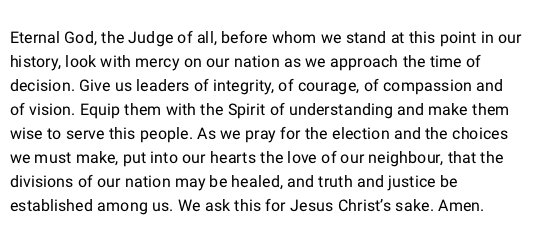
I've posted this prayer today. As a person of faith, I believe that everything we human beings do, we do before God. So it's important that we pray for the forthcoming general election. Let me try to explain what I mean - and what I don't mean when I say this.

I know that the Church of England has also issued a prayer today. It's fine as far as it goes. It asks that we the electorate may have wisdom at election time, be protected from despair, cynicism and false utopianism, and help make politics "a noble calling that serves the common good of all". I especially like that last bit. And I like the appeal to integrity as we cast our vote. G. K. Chesterton once said that the problem with elections was not that only half the electorate voted, but that only half the elector voted: half-heartedly, without real conviction, not really believing that elections make a difference.

But we make our prayers too narrow by false limits of our own (apologies to Father Faber for misquoting his famous hymn). We should be more ambitious as we lay the issues of this election before God. It's the outcome that matters, not simply the process that leads up to it. And while we mustn't turn prayer into a kind of spiritual manipulation motivated by party politics, I think we can agree that we should crave leaders who are principled, embody healthy values and who will have the courage to make decisions that will put them into practice. Hence my use of words like integrity, courage, compassion, vision, truth, justice, the love of neighbour and the healing of division in our nation - surely a top priority for everyone in public life right now. The Seven Gifts of the Spirit that are set out in the messianic portrait painted in Isaiah 11 might be a good place to begin exploring what we look for in our leaders: this was the text in my mind when I alluded in the prayer to "the Spirit of understanding".

No doubt we won't all agree about what these values and virtues mean in practice. But I believe that to pray with integrity about the kind of nation we want to be also commits us to debating with integrity during the election campaign. The lack of it was what many of us lamented during the EU referendum campaign. To descend to empty slogans (or, to quote Chesterton again, the "easy speeches that comfort cruel men") is to devalue what we mean by democracy. An election debate means listening carefully, evaluating evidence, discerning good arguments from bad, and not personalising matters of principle. (So please let's stop referring to Theresa May as "the vicar's daughter" - she deserves to be heard in her own right as a responsible adult woman, not someone who is still being defined by her father, however good a priest he no doubt was.)

Above all we need to be committed seekers after truth. A good election is one where we don't cling to old political tribalisms, some of which have clearly had their day. On the contrary, we need to take the trouble to think for ourselves as grown-ups who are privileged, in a way not open to everyone in our world, to be able to take part in a democratic election. To listen, to think and to debate in this respectful way is, I want to say, an act of discernment. It asks the question, where might the voice of wisdom and truth be detected amid the babble of human voices that clamour for our attention? Where might we even hear the voice of God? Discernment and prayer are close relatives.

I'm not saying it's easy. Discernment never is. The word diakrisis literally means "making a judgment", coming to a mind. The weighing of arguments, the ability to place them in a larger context, the capacity to inquire what theological or ethical issues might be at stake all demands wisdom, effort and good deal of perseverance. But if we care about our nation and the human family of which we are part - if indeed, we are not only good citizens of the UK but also, in the best sense, citizens of the world (sorry, Mrs May!), then discernment is precisely what we are called to practice in the next few weeks. Amid the clamour of earthquake, wind and fire, we need to listen out for the still small voice. Not just for our own sake, the nation's sake or the world's sake, but for God's sake too.

This is where prayer comes in. If we are people who pray, our concerns will already be engaged towards those who represent us in Parliament and the other institutions of which we are part. But now, as we get ready to make political choices that will have far-reaching consequences, it's especially a time to focus on our common life, and pray for wise and principled leaders who will cherish just, compassionate and humane values. We need to pray for the destiny of our nation as it searches for its place in a changing world order.

Prayer isn't (or shouldn't be) a way of getting God to orchestrate events our way. Nor is it a binary spiritual exercise ("answered" or "not answered"). It's more subtle than that. I believe it is a genuine and heartfelt desire to bring the affairs of the nation into the orbit of God's love and care, to acknowledge that all life is dependent on him, and that we are ultimately accountable to him as our Judge. It is a joyful affirmation that out of his love for the world, God is passionately concerned for the welfare of all peoples. Self-interest doesn't come into it - or, shall we say, ought to become as enlightened as possible by our love of God and our neighbour. Perhaps the best prayers are those that spring not from desperation but from gratitude and that are built on the central petition of the Lord's Prayer, "your kingdom come".

Even if you are not a religious person who habitually prays, maybe you could still think about the forthcoming election in this kind of way? Can we agree to practise "mindfulness" together over the next few weeks and try to raise the tone of the debate? Maybe we can make common cause with everyone of good will who wants to play a part in shaping a healthy ecology of mind and heart during the campaign? Perhaps we can encourage one another to entertain the idea of a more generous political discourse that rises above tired, simplistic formulae and genuinely tries to listen and understand?

There are two direct benefits of thinking about and praying for the election in the way I've suggested. The first is to revitalise our imagination about what is possible, what our society could become. The other is to help us learn the lesson of humility. Our politics could really do with generous helpings of both.

Wednesday, 9 November 2016

The Sound of the Trump

For the second time in a year, I'm writing on a day we hoped and prayed would never dawn.

Early this morning in the small hours, I had a dream-like notion that something bad had happened. Floating in the no man's land between wakefulness and sleep, you don't quite know what state you're in. Idly I turned the radio on, thinking I would be asleep again within minutes, reassured that Hillary Clinton was winning in Florida, North Carolina and Ohio. I couldn't quite make sense of what I was hearing. But it soon became clear. Terribly clear. Ominously clear. I was awake, and behold, it wasn't a dream.

So Donald Trump is now President-elect. I can scarcely take it in, if I am honest. That this man has been elected to the Presidency is what we told one another a year ago, a week ago, a day ago could never happen. But it has, against all the odds. What can I add to the global outpouring of report, comment and interpretation on this extraordinary day in American politics?

I don't need to rehearse the worries and fears many of us feel today. Whether it's immigration, the economy, climate change, international relations, human rights, healthcare, diversity or just basic respect for human beings (especially women, people of colour, the disabled and the LGBT community), Mr Trump has already said enough during a dreadful campaign to give us a thousand reasons to be afraid. His statesmanlike words this morning were well chosen, but they have to be judged in the light of the bullying and contempt that has run through his speeches. It's not that he's a novice, untried in a publicly accountable leadership role and without any experience of elected office or military service. It's the sheer want of political and social argument, respect for other people and any sense of persona truth-seeking that I am alarmed about. We should be seriously rattled.

But here are some more personal thoughts on a dispiriting and sombre day.

First, let's remember the millions of decent Americans who could not with integrity vote for Donald Trump. I include in that not only Democrats but a significant number of Republicans as well, all people who saw through Trumpery and had a larger, more generous and altogether more noble vision of their country and its place in the world. They will be bitterly disappointed today. We need to stand in solidarity with those men and women and encourage them not to despair, but to be robust in challenging the new regime so that it is held to account. We want Mr Trump to be a good president for the sake of his people, but we don't wish him a long honeymoon. He has too much work to do, too many bridges to build, too many wounds to heal.

Secondly, many people, including Donald Trump himself, have seen this outcome as an American Brexit, big time. That's true up to a point. Populism has found its voice against the sneered-at political establishment like it did here. There's been the same disdain for evidence, for the hard facts that ought to lead the making of a case rather than follow it. We've seen the same absence of any serious analysis or argument. We've witnessed the same belligerence against those who dared not to see things through the Trump lens. We've had the same sorts of myth-making brazenly propagated as truth with the result that millions of people  have been hoodwinked. All this has become familiar to us over here during the referendum campaign. 


But the parallel isn't quite exact. Half the American population (indeed, probably slightly more) did not endorse Mr Trump just as 48% of UK voters did not choose Brexit. Those men and women whom I spoke about just now will live to fight another day. If they want to, they can vote Donald Trump out of office at the end of his first four year term. You can do a lot of harm in four years but the beauty of democracy is that every so often, you get to unseat your elected representatives if they don't deliver. There could be another incumbent in the White House in a relatively short while. If the nation has been injured meanwhile, steps can then be taken to heal the damage.


Brexit, however, can't be reversed, at least, not in a short or medium timespan. "Brexit means Brexit" as we have been endlessly reminded. When we leave the European Union, it will be for good, and on whatever terms we have negotiated in the coming two years. So as a political event, a permanent Brexit is more far-reaching in its effects than a wayward election whose consequences, apart from the catastrophic, could one day be undone.

I'm not in the least sanguine about this. Donald Trump is perfectly capable - not least because he is new to public office - of wreaking havoc in national and international affairs. We know what the global threats are, and a time could arise when unstable situations reach a tipping point. War, the breakdown of trust in civil society, the fragility of currencies and banks, climate change - all these could reach a crisis that could bring about irreversible change. It doesn't have to happen through malice. Mistakes, lack of judgment and mere innocence can join forces to create a perfect storm. The reckless tone of some of Trump's speeches combined with his inexperience should make us very afraid - not just of what he could instigate, but how he could misread and mis-respond to external threats whether real or perceived. If the lack of restraint in his rhetoric is followed by a similar deficit in his actions, that would be deeply concerning

It's a case of hoping for the best while preparing for the worst. But I have faith in the good sense of the American people not to tolerate abuse of high office through vanity, self-regard, croneyism, contempt for others, 
taking needless risks or riding roughshod over the common good. They can comfort themselves that electorates are notoriously fickle. They can already look forward to and start planning for 2020 with far-sighted 20/20 vision. And they will. Of that I'm sure. 
 

One more thing. The Trump mantra "let's make America great again" - like Farage's "give us our country back" - are facile slogans to feed the baying mob. They are easy speeches that "comfort cruel men", to raid a hymn by G. K. Chesterton. What they come down to is power and wealth. Donald Trump's campaigning message has been that wants to put the world in its place, wants America to be admired and looked up to deferentially. But thoughtful people know that what makes a nation truly great is not its wealth or power. It's the character of its people. "Righteousness exalts a nation" says the Book of Proverbs. Only that kind of greatness is worth cultivating, whether in the United States or Great Britain. And maybe ethical and moral greatness understands what it means to step down from the high pedestal in order to promote the welfare of others by washing their feet. "Whoever would be great among you" said Jesus " must learn to become a servant."

Early this morning I tweeted from Shakespeare's Tempest. I quoted the desperate cry of the mariners in Scene 1: "All lost! To prayers, to prayers! All lost!" It wasn't meant ironically: if we are people of faith, we shall surely be praying for America and for Donald Trump. What should we pray, you ask? Where do I start? How about praying that he will be a quick learner? He will need to be if he is to acquire as soon as possible the skills of statecraft in a world that is infinitely more complex than the crude binaries that pepper his speeches. And that he'll surround himself with good 
people fit for sound government. And that he'll treat people respectfully. And that he'll cultivate humility and even, from time to time, swallow a dose of healthy self-doubt. And that...

Above all he will need wisdom if his leadership is to have real authority. King Solomon's prayer for wisdom at the start of his reign (1 Kings 3) would be a good place to start. I've even put last Sunday's sermon about Solomon on the web to help him.