Dear Michael, I begin to feel that your negativity is bordering on the unpatriotic! Don't you think that our leaders deserve our support?
That was an intriguing tweet to receive yesterday, not as a personal message but publicly. She (it was from someone I know) was responding to a tweet I'd posted that contained a link to an article in The Guardian. It was lamenting our political leaders' lack of imagination and sense of history in their handling of the Brexit negotiations, specifically the matter of the Irish border.
In the two years I've been blogging about the EU, I've been accused of many things: being intemperate, ignorant, theologically inept (yes!), and over-confident about being a Remainer. But this is the first time my patriotism has been called into question (though it's a common jibe from people who should know better that Europhiles collectively are not acting patriotically).
So let's go there. First, we need to disentangle patriotism and nationalism. Patriotism means a love of and loyalty to your homeland. In Roman thought, you owe your homeland that much simply because it bore you and nurtured you. It's an act of piety (pietas) to acknowledge your debt to the people and institutions that have formed you. This is not at all the same as saying that your homeland is better than anyone else's. It's simply yours. It's part of your identity as a human being. That's why it's precious to you. At its best, patriotism is a virtue that is liberal, humane, peaceable and beneficent.
Nationalism is different. "Hard" nationalisms survive and flourish because of an innate conviction that somehow, your nation is superior to others. This can be on the grounds of almost anything you care to name, your proud history for example, or your race, religion, intellectual enlightenment, military prowess or wealth. "Soft" nationalisms are more subtle, and not always conscious. But they are expressed by aims and behaviours such as pursuing political or economic purposes that benefit your own nation in preference to, or at the expense of, others. This tends to foster national autonomy and self-determination, where the good of a nation state is no longer understood in the setting of the wider human family. It's hard not to think that agressive flag-waving, hostility to immigrants and rigorous border controls encourage a kind of national egoism that owes more to a romantic notion of "blood and soil" than to a rational idea of what it means to be good citizens.ii
I've often written about my late mother's side of our family. She was a German Jewess who escaped from the Third Reich before the war and was welcomed as a refugee in the UK. She settled here permanently, married my (gentile) father and wanted nothing else than to live out her days in domestic tranquility. She absorbed British ways, learned to speak English free of any German accent, brought her children up to love this country as the civilised, generous nation she had found it to be when she needed rescuing. She became, I think it's fair to say, a patriotic British citizen (she would never have said "English") and encouraged us to be the same. But her keenly attuned antennae abhorred the slightest whiff of self-regarding nationalism. She was a citizen of the world and of her continent, and for this reason was appalled that her adopted country opted to leave the EU just before she died.
For me, this is the nub of Brexit. What was the patriotic thing to do when we voted in last year's Referendum? Part of the answer is surely, to think about what would be in our country's best interests, what would enable it to flourish in the future. I'm sure that most people voted in that way, whether they were Brexiters or Remainers.
But patriotism (precisely because it is not nationalism) doesn't restrict that question only to "what's best for Britain" (to quote the tiresome rhetoric of David Cameron when he tried to renegotiate the UK's relationship with the EU). It asks how the welfare of our nation sits alongside the welfare of all the nations and of the world as a whole. It plays with the conjecture that what's best for Britain in the long run will also turn out to be best not only for Europe but for the worldwide human family. What if we even entertained the thought that we should start at the other end of the question, so to speak, and begin by asking what's best for others, especially those a lot less privileged than we are? I want to say that that option, too, is a patriotic one because it sees flourishing as mutual. We only prosper in any profound sense when everyone else does as well. It's what it means to love your neighbour as yourself. That Golden Rule should have been right at the heart of the Referendum debate. It grieved me that it wasn't.
So I see patriotism as inextricably linked to our belonging, our citizenship, not only in a national sense but in a global one. Patriotism is certainly not less than loving your country (and why not also your region, your locality, the city, town or village where you live?). If wherever we call "home" is important to us, then we should love it and everyone else whose home it also is. But belonging has concentric circles. I love my European homeland and am proud to carry a passport that announces me to be an EU citizen as well as a British one. I love the planet I have been born on, so broken and divided and carrying infinite burdens of pain, yet for all that still full of beauty and goodness, so rich in the diversity of its peoples with whom it's a joyful mystery of life that we share this globe together. Theresa May was quite wrong to say that if you are a citizen of everywhere, "a citizen of the world", you are a citizen of nowhere. Patriotism means we can be glad and grateful to be citizens of many different "somewheres", all of which we can be loyal to and love, whether it's the world we live in, the nation of our origins, or the particular place that we call "home".
This is why I believe that my vote to remain in the EU was profoundly patriotic. A patriotism for today means that we must continue to strive for a peaceable commonwealth of nations and peoples that transcends national boundaries, in which our own flourishing is part of everyone else's. So was it "bordering on the unpatriotic" to question the leadership of those who are trying to negotiate a Brexit settlement with the EU? I don't think so. A grown-up democracy doesn't blindly follow its leaders, least of all when it fears it may be heading for disaster. Yes, there is a loyalty to democratic choices that is required of all citizens, whether it is the outcome of a referendum or the government we have elected.
But it can never be an uncritical loyalty. To go on questioning, exploring, doubting, challenging, being open to change in the light of new evidence or arguments - these are both the privileges and duties of all of us in a democratic society. When it comes to Brexit, the national conversation was not suddenly closed off on 23 June 2016. On the contrary, each new step forward requires that conversation to be shifted and reconfigured in the light of altered circumstances or newly understood realities. It's patriotic to want the best out of each iteration. And it would be patriotic as well as democratic if, in the light of circumstances, we decided as a nation to change our minds about Brexit. (The "will of the people" refrain trotted out by some of our elected members including many who voted Remain doesn't advance intelligent discourse in any way that I can see.)
So you can call me a member of Her Majesty's loyal "Brexit Opposition" if you like. A twenty-first century recusant even, as Tony Dickinson suggested in response to the first version of this blog. For I believe that it's not only allowable but positively necessary to monitor how such a major decision is being worked out in practice, interrogate it closely, scrutinise the performance of those who are steering it so that we can hold them to account. If I say that I just don't believe that the case has been made for Brexit, and that this year has felt like a catalogue of mistakes, unintended consequences and muddled aims, is that unpatriotic? Not if it's said out of a genuine care for the welfare of my nation. On the contrary, maybe it's those who won't engage any further in the Brexit conversation who don't care enough about what happens to our nation.
I don't accuse the good person (whose tweet started this whole thing off) of not caring. Far from it. But I did think I needed to explain myself and defend what I want to describe as a liberal global patriotism. In these times, we have to learn to construe patriotism in the largest, most international way we can. Our world is simply too small for any of us to imagine that supposedly sacrosanct national borders can still define the limits of our concern. We urgently need to cultivate a good patriotism if all life on the planet is going to be respected and conserved. Nations and peoples need to act together to solve the world’s problems. In partnerships, we can achieve vastly more than we ever can on our own.
As I see it, Brexit is propelling the nation in completely the wrong direction, towards isolationism and disintegration. That’s dangerous. It’s not unpatriotic to say so.
About Me

- Aquilonius
- Pilgrim, priest and ponderer. European living in North East England. Retired parish priest, theological educator, cathedral precentor and dean.
Showing posts with label Theresa May. Show all posts
Showing posts with label Theresa May. Show all posts
Monday, 27 November 2017

Thursday, 22 June 2017
Brexit: a Year after the Referendum
The first anniversary of a bereavement is a time of mixed feelings. On the one hand, the fact that the date has come round again can reopen the sharp pain of loss. On the other hand, it can also help us continue to let go of the past as we come to terms with the life we must now live.
Tomorrow, it will be one year since we voted to leave the European Union. Here's what I wrote in a blog the next day.
If I say that I am heartbroken, I don't want you to think that I'm dramatising. But as this "day after" dawns, it's hard for me to see any good in it. So much of my own story is intertwined with the story of continental Europe - if you've been reading this blog regularly, you'll understand how. So it feels as if part of my identity is being stripped away, all that is symbolised by the words "European Union" displayed in the cover of my passport. I've been immensely proud of my EU citizenship. I've regarded it as a privilege to think of myself in that way. To face the fact that I am going to lose a fundamental aspect of myself feels terrible. It's as if a light is going out.
Tomorrow, it will be one year since we voted to leave the European Union. Here's what I wrote in a blog the next day.
If I say that I am heartbroken, I don't want you to think that I'm dramatising. But as this "day after" dawns, it's hard for me to see any good in it. So much of my own story is intertwined with the story of continental Europe - if you've been reading this blog regularly, you'll understand how. So it feels as if part of my identity is being stripped away, all that is symbolised by the words "European Union" displayed in the cover of my passport. I've been immensely proud of my EU citizenship. I've regarded it as a privilege to think of myself in that way. To face the fact that I am going to lose a fundamental aspect of myself feels terrible. It's as if a light is going out.
When it was clear that Leave were on their way to winning, Paddy Ashdown tweeted: "God help our country". I share his sense of desperation. Or is it desolation? Or devastation? All those words seem to fit. At a stroke, we find ourselves in exile. It feels like a lonely place to be.
But I know, of course, that it is not the end of the world, however bad it seems. What I wrote at the end of the official (Christians for Europe) blog is the most important sentence of all. It's a quote from St Paul's second Corinthian letter where, having catalogued the ordeals and suffering he has had to face for the sake of the gospel, he speaks of his indomitable hope in the God of resurrection. "We do not lose heart."
I need to say those words to myself over and over again. It will take time to come to terms with what we have done as a nation. There are "fightings within and fears without". We undoubtedly face times of great difficulty. It may be that the UK may come to rue the day. But Paddy Ashdown has given me the clue about facing the future. "God help our country" is the best prayer we can say right now. For praying is all I can think of doing at this moment.
What does it feel like a year on?
I wish I could say that we are in an altogether better place. I wish I could say that although I disagreed strongly with the Brexit vote, at least we have been able to unite around the result and face our future outside the EU with confidence. I wish I could say that our government has done its very best to recognise that nearly half of those who voted in the Referendum chose "Remain" and reach out to them. I wish I could say that as the negotiations began, our country had made early and binding undertakings to EU citizens from abroad who are resident in the UK. There is so much else I wish I could say today.
Instead, our nation seems more confused than ever about what it really wants. Who would have thought, on 23 June 2016, that within twelve months a new prime minister would be in office, and that we would have held another general election? Who could have predicted, even a few weeks ago, that its outcome would be a hung parliament with all its weaknesses and ambiguities? The word disarray doesn't feel too strong to describe the state we're in.
However, let's try to accentuate the positive. It's true that one reading of the election result is that as a nation we are more divided than ever. But there's another way of seeing it. It's that the British people has perhaps spoken with a wisdom that was not wholly conscious. I think we are saying: we want to see a more consensual style of politics in the UK. We want to see political parties talk to one another across their differences. In particular, we do not want the doctrinaire "hard" Brexit that Theresa May's rhetoric and negotiating position was leading us towards. The UK, I believe, wants to step back from this cliff-edge and find a way of leaving the Union that preserves as much as possible of what was good about our EU membership. This is now the mandate with which the electorate has charged the Prime Minister. And it's clear that Parliament is in no mood to make life easy for her. The fiendish complexities of Brexit legislation make for a formidable mountain to climb. The Government will be sorely tested at every step. That will be good for the outcome. It's too important for there not to be extensive and thorough scrutiny that a hung parliament now makes inevitable.
If it's going to be so hard to achieve, can we believe Brexit will really happen? Who knows. But I'm clear about one thing. The British people should be allowed a say on whether or not we approve the Brexit terms when they are finally negotiated. I'm not at all enamoured of referenda, because we elect MPs to make national decisions on our behalf. But as we look back to the decision of 2016, it's now become obvious that the vote did not express any view about the kind of Brexit that would best serve the nation, whether "hard", "soft" or "crashing out", whether in or out of the Single Market and the Customs Union and so on. The Government has simply made facile assumptions about what it thought we meant, and acted on them. That is now not going to be as easy to do. It seems to me that the only safe way of ensuring that the nation is behind whatever Brexit is negotiated is to put it to the electorate once again.
And if the electorate changes its mind? Well, that is its right. After all, the 2016 Referendum itself represented a change of mind following the UK's decisive endorsement of EEC membership in 1975. The sovereignty of Parliament implies that it may, if it wishes, consult the electorate and, if so advised, change its own mind on decisions reached previously. No decision is absolute: the 2016 Referendum result is not irrevocable. If the nation wishes to reverse it, we can. And this summer's election result may just suggest that the tide is turning and we are beginning to see sense.
Last year's prayer is still valid. I pray it often. I hope we all do. "God save our country." But it's not just our nation we must pray for. As I argued in last year's blogs, it's absolutely not simply a case of "what's best for Britain". We must pray for the welfare of Europe too, and of the whole family of humanity. These global concerns were always meant to be at the heart of our EU membership. We should never have narrowed our vision and become known across the Union for our grudging, foot-dragging ways. We Remainers should have talked up the importance of being an outward-facing people far more than we did in 2016 as a way of countering the self-concern of so much of the Brexit campaign and its meretricious red bus.
But there's still time to think again. That's part of moving on. Lament comes into things. But so does hope. As I wrote last year, we do not lose heart.
I wish I could say that we are in an altogether better place. I wish I could say that although I disagreed strongly with the Brexit vote, at least we have been able to unite around the result and face our future outside the EU with confidence. I wish I could say that our government has done its very best to recognise that nearly half of those who voted in the Referendum chose "Remain" and reach out to them. I wish I could say that as the negotiations began, our country had made early and binding undertakings to EU citizens from abroad who are resident in the UK. There is so much else I wish I could say today.
Instead, our nation seems more confused than ever about what it really wants. Who would have thought, on 23 June 2016, that within twelve months a new prime minister would be in office, and that we would have held another general election? Who could have predicted, even a few weeks ago, that its outcome would be a hung parliament with all its weaknesses and ambiguities? The word disarray doesn't feel too strong to describe the state we're in.
However, let's try to accentuate the positive. It's true that one reading of the election result is that as a nation we are more divided than ever. But there's another way of seeing it. It's that the British people has perhaps spoken with a wisdom that was not wholly conscious. I think we are saying: we want to see a more consensual style of politics in the UK. We want to see political parties talk to one another across their differences. In particular, we do not want the doctrinaire "hard" Brexit that Theresa May's rhetoric and negotiating position was leading us towards. The UK, I believe, wants to step back from this cliff-edge and find a way of leaving the Union that preserves as much as possible of what was good about our EU membership. This is now the mandate with which the electorate has charged the Prime Minister. And it's clear that Parliament is in no mood to make life easy for her. The fiendish complexities of Brexit legislation make for a formidable mountain to climb. The Government will be sorely tested at every step. That will be good for the outcome. It's too important for there not to be extensive and thorough scrutiny that a hung parliament now makes inevitable.
If it's going to be so hard to achieve, can we believe Brexit will really happen? Who knows. But I'm clear about one thing. The British people should be allowed a say on whether or not we approve the Brexit terms when they are finally negotiated. I'm not at all enamoured of referenda, because we elect MPs to make national decisions on our behalf. But as we look back to the decision of 2016, it's now become obvious that the vote did not express any view about the kind of Brexit that would best serve the nation, whether "hard", "soft" or "crashing out", whether in or out of the Single Market and the Customs Union and so on. The Government has simply made facile assumptions about what it thought we meant, and acted on them. That is now not going to be as easy to do. It seems to me that the only safe way of ensuring that the nation is behind whatever Brexit is negotiated is to put it to the electorate once again.
And if the electorate changes its mind? Well, that is its right. After all, the 2016 Referendum itself represented a change of mind following the UK's decisive endorsement of EEC membership in 1975. The sovereignty of Parliament implies that it may, if it wishes, consult the electorate and, if so advised, change its own mind on decisions reached previously. No decision is absolute: the 2016 Referendum result is not irrevocable. If the nation wishes to reverse it, we can. And this summer's election result may just suggest that the tide is turning and we are beginning to see sense.
Last year's prayer is still valid. I pray it often. I hope we all do. "God save our country." But it's not just our nation we must pray for. As I argued in last year's blogs, it's absolutely not simply a case of "what's best for Britain". We must pray for the welfare of Europe too, and of the whole family of humanity. These global concerns were always meant to be at the heart of our EU membership. We should never have narrowed our vision and become known across the Union for our grudging, foot-dragging ways. We Remainers should have talked up the importance of being an outward-facing people far more than we did in 2016 as a way of countering the self-concern of so much of the Brexit campaign and its meretricious red bus.
But there's still time to think again. That's part of moving on. Lament comes into things. But so does hope. As I wrote last year, we do not lose heart.
Saturday, 10 June 2017
If I were Theresa May... Seven Things to Think About
Never will a prime minister have been on the receiving end of so much advice. It's enough to make you feel sorry for her. Nevertheless, here's one more offering for the smorgasbord as she tries to pick up the pieces after the election.
Who am I to say anything? I'm a lay person when it comes to politics. I realise that comment is easy and comment is free; it's much harder to do the job. Despite her mistakes, despite the fact that she brought this election fiasco on herself, I feel for Mrs May. She cuts an isolated and lonely figure, tragic in the proper meaning of that word because her nemesis is the consequence of her own flawed vision.
So I write in a spirit of constructiveness as one (retired) leader to another. My experience tells me that we ought to be worried at the moment. These volatile days call for highly skilled leadership. How leaders behave under pressure reveals their strengths and weaknesses. Especially the latter. And I don't know that Mrs May has got it right in the last couple of days, indeed, the last couple of months.
But more important than any leadership experience I have, I write as a citizen of this country. I have cast my vote and that gives me an interest in what happens next. (If you chose not to vote, that suggests you don't care too much about your own future or the nation's. Dare I suggest that in that case you forfeit your right to comment on the outcome of this election?) The surprise result has consequences for us all. There needs to be an honest conversation among the electorate to try to understand what has happened. To talk to one another is part of being good citizens. It's what democracy means, not just voting but participating. Gaining insight will take time, and this is only the day after. Nevertheless, here goes.
First, Mrs May needs to say sorry. I don't mean to her own party, her MPs who lost their seats, those who supported them in their constituencies, her own cabinet colleagues and staff. She has done this (not as swiftly as they would have liked). But what she has not done or even hinted at doing is to apologise to the nation. She has put us through a bruising election that we did not need nor ask for. It has cost a lot of money, and more importantly, a vast amount of precious time that should have gone into dealing with the crises we face such as the terror attacks and Brexit.
It's hard not to feel used (or abused?) by a gamble which, even if it had paid off, would always have been a kind of large-scale displacement activity. We can conjecture about her reasons, though she was clear what they were when she announced it. Whatever she intended. it took our eyes off the balls that were, still are, flying through the air above our heads. But it hasn't paid off. The opposite in fact. That needs to faced up to and apologised for. By her. In person.
If only she had begun by apologising when she spoke to the nation yesterday outside No 10. It would have shown something of the humility we like to see in our leaders. Contrition in public life is a sign of wisdom. It shows we know the limits of our powers and recognise our capacity to get things wrong. Is it too late now? My experience tells me that it's never too late, though apologising always comes with more conviction when it's done as soon as possible. In her shoes, I'd try apologising rather than defending myself when I did the next round of media interviews. I'd say to myself that in this catastrophe, there wasn't much to be lost.
And it would be the right thing to do. "I beseech you, think it possible in the bowels of Christ that you may be mistaken." I've always cherished that advice from Oliver Comwell to parliamentarians. I don't trust leaders who are without any shred of self-doubt. So I was nervous yesterday when the PM spoke no fewer than three times about "certainty". It didn't sound well on a day when we looked for a little more humility and tentativeness in the light of events.
Secondly, the PM needs to be more candid with the nation. It is striking that since the election result, she has stuck rigidly to a message about having "more seats and more votes" than any other party. This is true but it's not the point. She told us when she launched the election that she looked for a bigger majority to strengthen her mandate in negotiating Britain's exit from the European Union. She has signally failed to achieve this. And that has damaged, not enhanced, our position in those negotiations that will shape our country's history for decades.
Nicola Sturgeon got it right when she said how disappointed she was at the loss of SNP seats, even if it was still the largest party in Scotland. She promised she would consider and reflect in the light of the election. Mrs May needs to do that too, and demonstrate more transparency. She must make it clear that she is not just reading from a script but is thinking hard about recent events. This includes the part she herself has played in calling this election and how she has performed during the campaign. There are tough lessons to be learned for her personally. Some are saying that her credibility has been shot to pieces by the gamble she has taken. Maybe. But I do know that she won't be credible if she doesn't show signs of having pondered deeply. Being a "reflective practitioner" is an inescapable aspect of good leadership. We need to know that she understands this.
Thirdly, Mrs May needs to find a different style of working. The rhetoric from the Downing Street lectern last night made it sound like it's business as usual. It's absolutely not! British politics has changed during this election. It's become clear that voters want to be treated like grown-ups. They want to take part in conversation, not be lectured to de haut en bas from a script that "may" not be departed from. The "Maybot" epithet is unkind (even if it's very funny). But like all good caricature, it contains more than a grain of truth. Mrs May's refusal to take part in broadcast debates with other leaders was a clue to this aspect of her character. It hasn't played well. Maybe she has been too quick to listen to the advisors who seem to have had enormous influence over her. Perhaps she needs to discover a new "self" in her leadership role, humanise her persona where she can.
If I were leading a minority government in the aftermath of this unforced error, I would want to reach out to the leaders I had failed to engage with during the campaign. I don't mean her natural allies like the DUP. I mean everyone who shared my belief in doing our best for our nation. I would want to sit down with opposition leaders and ask, How can we work together when our nation faces so many big, even life-threatening, challenges? Without sacrificing principle, are there ways in which we can give and take for the sake of the common good? I think the non-hawkish majority of the electorate likes it when people of different opinions start working together. It's how we find that very often, what unites us is far greater than what divides. I'm not naive about this. It's difficult and takes effort and much patience. Yet this is just such a time at least to try out a collaborative approach to the nation's challenges. Her emotional intelligence ought to be telling her that.
Fourthly, the Prime Minister needs to pay attention to the messages of the election result. There's a lot of "noise" around in these febrile times when we are trying to make sense of an unexpected and perhaps confusing vote. But here's what clear. Our nation is divided, perhaps more than ever it was before the EU referendum. The polarisation of opinion between left and right, young and old, cities and countryside, among the UK's nations and regions, has been much commented on. Another aspect of good leadership is that it is responsive to change. There is a multitude of issues debated during the campaign where the election result calls for a rethink in policy and presentation. I don't simply mean Brexit. I'm thinking of the future of the NHS, education, local authority funding, austerity, welfare and national security. Being responsive as a leader means taking the evidence seriously. If I were the PM I'd want to listen again to some of the best media campaign debates, re-read some of media commentary, try to map the landscape I was travelling in and try to discern the best way to traverse it.
Fifthly, Mrs May needs to look again at Brexit. Why specifically? Because this was her stated reason for calling the election in the first place. It's very odd how Brexit did not feature very much in a campaign whose focus this was meant to be. We were told she was looking for a result that would strengthen her position in Brussels when the negotiations began. Fair enough. Yet we did not learn anything we didn't already know about her negotiating stance. And now that we are on the brink of them, all the evidence suggests that despite everything, she is going into them with her well-known hard Brexit position unchanged.
I don't think this will do. The message from the election seems to be: we as a nation are not disputing the referendum result. But we do not want a hard Brexit. If we did, we would have voted massively to strengthen the PM's position as she asked us to. In particular, everyone who defected from UKIP would have tumbled into Mrs May's arms and not voted Labour in the numbers they did. So we badly need a far more open, nuanced, approach to Brexit. She needs to go into the negotiations willing to have an adult conversation with the EU, not just set out her stall and lay down the gauntlet. She needs to treat the EU27 nations as our best allies and close friends, not as adversaries. And first on her to-do list must be to offer unconditional permanent residence to citizens from other EU countries who are already living in the UK and who are desperately worried about their future.
Sixthly, she must not resign any time soon. This bit Mrs May seems to have got right. What we need now is indeed a version of the stability she has talked so often about. It won't be "strong and stable" but even in her fragility, there can be a measure of continuity. Another Tory leadership election would not help. Even less another general election, at least for a while. Yes, I doubt that Theresa May has a long-term future as a prime minister, maybe not more than a few months. But more elections, with all the uncertainty they produce, can only distract further from the Brexit negotiations and all the other crises our nation is facing. (In any case, I doubt that my ageing constitution can face many more long and anxious nights in front of the TV.)
To me, David Cameron piled error upon error by resigning on the day after the referendum when he had promised to carry on, whatever the result. I think that was an terrible mistake, an unforgivable failure of leadership. Yes, it's tempting to throw in the towel when things don't go according to plan. Which of us hasn't thought in that way when times are tough and so many seem to be against you? But the day after is not the time to make far-reaching decisions. All credit to the PM for putting nation above personal interest, at least in this respect.
Lastly, Mrs May should re-read what she said on the day she took office. When I was a dean, I looked from time to time at the sermon I preached at my inauguration service. Did I really say that, I would ask myself? It was important to be reminded of those first fine (I don't say careless) raptures. I suggest Mrs May does the same. She started out well. She spoke about helping those most in need of what a good administration can do. She wanted to support the "just about managing". Many of us felt included to an extent we hadn't foreseen. It was probably her best moment. We had high hopes.
How long ago it now seems! Mrs May has made so many mistakes in her incumbency that it's hard to imagine that her standing can ever recover. It probably can't: history will make up its mind about that. But maybe she can repair her reputation a little by going back to the values she laid out in her personal manifesto. If she cares about how we remember her, it may be as simple as refreshing her memory to help her re-set her approach to public office.
There's a lot more to say about the 2017 election and how it will reshape our politics. But that's for another time. Meanwhile, we say our prayers and keep the conversation going.
Who am I to say anything? I'm a lay person when it comes to politics. I realise that comment is easy and comment is free; it's much harder to do the job. Despite her mistakes, despite the fact that she brought this election fiasco on herself, I feel for Mrs May. She cuts an isolated and lonely figure, tragic in the proper meaning of that word because her nemesis is the consequence of her own flawed vision.
So I write in a spirit of constructiveness as one (retired) leader to another. My experience tells me that we ought to be worried at the moment. These volatile days call for highly skilled leadership. How leaders behave under pressure reveals their strengths and weaknesses. Especially the latter. And I don't know that Mrs May has got it right in the last couple of days, indeed, the last couple of months.
But more important than any leadership experience I have, I write as a citizen of this country. I have cast my vote and that gives me an interest in what happens next. (If you chose not to vote, that suggests you don't care too much about your own future or the nation's. Dare I suggest that in that case you forfeit your right to comment on the outcome of this election?) The surprise result has consequences for us all. There needs to be an honest conversation among the electorate to try to understand what has happened. To talk to one another is part of being good citizens. It's what democracy means, not just voting but participating. Gaining insight will take time, and this is only the day after. Nevertheless, here goes.
First, Mrs May needs to say sorry. I don't mean to her own party, her MPs who lost their seats, those who supported them in their constituencies, her own cabinet colleagues and staff. She has done this (not as swiftly as they would have liked). But what she has not done or even hinted at doing is to apologise to the nation. She has put us through a bruising election that we did not need nor ask for. It has cost a lot of money, and more importantly, a vast amount of precious time that should have gone into dealing with the crises we face such as the terror attacks and Brexit.
It's hard not to feel used (or abused?) by a gamble which, even if it had paid off, would always have been a kind of large-scale displacement activity. We can conjecture about her reasons, though she was clear what they were when she announced it. Whatever she intended. it took our eyes off the balls that were, still are, flying through the air above our heads. But it hasn't paid off. The opposite in fact. That needs to faced up to and apologised for. By her. In person.
If only she had begun by apologising when she spoke to the nation yesterday outside No 10. It would have shown something of the humility we like to see in our leaders. Contrition in public life is a sign of wisdom. It shows we know the limits of our powers and recognise our capacity to get things wrong. Is it too late now? My experience tells me that it's never too late, though apologising always comes with more conviction when it's done as soon as possible. In her shoes, I'd try apologising rather than defending myself when I did the next round of media interviews. I'd say to myself that in this catastrophe, there wasn't much to be lost.
And it would be the right thing to do. "I beseech you, think it possible in the bowels of Christ that you may be mistaken." I've always cherished that advice from Oliver Comwell to parliamentarians. I don't trust leaders who are without any shred of self-doubt. So I was nervous yesterday when the PM spoke no fewer than three times about "certainty". It didn't sound well on a day when we looked for a little more humility and tentativeness in the light of events.
Secondly, the PM needs to be more candid with the nation. It is striking that since the election result, she has stuck rigidly to a message about having "more seats and more votes" than any other party. This is true but it's not the point. She told us when she launched the election that she looked for a bigger majority to strengthen her mandate in negotiating Britain's exit from the European Union. She has signally failed to achieve this. And that has damaged, not enhanced, our position in those negotiations that will shape our country's history for decades.
Nicola Sturgeon got it right when she said how disappointed she was at the loss of SNP seats, even if it was still the largest party in Scotland. She promised she would consider and reflect in the light of the election. Mrs May needs to do that too, and demonstrate more transparency. She must make it clear that she is not just reading from a script but is thinking hard about recent events. This includes the part she herself has played in calling this election and how she has performed during the campaign. There are tough lessons to be learned for her personally. Some are saying that her credibility has been shot to pieces by the gamble she has taken. Maybe. But I do know that she won't be credible if she doesn't show signs of having pondered deeply. Being a "reflective practitioner" is an inescapable aspect of good leadership. We need to know that she understands this.
Thirdly, Mrs May needs to find a different style of working. The rhetoric from the Downing Street lectern last night made it sound like it's business as usual. It's absolutely not! British politics has changed during this election. It's become clear that voters want to be treated like grown-ups. They want to take part in conversation, not be lectured to de haut en bas from a script that "may" not be departed from. The "Maybot" epithet is unkind (even if it's very funny). But like all good caricature, it contains more than a grain of truth. Mrs May's refusal to take part in broadcast debates with other leaders was a clue to this aspect of her character. It hasn't played well. Maybe she has been too quick to listen to the advisors who seem to have had enormous influence over her. Perhaps she needs to discover a new "self" in her leadership role, humanise her persona where she can.
If I were leading a minority government in the aftermath of this unforced error, I would want to reach out to the leaders I had failed to engage with during the campaign. I don't mean her natural allies like the DUP. I mean everyone who shared my belief in doing our best for our nation. I would want to sit down with opposition leaders and ask, How can we work together when our nation faces so many big, even life-threatening, challenges? Without sacrificing principle, are there ways in which we can give and take for the sake of the common good? I think the non-hawkish majority of the electorate likes it when people of different opinions start working together. It's how we find that very often, what unites us is far greater than what divides. I'm not naive about this. It's difficult and takes effort and much patience. Yet this is just such a time at least to try out a collaborative approach to the nation's challenges. Her emotional intelligence ought to be telling her that.
Fourthly, the Prime Minister needs to pay attention to the messages of the election result. There's a lot of "noise" around in these febrile times when we are trying to make sense of an unexpected and perhaps confusing vote. But here's what clear. Our nation is divided, perhaps more than ever it was before the EU referendum. The polarisation of opinion between left and right, young and old, cities and countryside, among the UK's nations and regions, has been much commented on. Another aspect of good leadership is that it is responsive to change. There is a multitude of issues debated during the campaign where the election result calls for a rethink in policy and presentation. I don't simply mean Brexit. I'm thinking of the future of the NHS, education, local authority funding, austerity, welfare and national security. Being responsive as a leader means taking the evidence seriously. If I were the PM I'd want to listen again to some of the best media campaign debates, re-read some of media commentary, try to map the landscape I was travelling in and try to discern the best way to traverse it.
Fifthly, Mrs May needs to look again at Brexit. Why specifically? Because this was her stated reason for calling the election in the first place. It's very odd how Brexit did not feature very much in a campaign whose focus this was meant to be. We were told she was looking for a result that would strengthen her position in Brussels when the negotiations began. Fair enough. Yet we did not learn anything we didn't already know about her negotiating stance. And now that we are on the brink of them, all the evidence suggests that despite everything, she is going into them with her well-known hard Brexit position unchanged.
I don't think this will do. The message from the election seems to be: we as a nation are not disputing the referendum result. But we do not want a hard Brexit. If we did, we would have voted massively to strengthen the PM's position as she asked us to. In particular, everyone who defected from UKIP would have tumbled into Mrs May's arms and not voted Labour in the numbers they did. So we badly need a far more open, nuanced, approach to Brexit. She needs to go into the negotiations willing to have an adult conversation with the EU, not just set out her stall and lay down the gauntlet. She needs to treat the EU27 nations as our best allies and close friends, not as adversaries. And first on her to-do list must be to offer unconditional permanent residence to citizens from other EU countries who are already living in the UK and who are desperately worried about their future.
Sixthly, she must not resign any time soon. This bit Mrs May seems to have got right. What we need now is indeed a version of the stability she has talked so often about. It won't be "strong and stable" but even in her fragility, there can be a measure of continuity. Another Tory leadership election would not help. Even less another general election, at least for a while. Yes, I doubt that Theresa May has a long-term future as a prime minister, maybe not more than a few months. But more elections, with all the uncertainty they produce, can only distract further from the Brexit negotiations and all the other crises our nation is facing. (In any case, I doubt that my ageing constitution can face many more long and anxious nights in front of the TV.)
To me, David Cameron piled error upon error by resigning on the day after the referendum when he had promised to carry on, whatever the result. I think that was an terrible mistake, an unforgivable failure of leadership. Yes, it's tempting to throw in the towel when things don't go according to plan. Which of us hasn't thought in that way when times are tough and so many seem to be against you? But the day after is not the time to make far-reaching decisions. All credit to the PM for putting nation above personal interest, at least in this respect.
Lastly, Mrs May should re-read what she said on the day she took office. When I was a dean, I looked from time to time at the sermon I preached at my inauguration service. Did I really say that, I would ask myself? It was important to be reminded of those first fine (I don't say careless) raptures. I suggest Mrs May does the same. She started out well. She spoke about helping those most in need of what a good administration can do. She wanted to support the "just about managing". Many of us felt included to an extent we hadn't foreseen. It was probably her best moment. We had high hopes.
How long ago it now seems! Mrs May has made so many mistakes in her incumbency that it's hard to imagine that her standing can ever recover. It probably can't: history will make up its mind about that. But maybe she can repair her reputation a little by going back to the values she laid out in her personal manifesto. If she cares about how we remember her, it may be as simple as refreshing her memory to help her re-set her approach to public office.
There's a lot more to say about the 2017 election and how it will reshape our politics. But that's for another time. Meanwhile, we say our prayers and keep the conversation going.
Thursday, 20 April 2017
Praying for the Election
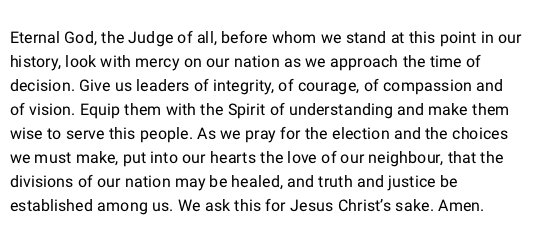
 I've posted this prayer today. As a person of faith, I believe that everything we human beings do, we do before God. So it's important that we pray for the forthcoming general election. Let me try to explain what I mean - and what I don't mean when I say this.
 I know that the Church of England has also issued a prayer today. It's fine as far as it goes. It asks that we the electorate may have wisdom at election time, be protected from despair, cynicism and false utopianism, and help make politics "a noble calling that serves the common good of all". I especially like that last bit. And I like the appeal to integrity as we cast our vote. G. K. Chesterton once said that the problem with elections was not that only half the electorate voted, but that only half the elector voted: half-heartedly, without real conviction, not really believing that elections make a difference.
But we make our prayers too narrow by false limits of our own (apologies to Father Faber for misquoting his famous hymn). We should be more ambitious as we lay the issues of this election before God. It's the outcome that matters, not simply the process that leads up to it. And while we mustn't turn prayer into a kind of spiritual manipulation motivated by party politics, I think we can agree that we should crave leaders who are principled, embody healthy values and who will have the courage to make decisions that will put them into practice. Hence my use of words like integrity, courage, compassion, vision, truth, justice, the love of neighbour and the healing of division in our nation - surely a top priority for everyone in public life right now. The Seven Gifts of the Spirit that are set out in the messianic portrait painted in Isaiah 11 might be a good place to begin exploring what we look for in our leaders: this was the text in my mind when I alluded in the prayer to "the Spirit of understanding".
No doubt we won't all agree about what these values and virtues mean in practice. But I believe that to pray with integrity about the kind of nation we want to be also commits us to debating with integrity during the election campaign. The lack of it was what many of us lamented during the EU referendum campaign. To descend to empty slogans (or, to quote Chesterton again, the "easy speeches that comfort cruel men") is to devalue what we mean by democracy. An election debate means listening carefully, evaluating evidence, discerning good arguments from bad, and not personalising matters of principle. (So please let's stop referring to Theresa May as "the vicar's daughter" - she deserves to be heard in her own right as a responsible adult woman, not someone who is still being defined by her father, however good a priest he no doubt was.)

I'm not saying it's easy. Discernment never is. The word diakrisis literally means "making a judgment", coming to a mind. The weighing of arguments, the ability to place them in a larger context, the capacity to inquire what theological or ethical issues might be at stake all demands wisdom, effort and good deal of perseverance. But if we care about our nation and the human family of which we are part - if indeed, we are not only good citizens of the UK but also, in the best sense, citizens of the world (sorry, Mrs May!), then discernment is precisely what we are called to practice in the next few weeks. Amid the clamour of earthquake, wind and fire, we need to listen out for the still small voice. Not just for our own sake, the nation's sake or the world's sake, but for God's sake too.
This is where prayer comes in. If we are people who pray, our concerns will already be engaged towards those who represent us in Parliament and the other institutions of which we are part. But now, as we get ready to make political choices that will have far-reaching consequences, it's especially a time to focus on our common life, and pray for wise and principled leaders who will cherish just, compassionate and humane values. We need to pray for the destiny of our nation as it searches for its place in a changing world order.
 Prayer isn't (or shouldn't be) a way of getting God to orchestrate events our way. Nor is it a binary spiritual exercise ("answered" or "not answered"). It's more subtle than that. I believe it is a genuine and heartfelt desire to bring the affairs of the nation into the orbit of God's love and care, to acknowledge that all life is dependent on him, and that we are ultimately accountable to him as our Judge. It is a joyful affirmation that out of his love for the world, God is passionately concerned for the welfare of all peoples. Self-interest doesn't come into it - or, shall we say, ought to become as enlightened as possible by our love of God and our neighbour. Perhaps the best prayers are those that spring not from desperation but from gratitude and that are built on the central petition of the Lord's Prayer, "your kingdom come".
Even if you are not a religious person who habitually prays, maybe you could still think about the forthcoming election in this kind of way? Can we agree to practise "mindfulness" together over the next few weeks and try to raise the tone of the debate? Maybe we can make common cause with everyone of good will who wants to play a part in shaping a healthy ecology of mind and heart during the campaign? Perhaps we can encourage one another to entertain the idea of a more generous political discourse that rises above tired, simplistic formulae and genuinely tries to listen and understand?
There are two direct benefits of thinking about and praying for the election in the way I've suggested. The first is to revitalise our imagination about what is possible, what our society could become. The other is to help us learn the lesson of humility. Our politics could really do with generous helpings of both.
Monday, 30 January 2017
Theresa May and Brexit
The Prime Minister has set out her Brexit stall. In her speech she sounded persuasive, far-sighted and upbeat as she spoke about how we would leave the European Union. It brought some clarity and this is to be welcomed.
We can’t accuse Theresa May of lacking vision. She asks the right question, what kind of country do we want to be? Her answer deploys a panoply of noble ideals: “stronger, fairer, more united, more outward-looking”, “secure, prosperous, tolerant, a magnet for international talent and a home to the pioneers and innovators who will shape the world ahead”.
No-one will dissent from these aspirations. We all want the best for our country. But why does it need Brexit to bring it about? Misgivings set in as early as the fourth sentence of the speech. The British people, she says, “voted to leave the European Union and embrace the world”. It takes considerable effort to recall where “embracing the world” featured in the Leave campaign. What we remember are attacks on immigration and the populist cry “give us our country back!” It’s hard to spin Brexit as internationalism.
Mrs May wants Britain to be “a great, global, trading nation that is respected around the world”. Those words capture her fundamentally nostalgic ambition for Britain. She draws on a memory coloured by the way Victorian politicians and industrialists spoke about Britain’s role in the world, fuelled by the vast economic opportunities empire had opened up. A post-colonial, not to say Christian, perspective should make us ask whether this kind of grandiose rhetoric belongs in the 21st century or whether a humbler register wouldn’t help make the friends we are going to need in the next few years.
The Prime Minister acknowledges that the UK must be “the best friend and neighbour to our European partners” as well as reaching out to the wider world. Indeed. But wasn’t this already being achieved by a Britain within the EU? From a Christian point of view, a people’s true greatness lies not in asserting its own independent identity but in its moral and spiritual character. To the founding fathers of the European project, catholic social teaching shaped the idea of a just, peaceable and collaborative partnership of nations in which sovereignty was pooled for the common good. It was as much about giving as receiving, serving as being served, in short loving your neighbour.
The historian Nicholas Boyle has argued that it’s the loss of a global imperial role that is partly responsible for Britain’s ambivalence about the EU. He believes that the UK, specifically the English, have got too used to exercising hegemony over others. Being “ordinary” is alien to us because we haven’t had much practice at it. So it’s not surprising that Britain has insisted on its exceptionalism as a “special case” within the EU. If post-imperial Britain had been content to play a more modest role in world affairs like most other nations, we might well have been more convinced Europeans.
As it is, the rhetoric of Brexit has mostly been driven by self-interest, in David Cameron’s oft-repeated phrase, “what’s best for Britain”. And Mrs May can’t shake it off, for all her commitment to being a good friend to the EU and wanting to see it flourish. Perhaps this is inevitable when trade, the economy, immigration and security dominate the agenda. I am not saying that Mrs May does not care about human rights, social justice, reconciliation, peace-making or the environment. But a Christian response to her statement about Brexit is bound to ask why they are not much more prominent.
For many in the finance and business sectors, the biggest stumbling block in the Prime Minister’s speech is her resolve that Britain will leave the Single Market. They are right to be worried about the hard, isolationist Brexit this betokens, given the undertakings made by leading Brexiters that this was not a necessary consequence of leaving the EU. It isn’t the only aspect of Brexit where 48% of those who voted are tempted to call “foul” and wonder where they are going to belong in Mrs May’s new Britain.
Religion is as concerned about the integrity of decision-making as the decision itself. This is at stake in Parliament’s role in the Brexit process. Mrs May has announced that the deal as finally negotiated will be brought before Parliament. But government sources have now disclosed that even if elected members reject it, Brexit will still go ahead. Given the emphasis Leavers laid on UK Parliamentary sovereignty during the referendum, where does that leave our democratic institutions?
Mrs May’s speech includes a ringing endorsement of the United Kingdom. “It is only by coming together as one great union of nations and people that we can make the most of the opportunities ahead.” This for Remainers is precisely the argument for the European Union and Britain’s membership of it. Not for the only time, the logic of her argument leads in completely the opposite direction to the one she takes. Does that sentence, so telling, unmask the emperor’s new clothes?
Subscribe to:
Posts (Atom)