About Me

My photo
Pilgrim, priest and ponderer. European living in North East England. Retired parish priest, theological educator, cathedral precentor and dean.
Showing posts with label Chesterton. Show all posts

Thursday, 20 April 2017

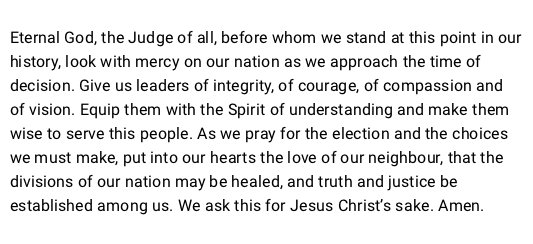
Praying for the Election


I've posted this prayer today. As a person of faith, I believe that everything we human beings do, we do before God. So it's important that we pray for the forthcoming general election. Let me try to explain what I mean - and what I don't mean when I say this.

I know that the Church of England has also issued a prayer today. It's fine as far as it goes. It asks that we the electorate may have wisdom at election time, be protected from despair, cynicism and false utopianism, and help make politics "a noble calling that serves the common good of all". I especially like that last bit. And I like the appeal to integrity as we cast our vote. G. K. Chesterton once said that the problem with elections was not that only half the electorate voted, but that only half the elector voted: half-heartedly, without real conviction, not really believing that elections make a difference.

But we make our prayers too narrow by false limits of our own (apologies to Father Faber for misquoting his famous hymn). We should be more ambitious as we lay the issues of this election before God. It's the outcome that matters, not simply the process that leads up to it. And while we mustn't turn prayer into a kind of spiritual manipulation motivated by party politics, I think we can agree that we should crave leaders who are principled, embody healthy values and who will have the courage to make decisions that will put them into practice. Hence my use of words like integrity, courage, compassion, vision, truth, justice, the love of neighbour and the healing of division in our nation - surely a top priority for everyone in public life right now. The Seven Gifts of the Spirit that are set out in the messianic portrait painted in Isaiah 11 might be a good place to begin exploring what we look for in our leaders: this was the text in my mind when I alluded in the prayer to "the Spirit of understanding".

No doubt we won't all agree about what these values and virtues mean in practice. But I believe that to pray with integrity about the kind of nation we want to be also commits us to debating with integrity during the election campaign. The lack of it was what many of us lamented during the EU referendum campaign. To descend to empty slogans (or, to quote Chesterton again, the "easy speeches that comfort cruel men") is to devalue what we mean by democracy. An election debate means listening carefully, evaluating evidence, discerning good arguments from bad, and not personalising matters of principle. (So please let's stop referring to Theresa May as "the vicar's daughter" - she deserves to be heard in her own right as a responsible adult woman, not someone who is still being defined by her father, however good a priest he no doubt was.)

Above all we need to be committed seekers after truth. A good election is one where we don't cling to old political tribalisms, some of which have clearly had their day. On the contrary, we need to take the trouble to think for ourselves as grown-ups who are privileged, in a way not open to everyone in our world, to be able to take part in a democratic election. To listen, to think and to debate in this respectful way is, I want to say, an act of discernment. It asks the question, where might the voice of wisdom and truth be detected amid the babble of human voices that clamour for our attention? Where might we even hear the voice of God? Discernment and prayer are close relatives.

I'm not saying it's easy. Discernment never is. The word diakrisis literally means "making a judgment", coming to a mind. The weighing of arguments, the ability to place them in a larger context, the capacity to inquire what theological or ethical issues might be at stake all demands wisdom, effort and good deal of perseverance. But if we care about our nation and the human family of which we are part - if indeed, we are not only good citizens of the UK but also, in the best sense, citizens of the world (sorry, Mrs May!), then discernment is precisely what we are called to practice in the next few weeks. Amid the clamour of earthquake, wind and fire, we need to listen out for the still small voice. Not just for our own sake, the nation's sake or the world's sake, but for God's sake too.

This is where prayer comes in. If we are people who pray, our concerns will already be engaged towards those who represent us in Parliament and the other institutions of which we are part. But now, as we get ready to make political choices that will have far-reaching consequences, it's especially a time to focus on our common life, and pray for wise and principled leaders who will cherish just, compassionate and humane values. We need to pray for the destiny of our nation as it searches for its place in a changing world order.

Prayer isn't (or shouldn't be) a way of getting God to orchestrate events our way. Nor is it a binary spiritual exercise ("answered" or "not answered"). It's more subtle than that. I believe it is a genuine and heartfelt desire to bring the affairs of the nation into the orbit of God's love and care, to acknowledge that all life is dependent on him, and that we are ultimately accountable to him as our Judge. It is a joyful affirmation that out of his love for the world, God is passionately concerned for the welfare of all peoples. Self-interest doesn't come into it - or, shall we say, ought to become as enlightened as possible by our love of God and our neighbour. Perhaps the best prayers are those that spring not from desperation but from gratitude and that are built on the central petition of the Lord's Prayer, "your kingdom come".

Even if you are not a religious person who habitually prays, maybe you could still think about the forthcoming election in this kind of way? Can we agree to practise "mindfulness" together over the next few weeks and try to raise the tone of the debate? Maybe we can make common cause with everyone of good will who wants to play a part in shaping a healthy ecology of mind and heart during the campaign? Perhaps we can encourage one another to entertain the idea of a more generous political discourse that rises above tired, simplistic formulae and genuinely tries to listen and understand?

There are two direct benefits of thinking about and praying for the election in the way I've suggested. The first is to revitalise our imagination about what is possible, what our society could become. The other is to help us learn the lesson of humility. Our politics could really do with generous helpings of both.

Tuesday, 23 February 2016

The EU: a view from Hadrian's Wall

I am lucky enough to live close to Hadrian's Wall, on the south side where the land drops sharply down into the valley of the Tyne. From my front door I often walk up the steep hill above the village to enjoy amazing views. To the south across the valley, the North Pennines rear up massively, their whale-backs dominating the horizon. To the north, the view is closed off by the ridge of volcanic rocks called the Whin Sill whose jagged edges serrate the sky. It carries the Roman wall that strides across the lands of Cumbria and Northumberland connecting east coast and west at this narrow neck of England. In front of that you can glimpse a road that runs parallel to the wall a mile or two to the south. This is the Stanegate, a Roman Road built earlier than the wall to link the strategic sites of Corbridge, Vindolanda and Carlisle.

Yesterday I took time out from EU-scanning the media to enjoy some fresh air. It's fascinating to read so much stimulating stuff, but after a while your head does begin to spin. Alone in this beautiful landscape washed by winter sunshine, I found myself musing as you often do on a walk, gathering wool as I say (hence the name of this blog). Here's where my thoughts were leading me.

I found myself thinking about what it means to live on a frontier. Northumberland has always been border country, long fought-over by Scots and English. We live in what used to be called for many centuries England's Middle March that sits between the English East March and the West. These were matched by the three Marches on the Scottish side. They were patrolled by wardens who sought to impose a degree of order in these often lawless territories where border reivers would sweep down the valleys to pillage and plunder at will. Not far away in the West March is an area that was officially known as the Debateable Lands. That name says it all. From the middle ages to the eighteenth century, you were careful whom you chose as your friends.

But long before all this, the Roman wall stood as an unforgettable symbol of a boundary. Bede, lover of most things Roman, knew about it, living as he did close to the military base of Arbeia whose impressive remains you can see laid out in the middle of South Shields. Why Hadrian's Wall was built in the first place isn't altogether clear (and the same goes for its Scottish cousin the Antonine Wall). But defence was certainly one reason, for the fortified milecastles proclaim only too clearly that in the early centuries of the Christian era, this was contested land. But both walls probably had a symbolic function, to delineate the north-western boundary of the Roman Empire. When the Antonine Wall was abandoned, Hadrian's was reinforced as if to say, here now is the settled border. To the south you are within the Pax Romana. To the north, its jurisdiction ceased, even if Romans often had military, social or trading reasons to venture frequently beyond it.

As I pondered on my walk, I thought about the symbolism of a boundary. What it does to its hinterland on either side is to impart a sense of liminality. You are on a threshold in these places. You straddle different worlds. Sometimes you are clearly pulled one way or the other, but often borderlands carry a sense of uncertainty where you have to stop and think about your belonging, even your very identity. That's why historically, liminal places are always marked out so that you pay attention to this fundamental activity of crossing-over: walls, watersheds, bridges, entrances and exits, even your own front door. These are sometimes happy places, sometimes uncomfortable and even painful, depending on what the threshold means. They can speak of welcome and homecoming. Or they can speak of alienation and exile, even death.

Walking on for a couple of miles, the Whin Sill was my constant northward companion, glowing green and gold in the clear clean light. How close to the 'edge' we are, I thought, the edge of an ancient civilisation that once embraced the whole of what we now call Europe. It felt oddly reassuring to think that Britannia was a province of Rome, part of a world that cherished learning, philosophy, law, politics, culture, sport, so much of what in medieval and Renaissance times would go into the shaping of our continent and our country. From this vantage point, it was as if I could look south across lands that shared the same values, the same sense of belonging: Britain, Gaul, Germany, Spain, Italy towards the Mediterranean that was Europe's cradle. And from this northern border, even this became more clearly just a part of an even longer story that also originated around the Mediterranean shores that I could, so to speak, see far off: the Greek and Hellenistic worlds, the Persian, and still more ancient, the Semitic that gave birth to the Judaeo-Christian-Moslem matrix that has been so influential in creating the Europe that we know.

Why I am I telling you this? Because a boundary has a way of imparting depth to a landscape of the mind. It stops you foreshortening the view because it draws attention to the extent and character of that prospect before you and your own place within it. Standing at the 'top' of Europe on this remote northern border was helping me to see the continent in its wholeness. And it underlined the importance of my sense of connection to it, my European belonging and identity in geography, culture and time. Nowadays the European Union doesn't notice this particular border, extending as it does (and how good this is) into Scotland and across the sea to Ireland. But I'm speaking symbolically here. (And just in case you're wondering, I am definitely not likening the EU to the Roman Empire or medieval Christendom. It's the symbolism I'm talking about.) I suddenly thought, how could these English lands that I love, for centuries tied umbilically to the 'Continent', become severed from our common European homeland which I also love, which I know and feel I belong to? It was an awful prospect.

I remembered something that G. K. Chesterton said about situations we think of as utterly incongruous. His example was William Gladstone smoking a cigar in the presence of Queen Victoria. It's not that it would be impossible. It could happen in theory. But it would be incredible. That's what I suddenly thought about the UK if it were severed from the EU. Brexit could so easily happen. But if it did, it would go against our history, our best interests, all our common sense. And that would make it incredible, absurd. Which is why I am supporting the case for our country to stay in the EU and not make this leap in the dark that any intelligent risk analysis must show threatens to do irreparable damage to our flourishing as a nation. Self-interest obviously comes into it, though a Christian case for the EU will want this to be enlightened self-interest.

But better still, with a stronger claim to be 'Christian' in its values, is to recognise how 'civilisation' is about the welfare of others as well as ourselves. Despite its weaknesses, the EU can be a force for good in building a more just and peaceable world. It's unthinkable that the United Kingdom, with its long history of aspiration, fairness, kindness, shrewdness, creativity, toleration and native wisdom would not want to play a leading part in this project. It's not just what the EU can do for us. It's what we can do for it, and through it, for the human race and the planet itself. At this ancient border, gazing back across the memory of a common civilisation, I realised just how insular it is, how self-serving, only to think only about what's good for us. And how un-British and un-English to think that way!

So I'm praying that the worst won't happen. For the next four months, the whole of the UK will become 'debateable lands' once again as the battle of ideas about the EU is fought out. Maybe what's at stake is nothing less than the identity or soul of Britain, even the soul of Europe itself. And that's about my own soul, my own identity too. I care about all these things. If I'm right, it will be worth investing time, effort and prayer at this unique time in our history. Indeed, I'd say it was vital.

If you'd like to, please join a (very) broad church of Christian support for our membership of the EU by following on Twitter: @Xians4EU or logging on to our Face Book page. I've written on this subject in a number of previous blogs on this site.