Today is World Food Day. I've learned that it's been observed on this October date since 1981 to draw attention to global hunger and stimulate action to support the most needy people of our world. It's also an opportunity to reflect on the food we eat and its significance for us personally and as societies. Recent themes for the day have included food security, agricultural co-operatives, food prices, migration and rural poverty. This year's focus is "our actions are our future".
As it happens, I've been thinking a lot about food this year. I went to the surgery in June to get myself checked out by the practice nurse. She looked me in the eye and said: "you're overweight with a BMI* that's well above the safe limit of 25. You need to reduce". So for the last four months I've been reducing. My ambition has been to get back to the weight I was in my mid-twenties. That would give me a BMI just within the safer zone (for as the nurse also pointed out, when you're a male of my age, you are automatically at risk of cardiovascular disease, hypertension and stroke. This year I've had to learn about the first two on that ominous list - but that's another story).
As we all know, there's nothing like dieting to get you thinking about food. I don't say obsessing about it - but it has a way of taking up more than its fair share of mental space. If you've watched Michael Mosley on TV (Trust Me, I'm a Doctor) or read his books, you'll know that he believes in the habit of regular fasting to stabilise our attitude to food. His 5-2 diet - five days of normal eating each week, two with significantly reduced calorie intake - has been widely adopted. My sister who is a professional personal trainer recommends it.
And of course, this matches the importance attached to a healthy rhythm of feasting and fasting in the world's religions. In the Christian shape of each week, Sunday is a festival (commemorating the resurrection) and Friday a fast (in memory of Good Friday). Lent and Eastertide offer annual seasons for self-denial and celebration. Every feast day has its vigil or fast. I dare say that if we ate and drank accordingly, we'd be healthier as a result. When I've got down to the weight I want to be (86kg since you ask - nearly there!), Christian discipline or askesis, if I stick to it and eat and drink sensibly, ought to make sure I stay there.
Eating sensibly maybe comes down to eating reflectively, thinking about what we eat and why. Here's where World Food Day comes in. "Our actions are our future." What actions might these be? There's any number of possibilities, whether we're talking about personal, or collective, political, actions. It's obvious to all of us that the unequal way the world's resources are distributed means food affluence for some (most of us in the west), food poverty for far more in the developing world. No little personal act of mine is going to make a difference to that global fact on the ground.
Yet we also know that a lot of littles can add up to a great deal. They can symbolise to ourselves and to others our resolve to work for political and economic change, to influence public attitudes so that imbalance is redressed in favour of those who are in most need. It's an offence to our human inventiveness and capacity for problem-solving that millions of people still cry out for their daily bread. It also means thinking locally: about supporting or volunteering at our nearby food-bank, for example, or at this time of year, asking what harvest festival gifts we can bring to church that will make a difference to the lives of others.
So I'm trying to be a little more reflective about what I eat and how. The sacramental quality of food becomes more important when you are careful about your habits - how much is symbolised by our eating and drinking, especially when we are with family and friends where the beautiful word companion comes into its own - literally, a "bread-sharer" as in the French word for a chum, copain. All of this is gathered up and transcended in the Christian eucharist, the sharing of bread and wine together in memory of Jesus who died and was raised up, who commanded us on the eve of his passion to do this in remembrance of him and in a shared meal, revealed himself as the risen Lord.
What's struck me most forcibly of all during these dieting weeks is how our eating habits are intrinsically bound up with the future of our planet. George Monbiot in his Guardian column has done more than most to highlight the effects our addiction to meat-eating is having on climate change. Last week the International Panel on Climate Change published its report. It tells us that unless temperature rise over pre-industrial levels is held to 1.5 degrees Celsius, the world faces catastrophic environmental damage which will lead to untold human consequences. Moreover, we have just twelve years left in which to address this crisis. Excessive meat consumption is part of the problem.
I'm struck by how disparate our attitudes to climate change are. Our government officially accepts the science behind the IPCC report and recognises the urgent need to reduce fossil-fuel dependence. Yet in the week after the report's publication, it reduces subsidies on electric cars and stands by while a court verdict allows fracking to begin again in the North of England. The public largely "gets" the message about fossil-fuels (don't use your car more than you have to, don't travel by air if there's a train you can catch, think about burning renewables rather than coal or gas) and plastics (you don't see many plastic bags being dispensed at supermarket checkouts nowadays). Yet it's far more resistant to the message about meat-eating, even though the cost to the planet of clearing forests for grazing, and of greenhouse gas emissions from cattle is unacceptably high.
So I link this year's World Food Day theme, "our actions are our future" with that of two years ago, "climate is changing; food and agriculture must change too". Food is not only about personal choices. It's political too. And as I've said, it also has profound theological and spiritual aspects. In the Lord's Prayer, daily bread really means "bread for tomorrow". I find that suggestive: if our decisions create futures for ourselves and others, so do our prayers. As for the present, our attitude to food and drink, like everything else, goes with the kind of care and responsibility we associate with mindfulness. The reflective eater, the mindful eater, the responsible eater, even the prayerful eater - I like the sound of those adjectives. They speak of wisdom. Late in time, as old age beckons, I'm trying to learn how important mindfulness is.
On last night's Look North there was a piece about the legendary Teesside Parmo that featured in a recent MasterChef broadcast. Obesity campaigners have pointed out that this North East delicacy consisting of chicken deep-fried in breadcrumbs topped with béchamel sauce and dripping with melted cheese comes in at around 2000 calories. That's close to what an average adult male needs each day to maintain his body weight. I don't want to score points but I somehow don't think this menu is for me.
By the way, I'm not a vegetarian though I love vegetarian food. I'm not teetotal. Most of fasting and dieting comes down to, not don't ever eat or drink this or that but if you do, do it with restraint. My wife tells me that portion-size is everything. Avarice and gluttony are among the seven deadly sins. Avarice is uncontrolled desire for what we don't need, gluttony uncontrolled consumption of it. Food and drink aren't the only things we desire to excess or consume too much of. But our eating and drinking can tell us much about ourselves. Which is why World Food Day is important, if only to make us think.
*body-mass index.
About Me

- Aquilonius
- Pilgrim, priest and ponderer. European living in North East England. Retired parish priest, theological educator, cathedral precentor and dean.
Showing posts with label mindfulness. Show all posts
Showing posts with label mindfulness. Show all posts
Tuesday, 16 October 2018

Thursday, 20 April 2017
Praying for the Election
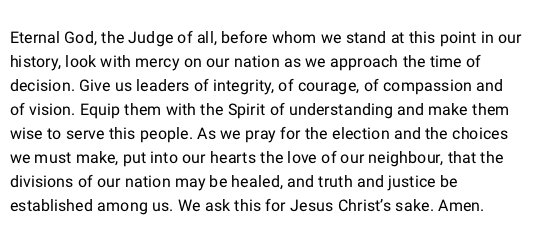
 I've posted this prayer today. As a person of faith, I believe that everything we human beings do, we do before God. So it's important that we pray for the forthcoming general election. Let me try to explain what I mean - and what I don't mean when I say this.
 I know that the Church of England has also issued a prayer today. It's fine as far as it goes. It asks that we the electorate may have wisdom at election time, be protected from despair, cynicism and false utopianism, and help make politics "a noble calling that serves the common good of all". I especially like that last bit. And I like the appeal to integrity as we cast our vote. G. K. Chesterton once said that the problem with elections was not that only half the electorate voted, but that only half the elector voted: half-heartedly, without real conviction, not really believing that elections make a difference.
But we make our prayers too narrow by false limits of our own (apologies to Father Faber for misquoting his famous hymn). We should be more ambitious as we lay the issues of this election before God. It's the outcome that matters, not simply the process that leads up to it. And while we mustn't turn prayer into a kind of spiritual manipulation motivated by party politics, I think we can agree that we should crave leaders who are principled, embody healthy values and who will have the courage to make decisions that will put them into practice. Hence my use of words like integrity, courage, compassion, vision, truth, justice, the love of neighbour and the healing of division in our nation - surely a top priority for everyone in public life right now. The Seven Gifts of the Spirit that are set out in the messianic portrait painted in Isaiah 11 might be a good place to begin exploring what we look for in our leaders: this was the text in my mind when I alluded in the prayer to "the Spirit of understanding".
No doubt we won't all agree about what these values and virtues mean in practice. But I believe that to pray with integrity about the kind of nation we want to be also commits us to debating with integrity during the election campaign. The lack of it was what many of us lamented during the EU referendum campaign. To descend to empty slogans (or, to quote Chesterton again, the "easy speeches that comfort cruel men") is to devalue what we mean by democracy. An election debate means listening carefully, evaluating evidence, discerning good arguments from bad, and not personalising matters of principle. (So please let's stop referring to Theresa May as "the vicar's daughter" - she deserves to be heard in her own right as a responsible adult woman, not someone who is still being defined by her father, however good a priest he no doubt was.)

I'm not saying it's easy. Discernment never is. The word diakrisis literally means "making a judgment", coming to a mind. The weighing of arguments, the ability to place them in a larger context, the capacity to inquire what theological or ethical issues might be at stake all demands wisdom, effort and good deal of perseverance. But if we care about our nation and the human family of which we are part - if indeed, we are not only good citizens of the UK but also, in the best sense, citizens of the world (sorry, Mrs May!), then discernment is precisely what we are called to practice in the next few weeks. Amid the clamour of earthquake, wind and fire, we need to listen out for the still small voice. Not just for our own sake, the nation's sake or the world's sake, but for God's sake too.
This is where prayer comes in. If we are people who pray, our concerns will already be engaged towards those who represent us in Parliament and the other institutions of which we are part. But now, as we get ready to make political choices that will have far-reaching consequences, it's especially a time to focus on our common life, and pray for wise and principled leaders who will cherish just, compassionate and humane values. We need to pray for the destiny of our nation as it searches for its place in a changing world order.
 Prayer isn't (or shouldn't be) a way of getting God to orchestrate events our way. Nor is it a binary spiritual exercise ("answered" or "not answered"). It's more subtle than that. I believe it is a genuine and heartfelt desire to bring the affairs of the nation into the orbit of God's love and care, to acknowledge that all life is dependent on him, and that we are ultimately accountable to him as our Judge. It is a joyful affirmation that out of his love for the world, God is passionately concerned for the welfare of all peoples. Self-interest doesn't come into it - or, shall we say, ought to become as enlightened as possible by our love of God and our neighbour. Perhaps the best prayers are those that spring not from desperation but from gratitude and that are built on the central petition of the Lord's Prayer, "your kingdom come".
Even if you are not a religious person who habitually prays, maybe you could still think about the forthcoming election in this kind of way? Can we agree to practise "mindfulness" together over the next few weeks and try to raise the tone of the debate? Maybe we can make common cause with everyone of good will who wants to play a part in shaping a healthy ecology of mind and heart during the campaign? Perhaps we can encourage one another to entertain the idea of a more generous political discourse that rises above tired, simplistic formulae and genuinely tries to listen and understand?
There are two direct benefits of thinking about and praying for the election in the way I've suggested. The first is to revitalise our imagination about what is possible, what our society could become. The other is to help us learn the lesson of humility. Our politics could really do with generous helpings of both.
Subscribe to:
Posts (Atom)