About Me

My photo
Pilgrim, priest and ponderer. European living in North East England. Retired parish priest, theological educator, cathedral precentor and dean.
Showing posts with label justice. Show all posts

Thursday, 20 April 2017

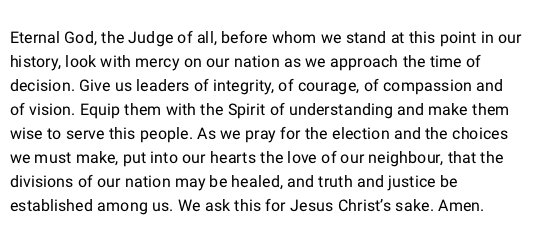
Praying for the Election


I've posted this prayer today. As a person of faith, I believe that everything we human beings do, we do before God. So it's important that we pray for the forthcoming general election. Let me try to explain what I mean - and what I don't mean when I say this.

I know that the Church of England has also issued a prayer today. It's fine as far as it goes. It asks that we the electorate may have wisdom at election time, be protected from despair, cynicism and false utopianism, and help make politics "a noble calling that serves the common good of all". I especially like that last bit. And I like the appeal to integrity as we cast our vote. G. K. Chesterton once said that the problem with elections was not that only half the electorate voted, but that only half the elector voted: half-heartedly, without real conviction, not really believing that elections make a difference.

But we make our prayers too narrow by false limits of our own (apologies to Father Faber for misquoting his famous hymn). We should be more ambitious as we lay the issues of this election before God. It's the outcome that matters, not simply the process that leads up to it. And while we mustn't turn prayer into a kind of spiritual manipulation motivated by party politics, I think we can agree that we should crave leaders who are principled, embody healthy values and who will have the courage to make decisions that will put them into practice. Hence my use of words like integrity, courage, compassion, vision, truth, justice, the love of neighbour and the healing of division in our nation - surely a top priority for everyone in public life right now. The Seven Gifts of the Spirit that are set out in the messianic portrait painted in Isaiah 11 might be a good place to begin exploring what we look for in our leaders: this was the text in my mind when I alluded in the prayer to "the Spirit of understanding".

No doubt we won't all agree about what these values and virtues mean in practice. But I believe that to pray with integrity about the kind of nation we want to be also commits us to debating with integrity during the election campaign. The lack of it was what many of us lamented during the EU referendum campaign. To descend to empty slogans (or, to quote Chesterton again, the "easy speeches that comfort cruel men") is to devalue what we mean by democracy. An election debate means listening carefully, evaluating evidence, discerning good arguments from bad, and not personalising matters of principle. (So please let's stop referring to Theresa May as "the vicar's daughter" - she deserves to be heard in her own right as a responsible adult woman, not someone who is still being defined by her father, however good a priest he no doubt was.)

Above all we need to be committed seekers after truth. A good election is one where we don't cling to old political tribalisms, some of which have clearly had their day. On the contrary, we need to take the trouble to think for ourselves as grown-ups who are privileged, in a way not open to everyone in our world, to be able to take part in a democratic election. To listen, to think and to debate in this respectful way is, I want to say, an act of discernment. It asks the question, where might the voice of wisdom and truth be detected amid the babble of human voices that clamour for our attention? Where might we even hear the voice of God? Discernment and prayer are close relatives.

I'm not saying it's easy. Discernment never is. The word diakrisis literally means "making a judgment", coming to a mind. The weighing of arguments, the ability to place them in a larger context, the capacity to inquire what theological or ethical issues might be at stake all demands wisdom, effort and good deal of perseverance. But if we care about our nation and the human family of which we are part - if indeed, we are not only good citizens of the UK but also, in the best sense, citizens of the world (sorry, Mrs May!), then discernment is precisely what we are called to practice in the next few weeks. Amid the clamour of earthquake, wind and fire, we need to listen out for the still small voice. Not just for our own sake, the nation's sake or the world's sake, but for God's sake too.

This is where prayer comes in. If we are people who pray, our concerns will already be engaged towards those who represent us in Parliament and the other institutions of which we are part. But now, as we get ready to make political choices that will have far-reaching consequences, it's especially a time to focus on our common life, and pray for wise and principled leaders who will cherish just, compassionate and humane values. We need to pray for the destiny of our nation as it searches for its place in a changing world order.

Prayer isn't (or shouldn't be) a way of getting God to orchestrate events our way. Nor is it a binary spiritual exercise ("answered" or "not answered"). It's more subtle than that. I believe it is a genuine and heartfelt desire to bring the affairs of the nation into the orbit of God's love and care, to acknowledge that all life is dependent on him, and that we are ultimately accountable to him as our Judge. It is a joyful affirmation that out of his love for the world, God is passionately concerned for the welfare of all peoples. Self-interest doesn't come into it - or, shall we say, ought to become as enlightened as possible by our love of God and our neighbour. Perhaps the best prayers are those that spring not from desperation but from gratitude and that are built on the central petition of the Lord's Prayer, "your kingdom come".

Even if you are not a religious person who habitually prays, maybe you could still think about the forthcoming election in this kind of way? Can we agree to practise "mindfulness" together over the next few weeks and try to raise the tone of the debate? Maybe we can make common cause with everyone of good will who wants to play a part in shaping a healthy ecology of mind and heart during the campaign? Perhaps we can encourage one another to entertain the idea of a more generous political discourse that rises above tired, simplistic formulae and genuinely tries to listen and understand?

There are two direct benefits of thinking about and praying for the election in the way I've suggested. The first is to revitalise our imagination about what is possible, what our society could become. The other is to help us learn the lesson of humility. Our politics could really do with generous helpings of both.

Sunday, 10 January 2016

Gay Anglicans and the Primates' Meeting: the open letter

I've signed an open letter that is published today. You have probably heard about it in today's news. More than 100 people, described in the press-release as 'senior Anglicans', have written to the Archbishops of Canterbury and York ahead of the Primates' Meeting this week. Here it is in full. 

Your Graces,

We the undersigned ask you, our Archbishops, to take an unequivocal message to your meeting of fellow Primates next week that the time has now come for:

- Acknowledgement that we, the Church, have failed in our duty of care to LGBTI members of the Body of Christ around the world.  We have not loved them as we should, and have treated them as a problem to be solved rather than as brothers and sisters in Christ to be embraced and celebrated.  We have made them feel second-class citizens in the Kingdom of God, often abandoned and alone.
 
- Repentance for accepting and promoting discrimination on the grounds of sexuality, and for the pain and rejection that this has caused. We, the Church, need to apologise for our part in perpetuating rather than challenging ill-informed beliefs about LGBTI people, such as the slanderous view that homosexuals have a predisposition to prey on the young.

We understand that the Primates come from a variety of contexts with differing ways of interpreting the Scriptures, but we urge you to be prophetic in your action and Christ-like in your love towards our LGBTI sisters and brothers who have been ignored and even vilified for too long.  

Please be assured of our prayers for you at this time, and that the world will know by our words and actions that everyone who is baptised into the faith is of equal value in our Lord Jesus Christ.

Yours sincerely

This isn't the first time I've blogged on same-sex relationships. But at the risk of repeating myself, I wanted to say something about why I've signed. It's for three reasons, all of which will, or ought to, be self-evident to Christian people, whatever their theological stance and whatever their sexual orientation.

First, I've signed because the church must be a place of truth. It follows the One who proclaimed himself as the Truth that would set us free. The truth of human sexuality is often hard to speak about because it is so complex. The discovery of my sexual identity is a lifelong task, and a God-given vocation. In cultures where same-sex relationships are not approved of, and gay people experience pressure or even persecution, truth-telling is driven underground. (Even in the west, gay teenagers often find it extraordinarily difficult open about their sexuality in the face of peer-pressure that is suspicious or hostile.) Sex is intended to be one of life's joyful mysteries, but the church has often debased it through suspicion or fear into a sorrowful one. It's vital that the church models a society that is open and unafraid in its take on human sexuality, acknowledging the consensus of serious research into same-sex attraction, challenging what the letter calls 'ill-informed beliefs about LGBTI people', and celebrating the truth of each cherished man or woman's sexual giftedness. This is a profoundly theological task that our church leaders must not evade.

Secondly, I've signed because the church must be a place of justice and equality. The treatment of homosexual people in many countries around the world is an offence to our sense of what is fair and right. At the very least, the honouring of human dignity and the recognition of difference should be a matter of ordinary courtesy. But Christians should aspire to an altogether bigger vision of how we should treat one another as made in the image of God. It is to me a matter of outrage that Christian churches anywhere in the world should collude with attitudes that are at best discriminatory and often very much worse where gay people are concerned. No primate would tolerate them if they stemmed from racism. A generation ago, many of us were hard at work endeavouring to make sure that women could take their place alongside men in the ministry of the Church of England. That too was a matter of justice because good theology always has a finely-tuned conscience. And while I am keenly aware that the idea of an 'inclusive church' can offend Christians in other more conservative parts of the world, and could also alienate people of other faith traditions, especially Muslims, it cannot be right not to act justly merely because of our fears. Our letter calls on the Primates to act according to what are surely their best instincts for a world that is more equitable and fair.

Thirdly, I've signed because the church must be a place of compassion and love. The Quakers (who have often been a long way ahead of the C of E in matters of justice, including their acceptance of homosexual people) are known as the Society of Friends. This is how St John sees the church gathered in the upper room, where disciples are set fee to love one another in a way that echoes God's eternal love for them. Human pain and suffering have a particular claim on our compassion. And we shouldn't make any mistake about the suffering and pain many gay people around the world experience. I include in this gay clergy and other ministers in the Church of England who, in an ecclesiastical culture perceived to be hostile, live in real fear of being found out. The Primates have a special responsibility to make sure that our churches are communities of hospitality and friendship that do not collude with hypocrisy. They, we all, have that calling because this is how God himself is always reaching out towards each of us. It's a great deal harder to act hospitably than to uphold simple binaries that banish the non-approved from acceptance. This truly is 'tough love'.

I hope that this letter will not come across as trouble-stirring or polemical. It's meant to be firm but eirenic in tone. It would be great if it helped give the Primates confidence as they debate human sexuality, if it helped them to know that every step they take, however tentative, towards changing entrenched attitudes and welcoming gay Christians into their communities will be warmly and gratefully supported. The first step, maybe, is to recognise that just as with female ordination, there will be differences of view among the Primates and this needs to be respected. (I'm not sure that it altogether is, yet.) As Justin Welby has said, in grown-up communities there must always be room for 'deep disagreement'. 

But our letter is looking for much more than this. We're looking for a deep change of hearts and minds. We use the word 'repentance'. That's undeniably a strong word, but nothing is less is called for in the face of any great wrong we have committed. I am pretty confident that in decades to come, we as churches shall be saying we are deeply sorry for the way we have mistreated and oppressed gay people in the past. So why not say it now? That would make the Anglican Communion a place of hope and sanctuary for LGBTI people across the world. 

Anglicanism has always been good at bridge-building: perhaps that's one of its gifts to the world church. That's why we have every reason to think it can rise to a challenge it has known about for decades. But I also want to sound a warning note. Our unity as Anglicans is profoundly important. But I don't believe it's more important than the fundamental Christian values which have given me the headings for this blog: truth, justice and love. If we know what is true, what is just and what is loving, we must not fail to obey their imperatives however painful the consequences may be and however little we may be honoured, still less thanked for it. 

So it will take great courage on the part of the Primates to do what our letter asks for. That's why we end our letter with the promise of our prayers for this week's meeting, and for Justin Welby as he presides over it. Let William Blake set the tone of our prayers and their debates with his famous words that get close to the heart of what we Christians believe about God and humanity:

For Mercy, Pity, Peace and Love
Is God our Father dear,
And Mercy, Pity, Peace and Love
Is Man, his child and care....

Where Mercy, Love and Pity dwell
There God is dwelling too.

You can read the press-release at http://www.lettertoarchbishops.wordpress.com/.