Tuesday 4 June
We awaken to thick fog. Both banks of the river are clothed
in the mist. Occasionally the ghostly outline of an onion-spited church or a
house can be glimpsed among trees that are no more than shadows on the river banks. From time to time tree trunks and branches drift languidly by. The fog emphasises our insulation from the world we are gliding through. We sail on in this capsule that is gliding so effortlessly across Eastern and Central Europe.
I speculate about the hazards of navigating
in these conditions. I’ve read enough about the Danube to realise how tricky it
is to stay safely within the deep water channels, avoid the sandbars that are
constantly shifting with the changing currents of the Danube as it responds to
rainfall and snowmelt upstream. These 135 metre-long river cruisers are flat
bottomed, enabling them to negotiate the river in all but the driest conditions
(I came across a bitter complaint on social media from last year telling us
how, when customers were already en route for the airport, Riviera had had to
cancel a cruise because there was not enough water in the river to navigate
safely).
 After breakfast the mist has cleared and we go out on deck
to enjoy the sunshine. We have now travelled beyond the Romanian border, so all
around it is Serbia. Pretty villages line the river bank on the south side
where a line of hills sweeps down to the river. The Danube is very high round
here. On the north bank, there is extensive flooding isolating horses, cattle
and pigs. Bird life is abundant, and a group of voyagers has gathered with
their field glasses and notebooks pointing out what’s to be seen - storks,
terns, Black-winged stilts, squacco herons, bee-eaters nesting in holes in sandy
banks, wagtails, little winged plovers, a white-tailed eagle, and even
golden orioles - heard but not seen.
That’s an impressive list of fauna, but I claim no
credit for it. I've no eye for bird life, alas. It calls for an attention to detail that I seem not to have been gifted with. I've always been drawn to the bigger picture. But I've enjoyed overhearing what these experts have been discussing
for an hour this morning - obsessives they tell me they are happy to be called. One of them
says that the history and politics have passed him by on this voyage, but the ornithology
has been to die for. He could sit on deck all day peering into the forests to enjoy their natural history. I reply how good it is that on this cruise there is
something for everyone. But another affirms that for her, the history and politics
have been eye-opening. “This voyage on the Danube has made me a better
European” she says with real conviction. I love that because it’s been
precisely the same for me.
 We draw in to Novi Sad. My guide book is unremittingly
negative about this once elegant Habsburg city, Serbia’s second largest with a quarter of million inhabitants. It suffered badly in
the Balkan wars, all three Danube bridges being destroyed in 1999. Our Serbian
guide corrects one misapprehension about this. It’s said that NATO bombed them
all. In fact, the bridge by Vauban’s citadel was blown up by Serbian forces
themselves to avoid offering up the citadel as a target for the bombers. Now
these three bridges have been rebuilt, the finest of them an “infinity” bridge
like Stockton’s, opened last year.
 We take a coach tour of the city, and there is more Serbian
history to go with it. Novi Sad (= "new orchard") is another very ancient settlement that became Roman Cusum when it was conquered and incorporated into the imperial province of Pannonia. We see Roman tombs outside the museum in which there is a good collection of antiquities. I wish we had time to look inside. In the centuries following the collapse of the Roman Empire, the city had a complicated history in which Hungarians, Slavs and later the Ottoman Empire all vied for control. In Habsburg days it was Ratzen Stadt, "Serb City".
We get to the final decade of the twentieth century and the terrible cost of Yugoslavia's break-up. Unlike a previous Serbian guide, today's doesn’t dismiss the 1990s as merely
“difficult”. She points out that Serbia sits on fault lines that divide
Rome from Constantinople, and Catholic from Orthodox, and Christian from Moslem, and after the last world war, all
faith groups from the communists. So it’s not surprising that conflict is an
ever-present risk in this part of Europe. And because whoever controls the
Danube controls central Europe, Novi Sad’s bridges are always going to be vulnerable
to attack. “It’s happened for centuries” she says, “and the 1990s attacks will
probably not be the last”. It’s a sobering introduction to the city.
We drive round the citadel, noting the entrances to the
tunnels that Empress Maria Theresa ordered to be constructed underneath the
fortifications. Mention of her name introduces the geographical position of
this place. Our guide says we are not to think of Novi Sad as a Balkan city but
rather as belonging to the Pannonian Plain that links it to the Austrian-Hungarian
Empire. This is a highly cosmopolitan city she says, in which no fewer than
eight languages are officially recognised. And as we drive round, we can’t help
noticing the colourful, vibrant character of the centre. It’s a lot better
than my gloomy prognostications informed by my book - but then that
was written closer to the destructive Balkan wars than we are now. I have
already decided that I like this place a lot more than Belgrade.

 We walk round the centre. In the Orthodox Church our guide
explains that it is strongly influenced by western ecclesiastical architecture.
Completed only in 1903 rather in the style of a London Wren church, it has
stained glass windows, most unusual for a church in the east. She elaborates on
further differences between Orthodox and Catholic architecture and
spirituality, including an excursus on the Iconoclastic controversy in order to
explain why Orthodox churches are filled with paintings but have no sculpture.
The significance of the iconostasis is explained, as is the liturgy of
Orthodoxy with its Little and Great Entrances. And the importance of the
eastern tradition of standing throughout the liturgy. It’s good that all this
is spelled out to people who may be unfamiliar with the practices of the
Orthodox (or, for that matter, any other) Church.
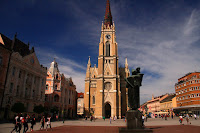 In the free time we have we wander round the streets,
and visit the Catholic Church in the central square (for there is a significant
minority Catholic community here). It’s a nicely designed hall church whose
aisle vaults reach the same height as the central nave.
 But after the Orthodox
Church, it leaves us cold. There isn’t the same spirit of devotion here,
somehow, the same fervour, the same conviction. I can’t explain it, but for the
first time I begin to see what it is that many western Christians find so
appealing about Eastern Christianity. One of my theological students is now an
Orthodox priest, while another has made the journey there and come back to
Anglicanism, albeit enriched by his experience. I recall my discussion with our
Bulgarian young guide Peter on the coach, how he complained that his Catholic
upbringing gave him no hint of the rich treasures of mystical prayer that
Orthodoxy had opened up for him. There’s a clear lesson for us practitioners
of western Christianity. Whatever else it is, it
needs to be more impassioned, more affective, less milk-and-water, less sweetly
reasonable, less afraid of touching and changing lives. This, I imagine, is what lies behind these
"Thy Kingdom Come" days between Ascension and Pentecost that we are travelling
through at this precise time.
 Back on the ship I sit by the open window and gaze out at
the river. It’s a lazy, sultry afternoon. We’ve already had one thunderstorm
today, but the cumulonimbus is piling up again and promises more to
come. A push-tug propels a heavy load of barges upstream at barely more reaching
walking pace against a fierce current energised by the recent downpours. This
journey is almost at an end. We have come a long way together, and I’m clear
that my writing about it is only the beginning of the search for understanding
what it may mean for my own Europeanism and my grasp of this continent’s past,
present and future. There is so much I realise I don’t know. What wasn’t I
paying attention to all these years? Why has this closed book of Eastern Europe
only now begun to open for me, in just the same way as classical Greece did
last autumn?
But there is still time for curiosity and discovery even
this late in life. “Old men should be explorers” said Joseph Haydn in old age,
a man from the golden age of imperial Austria-Hungary whose ear for the natural
world was so well-tuned and whose music, therefore, must have been inspired by
the Danube that flowed through the landscapes that he loved. I
hope I can live and die as an explorer of the spirit. A voyage like this is the
best possible metaphor, as it is the best possible stimulus too.

 Monday 3 June
We wake up early to a lot of noisy movement going on round
the ship. We are back in the Iron Gate Lock - the upper system where (going
upstream) the ship is lifted a full 40 feet while the mountain suddenly close
in all round, the Carpathians on the Romanian side to the north, the Balkans to
the south. This right bank is now Serbia, as I find having had a
text message to say that I have left my mobile phone’s roaming switched on and
have incurred unintended internet costs. I hastily turn it off where it will
stay until we renter a friendly EU country.
 It is overcast but the scenery all round is magnificent -
grander than I remember it a week ago when we were sailing downstream. I
imagine we are gliding along a Norwegian fjord, the surface of the water calm
and deep and still, unruffled save for our vessel that cuts its path cleanly
through the mirror leaving behind two beautiful hyperbolas of glassy waves that
curl their way to the shore on either side. Providence arranges that I am on
the correct side of the ship when I suddenly notice the famous Roman tablet,
the “Tabula Traiana” set into the cliffs just above the surface of the water. I
had missed this completely on the way down. It commemorates the Emperor Trajan
(one of the good ones, Hadrian’s predecessor and champion) who built his road
along the side of the canyon so that traffic could avoid navigating the
river on this deadly stretch of rapids, whirlpools and
cataracts. Just a little further up, Decabolos grabs everyone’s attention once
again, together with the beautiful little monastery at the water’s edge, its
petite towers setting off this marvellously dramatic stretch of the Danube to
perfection.
Our expedition today is the Mesolithic site of Lepenski Vir.
It would be nice to think that everyone who reads this blog has heard of this
remarkable place. I certainly hadn’t. Yet it can claim to be one of the most
important Stone Age sites in the world. Dating from 9000-6000 BCE, just after
the glaciers had started to retreat, Lepenski Vir is possibly the earliest city
in the world, not only in terms of its social and economic organisation but its
traditions of art and sculpture.

 The 600 metre red porphyric rock called Treskavac rears up
dramatically above the original site on the left bank. It dominates this
stretch of the river, glowing spectacularly when the summer sun is setting on
it. This seems explain why this part of the Danube was settled by nomads who
decided to adopt the settled life of hunter-gatherers. It no doubt carried
religious and totemic significance as it guarded the settlement as well as
providing a navigational point of reference and, not least, acting as a
lightning conductor due to the strong iron content of the rock. It’s also
suggested that this stretch of the river was especially rich in nutrients and
therefore fish because of how the water was stirred up by the rapids and
whirlpools of the Iron Gate Gorge.
All this is in the past tense, because the original
archaeological site no longer exists. Along with others in the gorge, it was
flooded in the 1970s following the construction of the hydro-electric Iron Gate
Barrage through which we have passed today. The dam has been blamed for the
destruction of so much that was unique to the gorge, not just the natural river
conditions but the towns and villages that had been established in the shelter
beneath the crags since antiquity. The loss to archaeology was incalculable.
I’ve already mentioned Trajan’s road, now under several metres of water. But
paradoxically, Lepenski Vir might never have been discovered had it not been
for the extensive archaeological surveys that the construction of the dam
precipitated between 1965 and 1970. Of the middle Stone Age sites, LV was
reckoned to be the most important and the best preserved.

 Removed to a higher level upstream, but still in clear sight
of the rock, LV is now contained in a striking iron-framed glass structure a
bit like a vast greenhouse. It’s a distant cousin of the Sage, Gateshead, also
on the south bank looking north across a great river. The foundations of the
trapezoidal houses are laid out on concrete foundations (yes, concrete! - we
forget how ancient this material is, and how the Romans exploited it in the
construction of some of their greatest buildings such as the Pantheon). Outside
the museum is a model of how one might have looked with thatched roof, a low
entrance and an opening above to release smoke from the fire burning inside.
Round the foundations of some of these houses are triangular designs, now
established as representing the numbers of generations that have lived in each
house. One has no fewer than nine of them.
The highlight of this memorable museum is the gallery where
excavated artefacts are displayed. A human skeleton shows the height to which
the men at LV grew - up to six feet, which contradicts the oft-quoted
assumption that in prehistory, people did not grow very tall because they were
not as well nourished as in historical times. Our guide speculates on the role
a healthy diet may have played in this. It’s clear that the people of LV only
ate fish, nuts and vegetables, probably not meat (or not much) and remarkably,
not fruit or berries, thus subsisting on a diet free of both animal fats and
sugars, yet still high in proteins. Maybe we should imitate them?
 But best of all in the gallery are the sculptures. Some are
purely decorative, geometric lattice patterns carved into the stone and
bringing it to life by imparting depth and texture. Others are busts of human
beings. I’m not sure if their significance has been fully understood yet. They
may depict heads of families or communities. They may represent ancestors to be
honoured. They may have religious significance symbolising the gods. Whatever
the meaning, they are highly evocative, among the most beautiful artefacts
we’ve seen on this extraordinary journey.
A final reflection strikes me as we leave the site. When we
arrived we were shown a short film made in the late 1960s chronicling the
discoveries at Lepenski Vir. The quality is terrible and you have to wonder why
a presentation on a site of this importance isn’t graced by something a lot
slicker and better. Yet it’s done with a lightness of touch that’s endearing.
To begin with, we see archaeologists shunning the camera crew as if to say, we are
experts here, not entertainers. By the end, having uncovered their marvellous
finds, they are filmed laughing and dancing in satisfaction for a project
that’s proved so rewarding. Many of this talented team of Serbian
archaeologists of more than half a century ago will now be dead. They have
joined the people of Lepenski Vir as those who are remembered but gone from us
into the shadowlands of death. I’m sobered by that thought about my own
mortality triggered a yellowing grainy film whose prehistoric stars still speak
to us so long after they have left the stage for good.

On getting back we wander round the village where we are
berthed. The whole of it was built to replace its flooded forebear, but it’s
been done with charm and with a thought to preserving a sense of scale. Pretty
pantile roofs everywhere, shops, cafes and leafy streets where children are
playing. In the church, paintings retrieved from the old building on the
riverbed are now displayed among the icons. A rusting steam engine from the nineteenth
century stands in front of the town hall - its wheels are without flanges and
it has a huge flywheel attached to its smoke box so was it a stationary engine
that used to haul ships by ropes up the canyon in this dangerous gorge? There’s
a market happening alongside it where beautiful fabrics are for sale at
ridiculous (to us) prices. I buy J a
coral-red silk scarf, but it’s the lace that catches everyone’s eye. I think of
my high church friends in the UK who would die for this.
Our impression is that Serbian villages are in better
shape than the Bulgarian villages we have seen downstream. Is this a
consequence of the different political history of Tito’s Yugoslavia that
bravely stood outside the bleak mainstream of Eastern European communism? Our
guide, like her two predecessors in Serbia, is keen to talk up her country.
“Tourism is very important to us n that we are recovering from the difficult
times of the 1990s.” Yet she allows no time for questions that might
probe this enigmatic statement. “Difficult times” is a euphemism for a brutal
war in which Serbia played a central part and whose nationalistic leaders
brought untold suffering through their policies of ethnic cleansing in Bosnia
and Kosovo.
It’s a deeply unhappy story, but Serbia seems not to be able
to speak about it in the way that, say, Germany is able to acknowledge its role
in the last war in a mature and reflective way. The ethnic fault lines that lay
across the Balkans in the 1990s still exist, just as the geological fault lines
do in this earthquake zone. Maybe EU membership on the part of some or all of
the Balkan nation’s May bring about a lasting peace. We haven’t heard about
that either, here in Serbia. Tomorrow we are in Novi Sad, Serbia’s second city.
Who knows what we’ll learn there in a place that experienced severe NATO
bombing in an attempt to deter the bellicose Serbs from their hostile activity
against their neighbours?
 Sunday 2 June
We sail into the port of Vidin on the right (Bulgarian) bank of the river. An impressive new road-rail bridge across the Danube linking Bulgaria to Romania was completed in 2013. It replaced the car-ferry which could not reliably run either in cold winters because of ice, or in dry summers because of lowered water levels. At such times, road traffic would need to detour through Rousse 190 miles downstream to take the only other Danube crossing, the "Friendship Bridge" connecting the two countries. On the lower Danube, all distances are huge by western European standards, whether it's to travel up and down along the river banks or to get across this mighty river.
We set out for the little town of
Belogradchik in the foothills of the Balkans. Our guide this time is a woman
who is not only Anglophile but has a distinctly British love of irony and
word-play. Once again we hear the take of a native Bulgarian on the history of
her country. But she is more outspoken than her predecessors in the
countries we’ve visited. As we leave Vidin she points out the effects communism
has had on her town. Once upon a time, she says, this was a jewel of the Lower
Danube, a stylish, beautiful riverside resort full of churches and mosques,
narrow streets and fine houses, a place that encapsulated the best of the
river’s rich, complex history from antiquity and the Christian Middle Ages through the
Ottoman centuries to the Victorian age of elegance. One book I’ve read says it
was once a magical town on the Danube where you first caught a whiff of the
Orient. “Now look at it!” she scorns as we drive past an unending sequence of
derelict socialist-realism factories, office buildings and apartment
blocks. Is there anything more depressing in the repertoire of human assault on
a townscape than concrete that has been abandoned? “If you want to know why we
hate communism so much, just visit Vidin.”
 We leave it behind us and head for the blue uplands on the
horizon. Rust-and-concrete grey gives way to lush greens. The cumulus is towering ominously. The road is torturous but well
engineered, and our driver is skilful. Your first view of Belogradchik is
across a deep forested valley. “There’s only one building in this town not to
like” announces our guide, “and that’s the socialist telephone exchange”. But
we don’t pay much attention to this charmless building so out of scale with the
intimate architecture of this town. What holds the attention from miles away is
the extraordinary acropolis that sits at the very top of this hilltop town. A
vast citadel built among red sandstone crags that tower above the
fortifications like giants’ teeth. It’s an unforgettable apparition.
 However, the sky is darkening ominously. “I pray that God
will preserve us from light (sic) and thunder this afternoon” she warns, all
irony gone. “There is iron in these rocks. If an electrical storm happens, and
hopefully it won’t, keep away from them for safety’s sake.” Through the
medieval gateway, we see a path snaking up a series of steps to another gateway
high up, then more steps to the crags at the very top. This adventure is not
for everybody. But even from the entrance you can take in the magnificent
spectacle of fortifications that are probably unique in Europe.
Known by the Ottomans as Kaleto ("the fortress"), the citadel was created in Roman times as a defensive structure to control the Danube plain at the northern edge of empire. It was remodelled in Ottoman times, and a splendid curtain wall added. We climb up and reach the middle gateway. The sky
ahead behind the towering rocky pinnacles is getting darker by the minute. But this is not a time
for faint-heartedness. We strike out again, onwards and upwards until we reach
the summit. From here there is a magnificent 360 degree panorama over
the mountains to the south and the lowlands to the north, with the town
(and telephone exchange) as foreground. But most spectacular of all is the sky
to southward, blue-black, brilliantly setting off the red rocks rearing up all
around us. It’s a photographer’s dream, this dramatic sky that so perfectly
echoes the dramatic landscape.
 But there is lightning in those clouds, and the first oily
drops of rain. We need to get off these rocks quickly. But like the summit of
Everest, traffic in both directions has to pass through a gully where the
steps are steep and narrow and only one person can get through at a time.
Some of our companions are not as fleet of foot as we (still) are, so there is
a queue to get off the acropolis, not a long one but enough to concentrate the
mind as the storm begins. Meanwhile a party of schoolchildren is on its way up.
They crowd inside the upper gate for shelter just as I reach the lower bastion, and the
heavens open.
The drive back to Vidin is eventful for the number of heavy
trucks that have appeared on the road, heading towards Sofia. It is narrow and
sinewy and the risks taken by some of these drivers anxious to make progress
are worrying. We round a bend and there directly in front of us is one big truck overtaking another. A head-on collision is averted but it’s a nasty moment. But
there’s a good moment later on. Our guide spots a stork in its nest at the top
of a pole guarding its young. We stop and enjoy the sight for a full five
minutes, a simple pleasure that is touching for its sweetness.
 Back in Vidin, we drive round the city. Our guide continues
her architectural survey of the depredations of communism on her native town while picking out
surviving buildings of beauty such as three houses from the Ottoman era, one of
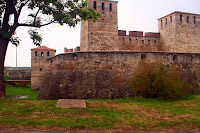
which has been lovingly restored by its owner. We walk to the medieval bastion, the Baba Vida fortress that guards the river upstream of the town. Its mighty curtain walls and towers testify to the threat posed to western Bulgaria by Serbia in the late middle ages. The nearby synagogue
is singled out for comment. This fine large late nineteenth century building is
ruinous now - emigration to Palestine after the war largely emptied Vidin of its Jews. But our guide tells us proudly that Bulgaria was the only state in Eastern
Europe that did not hand its Jews over to the Nazis to be deported and murdered. I find out later that this statement, while true, needs qualification. As an Axis power, Bulgaria was forced to collaborate with the deportation and murder of non-Bulgarian Jews resident in the country. However in 1943, a public outcry supported by both King and Church led to Jewish deportations being halted before any Bulgarian Jews had been transferred to the Germans. This only became generally known after the end of communism in 1989. It's a very different story from Romania and Hungary.
 While everyone else gets back on board ship, I wander round
the town centre alone with my camera. Children are playing round the grim
buildings that front the river, something you see all over Eastern Europe in
the way you used to in Britain in the 1950s and 60s when my generation was
growing up. Our guide has already commented on this, saying that smart phones
and computer games have yet to take over the lives of the young in the way they
have in the west. They laugh and giggle as I photograph them, then line up to
pose and wave merrily at me. “Hola” they shout, “hi!” And I can’t even say
hello or thank you back to the, in Bulgarian!

 This is one of the grimmest urban environments I’ve seen
on this cruise, so much the worse because of what was destroyed to create it.
Rust, weeds, rotting concrete are everywhere. Even the river frontage, normally the
showpiece of every riparian settlement, is brutalised by socialist-realist
buildings that are not only ugly in themselves but disproportionate in their
scale. The railway station seems to be an exception to this rule, contemporary,
clean, functionally elegant - but then I step inside the ticket hall that
fronts the rectangular plaza as if to say, here at least is an attempt to do
something that will make the twentieth century worth remembering. It is
deserted and has every appearance of having also been long abandoned. I may be
wrong about this - after all, it is Sunday afternoon and no rail movements are
due for a while. But as I look up at the destination indicator, my eye is
caught by two pigeons staring down at me from their perch on top of the
board. This is our domain now, they seem to say. At least till Monday morning.
Outside the station is an object of genuine beauty. It’s a
bronze sculpture commemorating those who fell in the conflicts that have
plagued the Balkans for so many centuries. Here is a soldier looking down at
his own sword in sorrow for the suffering and death it has been responsible for
during his time of service. It symbolises the universal longing for peace that
achieves real poignancy. Here is humanity’s best self, undaunted by the
corrosive effects of living under one tyranny after another.
 Saturday 1 June
After last night’s storm, it is cool and overcast on the
river today. We have said goodbye to Romania and are berthed back at Rousse in
Bulgaria where we were last week. We drive for a couple of hours to Arbanassi,
a village in the foothills of the mountains that straddle the central part of
the Balkan Peninsula.
Our guide is a young man who combines seriousness of
purpose with a light touch, just right for the job. He tells us more about
Bulgaria, a country I’ve always regarded as somewhat mysterious, as if it keeps
itself hidden away on the south bank of the Danube. Once again I’m struck by the deeply rural character of
these rolling landscapes. As we saw before, there are hardly any
buildings between the villages - no farm buildings like you see in Western
Europe, or Romania for that matter. Here, villages have clear boundaries.
Outside them, the countryside is deep, tranquil, remote, “one of the
most peaceful areas to live in the w
hole of Europe” he says. He speaks about
the depredations of the communist era, how long it is taking for the country to
recover. This is a refrain we have grown used to: every guide has told the same story. But it’s
been illuminating to hear it from the personal perspective of each of them, whether
in Hungary, Serbia, Romania or here in Bulgaria. Part of that story is also the
persistence of Christianity in these eastern European countries. And Peter our guide
speaks about both of these with
particular intelligence.
 We arrive at Arbanassi as a folk festival is in full swing.
Pretty girls and young men in native costumes are dancing to pipe and accordion
music. All round are stalls selling food, drink and souvenirs including an enticing
collection of mugs with Soviet heroes ironically depicted on them. My heart
sinks at the thought of an hour of nostalgic Bulgarian folklorique.
 But this is not the plan. We walk through this showpiece
village with its display of pantile roofs till we get to the little church. It
is a revelation. It was built at the turn of the sixteenth and seventeenth
centuries in what was then a Greek speaking Christian enclave in Ottoman
Bulgaria. Outside, it is nothing special, though I notice the
unusual presence of the Star of David engraved in a stone immediately above the
west door. Peter takes this as a sign that the church may have provided shelter
for the Jewish community during times of persecution, though the church guide
who takes us round the building interprets it as a reminder that Jesus was
himself a Jew. I wonder.
What is remarkable about this this church is its
interior decoration. (I have no images to share: photography is not allowed inside.) Every inch of it is covered with paintings - the two
narthexes, one on the north side and one on the west, and the nave itself.
Walls and vault are, to resort to cliché, a riot of colour. Can there be a
single Bible story that is not depicted somewhere in this extraordinary church?
It would take detailed study to work out the narrative scheme, and time to
linger is what you never have on these group visits. But the guide does her
work well. She points out the Tree of Jesse, Moses and the prophets, and scenes from the nativity,
passion and resurrection. Pilate washing his hands is memorable because Jesus is depicted as immersed in the water basin as if to say, Pilate washes his hands not only of a dilemma but of the very
Lord himself.
On the east wall of the central narthex is the last judgment,
with a river of fire emanating from Christ’s throne, and immersed in it, an
archbishop in full regalia. The guide, clearly a devout believer, finds this amusing. To me, most thought-provoking of all is a line of twelve
Greek philosophers, among them Socrates, Plato, Aristotle and Homer (yes, not just
a poet but a purveyor of wisdom) haloed just like the saints and
angels all around. It speaks of a sophisticated world view that is
brave enough to see the presence of the divine even in the writings of pagans.
There’s a world of insight here about grace and culture, and how the church should be doing theology
and mission in the market-place where many faiths, ideas and world views clamour to be heard. I sense that these powerful paintings we have seen have had an effect on some members of our group. Is awe the right word to describe it?
 After lunch we stop at the nearby university city of Veliko
Tarnovo, “the city of Tsars” that is spread out across a remarkable site where
four steep-sided valleys meet. We gaze from afar at the remarkable monastic citadel with
its walls and towers (why isn’t there an opportunity to visit it?) before
walking the old town and climbing up some steep steps to visit the beautiful eighteenth century
church. Inside, an elderly woman is selling candles. Our guide buys one.
Before our next port of call there is time for me to ask our guide about something he has said to us earlier. He's told us that he was brought up as a Catholic but
had turned to Orthodoxy in adulthood. He explains that he went to Germany to study economics. There he embraced atheism until he realised
that life without faith was unrewarding and empty. He recognised that his
upbringing had not given him the mystical or liturgical richness of
Orthodoxy, and that as a Bulgarian, this was the native faith of his
people. So he decided to convert. I ask him if he has studied theology, for his account of his
spiritual tradition is lucid and convincing. He says he hasn’t, apart from his own reading. "Are you an ordinand then?" I persist. He laughs and says
I’m not the first person to ask him. “Who knows what God may intend?” he
says. And he asks me to pray for him.
I’ve mentioned
the visceral hatred eastern Europeans have for the years of communism, but I've also sensed a similar if less explicit aversion for the centuries of Ottoman rule that
coloured so much of their medieval and modern history. At the beginning of May Pope Francis paid a pastoral visit to Bulgaria. It proved problematic. He had requested a meeting with the Orthodox Church's leaders, and asked to pray with them. However, the Bulgarians would not receive him as a fellow faith leader,
only as a head of state to whom political, but not spiritual, courtesies were
due. On the other hand Pope Francis did meet
Muslim leaders and, I understand, took part in a shared act of prayer with them.
Peter supported the stance of the Bulgarian Church leaders both in not recognising the Pope's spiritual authority (because of the Great Schism between the eastern and western church), and in their insistence that Islam is incompatible with Christianity. They believe that Pope Francis was compromised by meeting the imams and this justifies the Bulgarian church leaders’ resistance to welcoming him as their spiritual peer. “But Judaism, Christianity and Islam are
Abrahamic sister faiths” I remonstrate. "Allah is the God whom Jesus called Father, whom all three faiths worship because of Abraham.” “Yes, but Allah is not a Trinity of three Persons”
comes the response. “How can there be any sharing of holy things if
you can’t agree about the Trinity?” The spectre of Ottoman Islam seems to haunt this exchange. So this response is not only typical of Orthodox theology but of a particular historic expression of it that is so coloured by its former subservient relationship with Islam.
My own Christianity feels very different, so western is it, so influenced by the Reformation and the Enlightenment, and with a very different religious history behind it. Yes, his
faith is more ancient than mine, and I honour that.
Maybe I envy the certainty with which he practises it. I hope I am not less passionate about my faith than he is. We would gladly recite the creeds together. But in other respects we inhabit worlds that are very different and have been for centuries. Yet it is a fascinating conversation not only for its warmth and candour, but for how it helps me understand religion in Eastern Europe.
 We detour and sink down from the green plateau into a deep
gorge. The yellow limestone cliffs rise up sheer from the valley bottom, an
arresting sight in its own right. But this is the land of the famous Ivanovo
rock churches, created in these cliffs by monks who sought solitude here in the
thirteenth century. We walk up to the top of the cliffs by a steep path. There
is a profusion of colourful wild flowers. The tree canopy, as we climb clear of
it, shows every possible shade of green. It’s marvellously fresh, vivid and
vibrant, this holy and verdant landscape we find ourselves walking in on this
first day of summer. As we walk, Peter talks to us about the monastic life. I
was not expecting to learn about hesychasm and the Jesus Prayer on a Riviera
cruise. There can't be many guides who can speak about mystical
spirituality and prayer from the standpoint of a practitioner and do it so genuinely, without a trace of self-consciousness.
 We contour along a pretty path until we reach some caves in
the rocks. Here the monks lived in their solitariness. The low roofs are
darkened by smoke from their fires or, equally probably, their candles. These
primitive dwellings precisely echo their forebears, the desert fathers of Egypt
a thousand years earlier who set the pattern for monasticism and whose rules of
life proved such an inspiration in the
formation of monasticism in both the east and the west. Presumably this was a
conscious harking back to a more primitive way of life. Did they know about the
Irish monks who followed these patterns too in isolated locations like Skellig
Michael? You’d be tempted to doubt it, yet Irish monasticism had well-travelled
origins across Central Europe. I think of Cuthbert on the Inner Farne finding
seclusion not to get away from the business of everyday life but to immerse
himself more deeply in its challenges, choices and contradictions. And to fight
evil in the name of his Lord - the world’s demons, his own. “Go into your cell,
and your cell will teach you everything.”
 A little further on we come to the rock church itself,
dedicated to Saint Michael, the guardian of these high places. There are more
than twenty of them hidden among these cliffs and crabs; this is the finest,
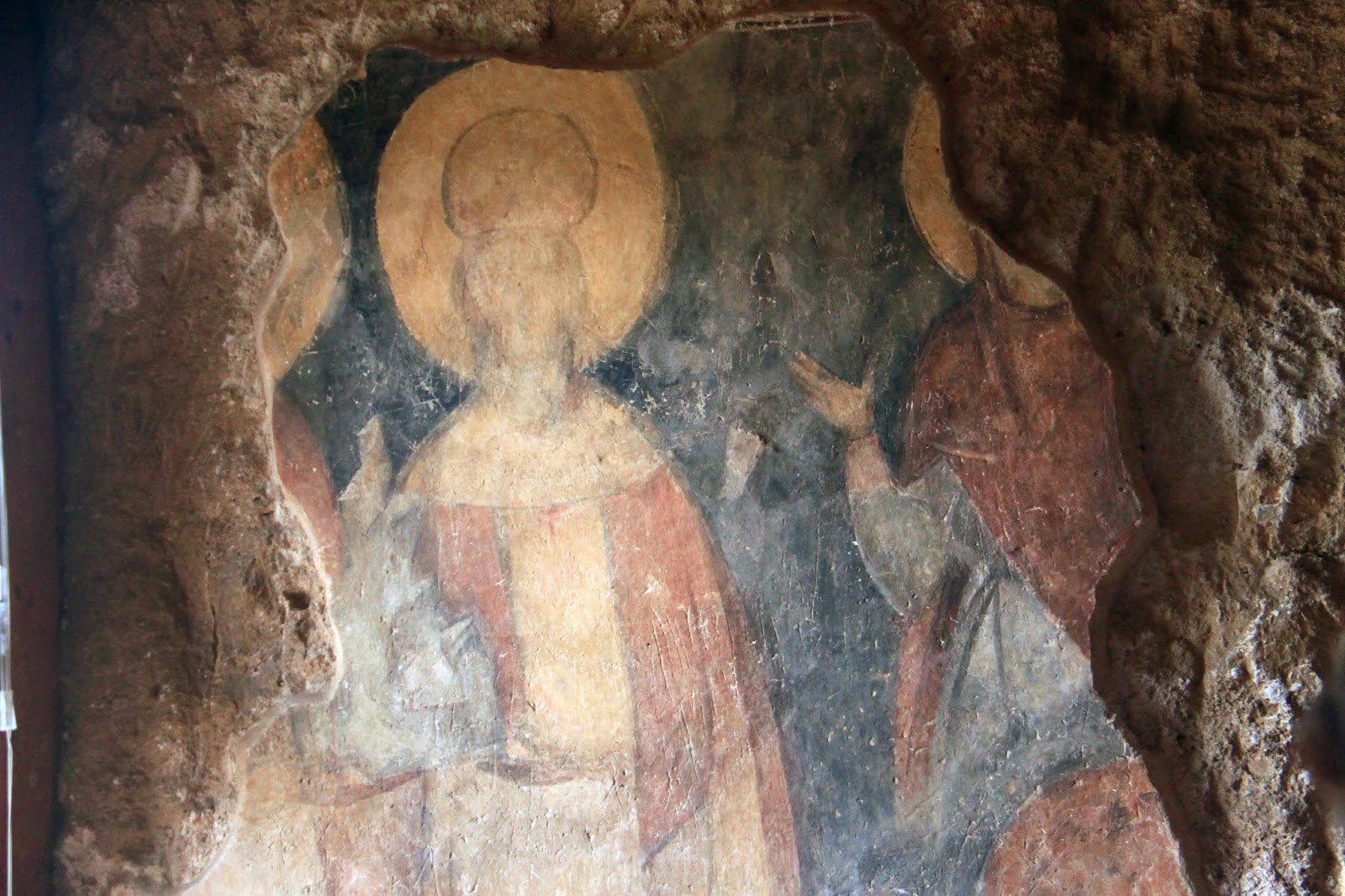
and the most visited. Like Arbanassi (but tiny, no larger than a monk’s cave),
its walls are covered with frescoes of Jesus, Mary and the saints. They take
you back to the devotion of these holy men, their willingness to forsake
everything for the sake of the gospel that called them into this life of
poverty and prayer. There is a little platform outside the cave (thoughtfully
supplied in modern times with a railing) on the cliff edge, with a sheer drop
below to the valley floor that it’s not good to look down on for too long. I
imagine a monk, stylite-like, perched on this space where there is barely room
for a human being to stand safely, totally still and silent in prayer, rapt
in contemplative communion with God.
 Then I look down at the ground. A metal rail has been inserted
across the cave’s opening in modern times, maybe to contain a door or window of
some kind. I look more closely at the lettering on the side. The message is
unmistakeable, announcing its place of origin. Middlesbrough. The
North East has come to Bulgaria. This calls for a photograph.
In the car park an elderly man is selling icons he has created (that's to say, "written") himself. I wish I could l could linger to buy one. But icons are prayers, windows on to heaven, and choosing one will not be hurried. It takes time because in truth, we do not choose the icon: the icon chooses us. And the coach and the ship will not wait.
But what a remarkable day it has been.

 Tuesday 4 June
 After breakfast the mist has cleared and we go out on deck
to enjoy the sunshine. We have now travelled beyond the Romanian border, so all
around it is Serbia. Pretty villages line the river bank on the south side
where a line of hills sweeps down to the river. The Danube is very high round
here. On the north bank, there is extensive flooding isolating horses, cattle
and pigs. Bird life is abundant, and a group of voyagers has gathered with
their field glasses and notebooks pointing out what’s to be seen - storks,
terns, Black-winged stilts, squacco herons, bee-eaters nesting in holes in sandy
banks, wagtails, little winged plovers, a white-tailed eagle, and even
golden orioles - heard but not seen.
 We draw in to Novi Sad. My guide book is unremittingly
negative about this once elegant Habsburg city, Serbia’s second largest with a quarter of million inhabitants. It suffered badly in
the Balkan wars, all three Danube bridges being destroyed in 1999. Our Serbian
guide corrects one misapprehension about this. It’s said that NATO bombed them
all. In fact, the bridge by Vauban’s citadel was blown up by Serbian forces
themselves to avoid offering up the citadel as a target for the bombers. Now
these three bridges have been rebuilt, the finest of them an “infinity” bridge
like Stockton’s, opened last year.
 We take a coach tour of the city, and there is more Serbian
history to go with it. Novi Sad (= "new orchard") is another very ancient settlement that became Roman Cusum when it was conquered and incorporated into the imperial province of Pannonia. We see Roman tombs outside the museum in which there is a good collection of antiquities. I wish we had time to look inside. In the centuries following the collapse of the Roman Empire, the city had a complicated history in which Hungarians, Slavs and later the Ottoman Empire all vied for control. In Habsburg days it was Ratzen Stadt, "Serb City".

 We walk round the centre. In the Orthodox Church our guide
explains that it is strongly influenced by western ecclesiastical architecture.
Completed only in 1903 rather in the style of a London Wren church, it has
stained glass windows, most unusual for a church in the east. She elaborates on
further differences between Orthodox and Catholic architecture and
spirituality, including an excursus on the Iconoclastic controversy in order to
explain why Orthodox churches are filled with paintings but have no sculpture.
The significance of the iconostasis is explained, as is the liturgy of
Orthodoxy with its Little and Great Entrances. And the importance of the
eastern tradition of standing throughout the liturgy. It’s good that all this
is spelled out to people who may be unfamiliar with the practices of the
Orthodox (or, for that matter, any other) Church.
 In the free time we have we wander round the streets,
and visit the Catholic Church in the central square (for there is a significant
minority Catholic community here). It’s a nicely designed hall church whose
aisle vaults reach the same height as the central nave.
 But after the Orthodox
Church, it leaves us cold. There isn’t the same spirit of devotion here,
somehow, the same fervour, the same conviction. I can’t explain it, but for the
first time I begin to see what it is that many western Christians find so
appealing about Eastern Christianity. One of my theological students is now an
Orthodox priest, while another has made the journey there and come back to
Anglicanism, albeit enriched by his experience. I recall my discussion with our
Bulgarian young guide Peter on the coach, how he complained that his Catholic
upbringing gave him no hint of the rich treasures of mystical prayer that
Orthodoxy had opened up for him. There’s a clear lesson for us practitioners
of western Christianity. Whatever else it is, it
needs to be more impassioned, more affective, less milk-and-water, less sweetly
reasonable, less afraid of touching and changing lives. This, I imagine, is what lies behind these
"Thy Kingdom Come" days between Ascension and Pentecost that we are travelling
through at this precise time.
 Back on the ship I sit by the open window and gaze out at
the river. It’s a lazy, sultry afternoon. We’ve already had one thunderstorm
today, but the cumulonimbus is piling up again and promises more to
come. A push-tug propels a heavy load of barges upstream at barely more reaching
walking pace against a fierce current energised by the recent downpours. This
journey is almost at an end. We have come a long way together, and I’m clear
that my writing about it is only the beginning of the search for understanding
what it may mean for my own Europeanism and my grasp of this continent’s past,
present and future. There is so much I realise I don’t know. What wasn’t I
paying attention to all these years? Why has this closed book of Eastern Europe
only now begun to open for me, in just the same way as classical Greece did
last autumn?