About Me

My photo
Pilgrim, priest and ponderer. European living in North East England. Retired parish priest, theological educator, cathedral precentor and dean.
Showing posts with label Christianity. Show all posts

Saturday, 18 January 2020

Haunted by the Holocaust, Haunted by Hope

This month marks the seventy-fifth anniversary of the liberation of Auschwitz on 27 January 1945. Holocaust Memorial Day is always a solemn occasion to make us stop and think. This year, perhaps, especially.

I was born a mere five years later. My father was a Londoner and my mother was from Düsseldorf in the German Rhineland, the second child of assimilated middle-class Jewish parents. She had been sent to England as a teenager in 1937 when the fate of Jews in Nazi Germany had become clear. She became a nurse and married my father after the war. The year I was born, her mother, my grandmother, followed her and settled in this country. She and my grandfather had fled for safety to the Netherlands after the outbreak of war. With the German occupation they were hidden underground and looked after by a pair of Dutch Christian women. My grandfather died shortly after liberation, but my grandmother, "Omummy", lived to a great age, it was said till she was 95 though no-one was quite sure.

In my early childhood we spoke German at home as well as English. I'm told my German had a pronounced Rhineland-Westphalia accent, for Omummy was from Cologne. She sang Schubert Lieder to me, and I began to pick out some of his simpler songs on the piano. Heidenröslein was one of them - a sweet little setting of a Goethe poem about unrequited love, how a beautiful flower, a rose, draws the blood of her admiring lover. Erlkönig was another, beyond my capacity of course to make sense of the furious piano part except the hammering octaves that picture a father's desperate ride as he tries to save his child from a delirious encounter with the dreaded "Elf-King". Goethe again.

That Romantic fusion of love, pain and death. I knew it in music before I understood that it was part of my own family history. Sensibly, my parents did not trouble us young children with the traumas of the recent past. My eyes began to be opened when I went to school in 1955. At first, when my mother came to collect me at the school gate, we would speak easily in both German and English. But soon, very soon indeed, I sensed that it wouldn’t do in postwar London to speak German in public. I don’t think anything was ever said, but I distinctly felt as children do, an atmosphere, odd looks, a coolness in the air. I dropped speaking German like a stone. And although I always understood it when my mother and grandmother were talking to each other, I only ever responded in English. Later on I was seduced by classical culture and Romance languages, and heartily wished that my pedigree had been part-French rather than part-German.

It was Christianity that first awoke the sense that my family origins mattered. As a chorister I would sing the Psalms and hear the scriptures read and preached about. As a teenager in the school Christian Union, I immersed myself in the Bible, learned to love it, and found myself amazed that for so long I had been ignorant of this semitic world in which Hebrew monotheism had been forged and in which Christianity had burst upon the world and taken shape. And into which I myself had been born! This story was mine! That moment of recognition came with the force of a real and life-changing disclosure. My Jewish identity (a legal fact in Rabbinic law, since my mother was Jewish) had become not just a matter of historical origin but of lived experience that made a difference to who and what I was as a person.

I began to read about the rise of the Nazis, the growth of antisemitism, the death camps. It was shocking to learn that members of my grandmother’s family, my family, had been deported to Auschwitz. It dawned on me that my grandmother and mother were extremely lucky to be alive, for given the survival rate of Jewish people brought up in Hitler’s Germany, they would have been expected to perish. Were it not for my grandparents’ foresight and the welcome given to German-Jewish refugees by the British government, I would not be here myself. Later I began to understand the ordeals of Holocaust survivors, not only during the Nazi era but since. And my own conflicts and struggles as a “second generation” survivor. As with all forms of cruelty and abuse, the effects are lifelong. You are always a survivor, even in the best and happiest of times.

********

Which is why Holocaust Memorial Day is a time when I want to revisit the past and try to understand. “Never again” is a fine aspiration, and an important one. But post-war history shows that even the so-called civilised world is far from owning it. The United Nations Convention of 1948 defines genocide as “acts committed with intent to destroy, in whole or in part, a national, ethnic, racial or religious group, as such”. Bosnia, Rwanda, Cambodia and Darfur are just a few of the names that haunt us from well-remembered decades when we saw the images on TV and in our newspapers and were powerless to do anything other than support victims in the aftermath of massacres of innocents. 

I used the phrase haunt us deliberately. I’m aware that as I grow older, I am more and more haunted by the genocide that is imprinted on my own family memory. It’s not my direct experience, thank God. But it feels as though it has become part of my personal take on things. It has given me a world view that is inevitably coloured by dark memories that function “as if” they were my own. I’m struggling to put this into words, to describe why its legacy in me is a profound pessimism about the ability, to say nothing of the collective will of humanity to save itself from instincts and drives that, unchecked, will inevitably destroy us. I recently read a vivid account of a field surgeon who had worked in theatres of conflict such as the Congo and Syria. The capacity in human beings to be cruel seems beyond belief. But it is real and it is terrifying. You only have to look at the images of photographer Don McCullin to see that. It doesn’t take much to inculcate a sense of both helplessness and hopelessness.

So haunted as I am, do I contemplate Holocaust Memorial Day with despair? It would be easy to be gloomy about this year’s seventy-fifth anniversary falling just four days before Brexit Day. The European Union stands as a project fundamentally designed after the last war to safeguard peace in a continent that had been bitterly fought over for centuries. “Never again!” What sense does it make in an increasingly fraught global environment to walk away from such a collaboration of nations and peoples? That remains my question, and I shall always believe, I think, that this is the biggest historical mistake my country has made in my entire lifetime.

Nevertheless, I must not give in to despair. By God’s grace I will not give in to it. Keeping hope alive seems to me to be one of the greatest gifts we human beings can offer one another as so many stories from the death camps testify. People often say to us God-botherers, “You’re so lucky to have faith. I wish I did”. The implication is that we expect God somehow to intervene, deliver us from times of trial, make things all right again. I tried to explain in my last blog why I don’t believe that any more. Religion can’t resort to magical thinking. Faith must “come of age”. There is no deus ex machina to rescue us from war, genocide, natural disaster or the climate emergency.

But I do believe that faith has the capacity to inspire and energise us to bring about personal transformation that makes a difference in the places in which we live and struggle and suffer, the worlds where we find ourselves to be desperate and afraid. At least, this is what I found when I turned to Christianity as a teenager and recognised myself as a child of Abraham. As I approach my eighth decade, that faith continues to sustain me. It binds me to people in every place who stand for truth against the lie. It affirms my solidarity with those across the world who care about justice, reconciliation and the healing of memories. It strengthens my will to stand alongside victims, not least in my own community who have found themselves at the receiving end of racism, sexual abuse, homophobic attacks and other hate crimes. And of course the antisemitism whose revival holds real and sinister echoes of Europe in the 1930s and the horrors it led to.

When you grow old, you’re increasingly aware that your journey is leading you towards an unknown region. Like Abraham, indeed, in all his perplexity, in all that he did not, could not, know. In him, says Genesis, all the world will find blessing. Does blessing happen as we begin to shed self-interest, travel more lightly, learn to look beyond ourselves? Is that how tragedy begins to purify our vision and despair is turned round? Is that how hope begins to be born? Is that how our longing for a better future for humanity begins to be shaped and to lead to action that could change the world?

I won’t answer these questions in my lifetime. But the story of Abraham and yes!, the anniversary of the liberation of Auschwitz point the way, offer a glimpse of what is life-affirming and good, reassure me that there is no shadow so dark that it cannot be penetrated by Light and Love. These are the gifts of the Christ Child that we celebrate in this season of Epiphany. They are life-giving, joyous and empowering. And that means I'm not only haunted by the Holocaust. I'm just as haunted by hope. Because it will not let me go.

Thursday, 24 October 2019

Ten Commandments for Brexit

I saw a tweet today from a finance company. "Ready for Brexit? Our ten-point checklist will help you get prepared. Act now to get the financial guidance you need. #LetsTalkBusiness." I retweeted it with a comment of my own. "Ready for Brexit? Nope. Are emotional and spiritual guidance on offer too?" No answer as yet. I wait in hope.

But while I wait, I'm thinking how important it is to cross this threshold with self-awareness and insight. Readers of my blog will know that I'm a Remain ultra. I believe that voting for Brexit was a terrible mistake for the nation to make. I think it is bound to have all kinds of consequences, mostly unforeseen, for the United Kingdom, not least the union of our four peoples. I can't see that any Brexit deal will benefit Britain as much as our present EU membership does. (And I write in North East England, destined to suffer the worst impact of any part of the UK in terms of its economy, manufacturing industry and employment.)

Nevertheless, I am realistic enough to recognise that Brexit is bound to happen with or without a deal whether it's in a week's time, a month's time or some time in the future. And while a big part of me will only be dragged kicking and screaming out of the European Union, a voice within tells me to get ready to leave as gracefully as I can. Not necessarily going gently into that not-so-good night, but at least trying to recognise that generosity is needed. It’s going to be hard. I'm addressing this blog to myself to begin with, and then to fellow Remainers who like me feel the pain of Brexit and yet want to go on living as good citizens, making the best of what seems like a thoroughly bad job.

So here's my answer to the question in my tweet. A ten-point checklist to help us get prepared emotionally, morally, spiritually. Ten Commandments for Brexit, if you like. #LetsTalkWisdom.

1 Understand the pain of loss.
Emotional intelligence is important here. For many of us, Brexit is a loss of identity and belonging the like of which we probably haven't experienced in our nation's life before. If you're like me you'll feel this loss in a surprisingly personal way. This is about me as well as us. So we should expect to experience the normal symptoms of bereavement such as denial, bewilderment, emptiness, anger, bargaining, depression - and maybe only much later, acceptance and resolution. The effects of Brexit on mental health have already been noted by some psychotherapists. We simply need to notice what we are going through, and be honest about it, at least with ourselves.

2 Don't feed anger and bitterness. Try to be positive.
Yes, we were lied to in the referendum campaign. This hasn't stopped since then. Inevitably we feel that the Brexit result, so finely balanced, was based on a false prospectus fed by the right-wing media. But there's nothing to be gained by nursing hurt feelings, still less by badmouthing those who misled the nation or colluded with them. We need to find healing in our nation if we are to have a future worth living for. Being positive can begin by celebrating the years we enjoyed EU membership and all the benefits it brought. Yes, we are sad beyond words to be leaving. We heartily wish we weren't. We are angry about it and are right to be. But we can resolve not to indulge in vengeful self-pity. Even in hard times, we can cultivate thankfulness. Let the power of grateful memory shed light on the way we navigate our path through this dark time of loss and grief.

3 Treat Brexiters with courtesy.
Loving my neighbour as myself is one of the two great precepts of the Torah, reiterated by Jesus in the gospels. We need to work hard at our relationships with Brexiters, and with former Remainers who have gone along with, even supported, the government's attempts to "get Brexit done". However much we may have been abused by Brexit campaigners, however easy it might have been to give back in kind, we should not compromise on respect and courtesy towards those with whom we profoundly disagree. Perhaps there are individuals to whom we need to say that we're sorry, and with whom we should try to be reconciled. It's beneath our self-respect to treat others with contempt and nurse our hatred. In a divided nation, dignity (= "worth") has been at stake during these past three years. Let's cultivate peace and friendship where we can. Let’s try to help one another speak our truth with gracefulness. And if Brexit unravels, let’s not crow "I told you so!"

4 Remain European in heart and mind.
Let's use language accurately. We are leaving the European Union but we are not leaving Europe. It matters that we go on thinking of ourselves as Europeans, and that this should continue to be a core part of our identity as British people. To be fair to Brexiters, this is a point many of them have been at pains to underline. Whatever our nation's political alignments in the future, nothing can rob us of being geographically, intellectually, culturally and spiritually at the heart of our continent. "No man is an island entire of itself." We are "part of the main". We need to affirm this ever more strongly after Brexit. Travel in Europe if you can; if not, travel in your mind and heart. We are Europeans, and always shall be.

5 Befriend EU nationals living and working in Britain.
There's a particular need right now to embrace the so-called "Three Million" from EU countries who are living among us in this country. Many of them continue to suffer great anxiety about their future, whether their application for residence in Britain will be granted, what their prospects for employment are. (And let's remember that British people resident in overseas EU countries are just as worried about the uncertainties they face, including the elderly who can't afford to move back to the UK but face big questions about their pensions and health care.) This of course is only part of our hospitality to and care for all who live among us who come from other parts of the world. We must use our imaginations and offer help and support where we can.

6 Keep the conversation about Europe alive.
Remainers are often told to take Brexit on the chin and move on. But it's wishful thinking to imagine that the debate about the EU will end on Brexit Day. On the contrary. Negotiating our future relationship with the EU, and reaching trade deals will take many years. This will guarantee that the EU will remain on the national agenda and in its consciousness for a long time to come. And I'm certain that our children's generation, frustrated beyond measure by the actions of their Brexiter parents in denying them the future they had taken for granted until 2016, will one day reopen the question of EU membership. This may happen sooner than we think. We should encourage them. We should support pro-European politicians and policies. Democracy is a conversation that never stops. There's nothing once-for-all about Brexit.

7 Challenge fake news about the European Union.
The rhetoric of the far right will continue to trumpet "taking back control" and play down the intangible benefits of EU membership such as promoting human rights and the rights of working people, sharing in the project of peace-building across the continent, collaborating in our response to the climate emergency, working together on programmes to tackle crime, slavery, trafficking, sexual exploitation and maintaining security. As good Europeans we must go on championing the EU's efforts to build a better world not just for its twenty-seven nations but for all human beings. That means challenging the lies and half-truths that will continue to bolster those who try to demonstrate how Brexit has been the salvation of Britain. The case for the EU still needs to be made, even if, for now, we shall have to help make it as fellow-travellers rather than citizen-members.

8 Play your part to make sure that Britain remains an outward-looking country.
The referendum mantra, "what's best for Britain" was an invitation to indulge the worst of self-serving attitudes. To love our neighbour means to look for the welfare of others as well as ourselves, or as the Golden Rule says, to do for them what we would want them to do for us. In the reciprocity of mutual service and self-giving lies our flourishing. What's best for us turns out to be what's best for others too. The nations of the United Kingdom, the European Union and the Commonwealth understand this mutuality and attempt to live by it, even if the reality falls short of the aspiration. Given the environmental and geopolitical threats we face, our race only has a future if we cultivate the love of neighbour among the world's peoples. To become insular, as we risk doing because of Brexit, would be to walk away from the global responsibility our nation has historically understood to belong to its vocation. EU membership was a test of our capacity to look beyond our borders to the welfare of other peoples and, ultimately, to the flourishing of the human family. It would be the death of this humane, fair-minded, civilised country if we abandoned that large and generous vision for the world and looked only to the interests of our own people.

9 Don't be nostalgic. Live in the present.
We can't know what life will be like once we've crossed the Brexit threshold. In these days of the so-called end-game, it may feel like going into a kind of exile. Nostalgia is literally, aching for home. Exiles wouldn't be human if they didn't experience it. But when Jeremiah tried to help his people make a good exile far from their homeland, he told them to invest in their present, not the past. "Build houses and live in them; plant gardens and eat what they produce...Seek the welfare of the city where I have sent you into exile, and pray to the Lord on its behalf, for in its welfare you will find your welfare" (Jeremiah 29.1-7). This should be our attitude for the years we shall live on Brexit Island, be they many or few. Investing in the present opens us to its possibilities. We learn to live, not out of regret for the past but attentive to the here and now. We are always the better for doing that.

10 Don't lose heart. And say your prayers.
I think this is the most important principle of them all. Brexit may have driven us to the brink of desperation, but we refuse to give up hope. What God means by this cataclysm that has overtaken our nation only he knows. It's beyond our understanding. But we mustn't succumb to despair. So we say our prayers for the family of humanity, for our European friends and neighbours, for our nation and for ourselves. We are not expecting God to save us from ourselves and the consequences of our decisions. But prayer affirms that God has not abandoned his world. To pray is to stand in hope and solidarity with the world in all its suffering and to ask what its healing and flourishing would mean. And then to commit ourselves to whatever actions arise from our having glimpsed our human condition from a larger and deeper perspective. Contributing towards a better, more wholesome politics in our nation is one way. "What matters for prayer is what we do next." That's how to keep the flame of hope burning and not lose heart.

Tuesday, 11 June 2019

Blue Danube to Black Sea Day 8: Churches of Bulgaria

Saturday 1 June
After last night’s storm, it is cool and overcast on the river today. We have said goodbye to Romania and are berthed back at Rousse in Bulgaria where we were last week. We drive for a couple of hours to Arbanassi, a village in the foothills of the mountains that straddle the central part of the Balkan Peninsula.

Our guide is a young man who combines seriousness of purpose with a light touch, just right for the job. He tells us more about Bulgaria, a country I’ve always regarded as somewhat mysterious, as if it keeps itself hidden away on the south bank of the Danube. Once again I’m struck by the deeply rural character of these rolling landscapes. As we saw before, there are hardly any buildings between the villages - no farm buildings like you see in Western Europe, or Romania for that matter. Here, villages have clear boundaries. Outside them, the countryside is deep, tranquil, remote, “one of the most peaceful areas to live in the w 
hole of Europe” he says. He speaks about the depredations of the communist era, how long it is taking for the country to recover. This is a refrain we have grown used to: every guide has told the same story. But it’s been illuminating to hear it from the personal perspective of each of them, whether in Hungary, Serbia, Romania or here in Bulgaria. Part of that story is also the persistence of Christianity in these eastern European countries. And Peter our guide speaks about both of these with particular intelligence.  

We arrive at Arbanassi as a folk festival is in full swing. Pretty girls and young men in native costumes are dancing to pipe and accordion music. All round are stalls selling food, drink and souvenirs including an enticing collection of mugs with Soviet heroes ironically depicted on them. My heart sinks at the thought of an hour of nostalgic Bulgarian folklorique.

But this is not the plan. We walk through this showpiece village with its display of pantile roofs till we get to the little church. It is a revelation. It was built at the turn of the sixteenth and seventeenth centuries in what was then a Greek speaking Christian enclave in Ottoman Bulgaria. Outside, it is nothing special, though I notice the unusual presence of the Star of David engraved in a stone immediately above the west door. Peter takes this as a sign that the church may have provided shelter for the Jewish community during times of persecution, though the church guide who takes us round the building interprets it as a reminder that Jesus was himself a Jew. I wonder.

What is remarkable about this this church is its interior decoration. (I have no images to share: photography is not allowed inside.) Every inch of it is covered with paintings - the two narthexes, one on the north side and one on the west, and the nave itself. Walls and vault are, to resort to cliché, a riot of colour. Can there be a single Bible story that is not depicted somewhere in this extraordinary church? It would take detailed study to work out the narrative scheme, and time to linger is what you never have on these group visits. But the guide does her work well. She points out the Tree of Jesse, Moses and the prophets, and scenes from the nativity, passion and resurrection. Pilate washing his hands is memorable because Jesus is depicted as immersed in the water basin as if to say, Pilate washes his hands not only of a dilemma but of the very Lord himself.

On the east wall of the central narthex is the last judgment, with a river of fire emanating from Christ’s throne, and immersed in it, an archbishop in full regalia. The guide, clearly a devout believer, finds this amusing. To me, most thought-provoking of all is a line of twelve Greek philosophers, among them Socrates, Plato, Aristotle and Homer (yes, not just a poet but a purveyor of wisdom) haloed just like the saints and angels all around. It speaks of a sophisticated world view that is brave enough to see the presence of the divine even in the writings of pagans. There’s a world of insight here about grace and culture, and how the church should be doing theology and mission in the market-place where many faiths, ideas and world views clamour to be heard. I sense that these powerful paintings we have seen have had an effect on some members of our group. Is awe the right word to describe it?

After lunch we stop at the nearby university city of Veliko Tarnovo, “the city of Tsars” that is spread out across a remarkable site where four steep-sided valleys meet. We gaze from afar at the remarkable monastic citadel with its walls and towers (why isn’t there an opportunity to visit it?) before walking the old town and climbing up some steep steps to visit the beautiful eighteenth century church.  Inside, an elderly woman is selling candles. Our guide buys one.  

Before our next port of call there is time for me to ask our guide about something he has said to us earlier. He's told us that he was brought up as a Catholic but had turned to Orthodoxy in adulthood. He explains that he went to Germany to study economics. There he embraced atheism until he realised that life without faith was unrewarding and empty. He recognised that his upbringing had not given him the mystical or liturgical richness of Orthodoxy, and that as a Bulgarian, this was the native faith of his people. So he decided to convert. I ask him if he has studied theology, for his account of his spiritual tradition is lucid and convincing. He says he hasn’t, apart from his own reading. "Are you an ordinand then?" I persist. He laughs and says I’m not the first person to ask him. “Who knows what God may intend?” he says. And he asks me to pray for him.

I’ve mentioned the visceral hatred eastern Europeans have for the years of communism, but I've also sensed a similar if less explicit aversion for the centuries of Ottoman rule that coloured so much of their medieval and modern history. At the beginning of May Pope Francis paid a pastoral visit to Bulgaria. It proved problematic. He had requested a meeting with the Orthodox Church's leaders, and asked to pray with them. However, the Bulgarians would not receive him as a fellow faith leader, only as a head of state to whom political, but not spiritual, courtesies were due. On the other hand Pope Francis did meet Muslim leaders and, I understand, took part in a shared act of prayer with them.

Peter supported the stance of the Bulgarian Church leaders both in not recognising the Pope's spiritual authority (because of the Great Schism between the eastern and western church), and in their insistence that Islam is incompatible with Christianity. They believe that Pope Francis was compromised by meeting the imams and this justifies the Bulgarian church leaders’ resistance to welcoming him as their spiritual peer. “But Judaism, Christianity and Islam are Abrahamic sister faiths” I remonstrate. "Allah is the God whom Jesus called Father, whom all three faiths worship because of Abraham.” “Yes, but Allah is not a Trinity of three Persons” comes the response. “How can there be any sharing of holy things if you can’t agree about the Trinity?” The spectre of Ottoman Islam seems to haunt this exchange. So this response is not only typical of Orthodox theology but of a particular historic expression of it that is so coloured by its former subservient relationship with Islam. 

My own Christianity feels very different, so western is it, so influenced by the Reformation and the Enlightenment, and with a very different religious history behind it. Yes, his faith is more ancient than mine, and I honour that. Maybe I envy the certainty with which he practises it. I hope I am not less passionate about my faith than he is. We would gladly recite the creeds together. But in other respects we inhabit worlds that are very different and have been for centuries. Yet it is a fascinating conversation not only for its warmth and candour, but for how it helps me understand religion in Eastern Europe.

We detour and sink down from the green plateau into a deep gorge. The yellow limestone cliffs rise up sheer from the valley bottom, an arresting sight in its own right. But this is the land of the famous Ivanovo rock churches, created in these cliffs by monks who sought solitude here in the thirteenth century. We walk up to the top of the cliffs by a steep path. There is a profusion of colourful wild flowers. The tree canopy, as we climb clear of it, shows every possible shade of green. It’s marvellously fresh, vivid and vibrant, this holy and verdant landscape we find ourselves walking in on this first day of summer. As we walk, Peter talks to us about the monastic life. I was not expecting to learn about hesychasm and the Jesus Prayer on a Riviera cruise. There can't be many guides who can speak about mystical spirituality and prayer from the standpoint of a practitioner and do it so genuinely, without a trace of self-consciousness.

We contour along a pretty path until we reach some caves in the rocks. Here the monks lived in their solitariness. The low roofs are darkened by smoke from their fires or, equally probably, their candles. These primitive dwellings precisely echo their forebears, the desert fathers of Egypt a thousand years earlier who set the pattern for monasticism and whose rules of life proved such an  inspiration in the formation of monasticism in both the east and the west. Presumably this was a conscious harking back to a more primitive way of life. Did they know about the Irish monks who followed these patterns too in isolated locations like Skellig Michael? You’d be tempted to doubt it, yet Irish monasticism had well-travelled origins across Central Europe. I think of Cuthbert on the Inner Farne finding seclusion not to get away from the business of everyday life but to immerse himself more deeply in its challenges, choices and contradictions. And to fight evil in the name of his Lord - the world’s demons, his own. “Go into your cell, and your cell will teach you everything.” 

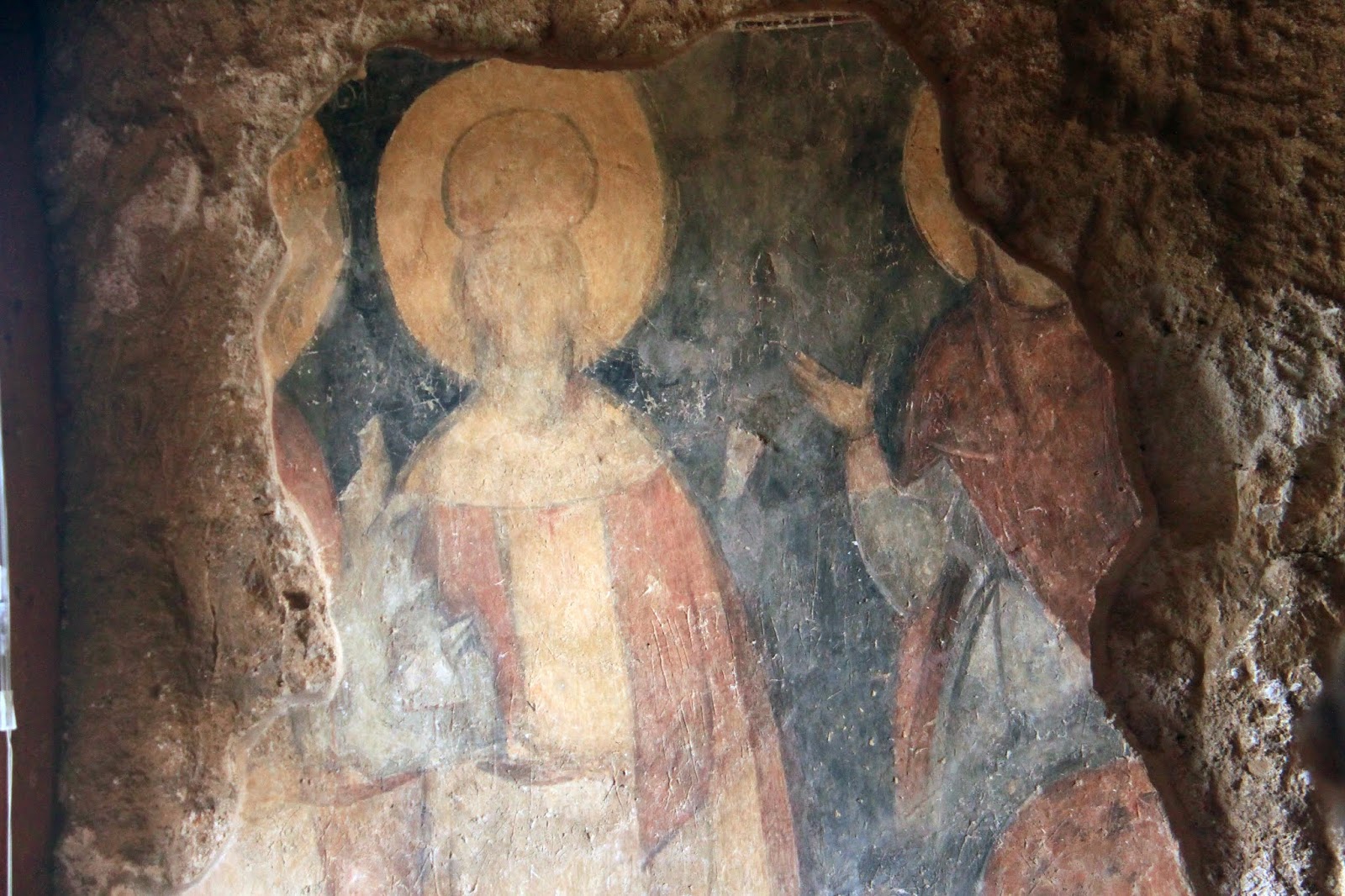
A little further on we come to the rock church itself, dedicated to Saint Michael, the guardian of these high places. There are more than twenty of them hidden among these cliffs and crabs; this is the finest, and the most visited. Like Arbanassi (but tiny, no larger than a monk’s cave), its walls are covered with frescoes of Jesus, Mary and the saints. They take you back to the devotion of these holy men, their willingness to forsake everything for the sake of the gospel that called them into this life of poverty and prayer. There is a little platform outside the cave (thoughtfully supplied in modern times with a railing) on the cliff edge, with a sheer drop below to the valley floor that it’s not good to look down on for too long. I imagine a monk, stylite-like, perched on this space where there is barely room for a human being to stand safely, totally still and silent in prayer, rapt in  contemplative communion with God.

Then I look down at the ground. A metal rail has been inserted across the cave’s opening in modern times, maybe to contain a door or window of some kind. I look more closely at the lettering on the side. The message is unmistakeable, announcing its place of origin. Middlesbrough. The North East has come to Bulgaria. This calls for a photograph.

In the car park an elderly man is selling icons he has created (that's to say, "written") himself. I wish I could l could linger to buy one. But icons are prayers, windows on to heaven, and choosing one will not be hurried. It takes time because in truth, we do not choose the icon: the icon chooses us.  And the coach and the ship will not wait.

But what a remarkable day it has been.

Friday, 17 May 2019

A Pilgrimage to Santiago

I am writing this blog on the train, heading homewards from Cardiff. I’ve spent this week with clergy from the Diocese of Llandaff. Not in Wales, but in Santiago de Compostela in Spain. Bishop June Osborne had invited me to travel with her group of over one hundred people who were making this pilgrimage as their clergy school. It was part of the Diocese’s preparation for the Year of Pilgrimage that begins next year, when the Church in Wales marks the centenary of its disestablishment.

My brief was to offer a daily Bible reading on the theme of pilgrimage. You can read my four addresses at http://northernambo.blogspot.com. I decided to draw on St Luke’s Gospel to help us make connections between pilgrimage down the centuries and our lives today. The first address was on “Pilgrimage and the Offering of Life” where we looked at the child Jesus in the temple. The second, “Pilgrimage and Truth-Seeking” was based on the story of the temptations in the wilderness. The third, “Pilgrimage and Pain” drew on the journey Luke describes Jesus as making as he “turned his face towards Jerusalem”. And the final address on the Emmaus Road resurrection story explored Jesus as our contemporary who, known or unrecognised, walks with us on pilgrimage.

The great thing about the week was the freedom the Bishop gave us to engage with Santiago in our own way. What mattered, she said, was to be together. There was daily worship of course - bilingual Welsh/English, echoing the bilingual culture of our Galician hosts where they speak both Spanish and Gallego: I loved that. There were shared meals enjoyed together (including, on the last evening, a conference dinner in the legendary Parador opposite the Cathedral). There were sessions with visiting speakers on pilgrimage in Wales, pilgrimage with children and resources for promoting pilgrimage in local churches. And many memorable conversations. And lots of laughter. But much of each day was deliberately kept free: to walk (if you wanted to), explore the city (if you wanted to), read (if you wanted to) or simply benefit from a gentler pace of life away from the pressures of “ordinary time”.

It was not my first visit to the great pilgrimage city of Santiago. Jenny and I had been there in 2006 when we drove slowly and reflectively along the entire length of the Camino from one of its traditional starting points in France, Vézelay. And back again, along a different route. We’d stopped at the churches and shrines, said our prayers and lit candles. We’d met other pilgrims on the Camino and listened to their stories. We’d enjoyed each other’s companionship - such a rich word, that, literally “bread-sharing” - and felt a sense of contentment for so much that was lovely in our lives. It was a beautiful experience. 

I shared some of this with the Llandaff clergy. I wanted to emphasise that pilgrimage is not about the means of transport we use to make the journey, but the spirit in which we do it. With the biblical texts to inform us, we looked at different ways of understanding pilgrimage. A journey with a purpose was one. A journey that led to transformation and change was another. A journey that moved us from being observers to becoming participants was a third. The important point is that we bring the whole of ourselves with us. And although we can never know how until we do it, it’s going to make a difference to our lives. To fly by jet from Cardiff to Compostela may not offer the romance and hard work of walking. But that doesn’t make it any less of a pilgrimage. What matters is why we’re making the journey in the first place.

I was keen to deepen my understanding of Santiago as a pilgrim destination. So I spent a lot of time walking round this beautiful granite city (and photographing it - for me, an indispensable way of paying attention to its sense of place). The historic centre is one of those rare places where every building seems right, from the great churches, palaces and monasteries that cluster round the Cathedral, to the more intimate charms of the pedestrianised arcaded streets and squares and alleys within the line of the ancient city walls. 

The museums were especially good. Outstanding was the Museum of Pilgrimage close to the Cathedral. The interior of this classical building has been brilliantly reimagined as a sequence of contemporary spaces in which artefacts relating to pilgrimage are beautifully displayed. I learned a lot about the history of the Santiago pilgrimage, not least its political role in the Reconquista, the seven centuries it took to re-Christianise Spain and drive out Islam. In the galleries I saw many depictions in art and sculpture of St James Matamoros, the “Moor-Slayer” brandishing his sword for Christendom and trampling down the Muslims. It was sobering - painful actually - to see these representations of the Son of Thunder (which you find all along the Camino) in the light of the history of relations between Christianity and Islam and the tensions we are acutely aware of in today’s world.

I’d recommend any pilgrim in Santiago to visit this museum. Not only does it shed light on the Camino and how the Cathedral at Santiago developed into the world-famous shrine it has become. It also explores pilgrimage as a spiritual concept, why people of all world faiths undertake it, what aspirations and ideals it represents. And as you move from floor to floor, the museum’s striking architecture opens up to offer glimpses of the Cathedral towering above you across the square, and to remind you where you are, and why. 

The Cathedral itself is the high point of any visit to Santiago. It is undoubtedly one of the most important Romanesque churches in Europe. This year, essential conservation work means that it is heavily scaffolded and access is severely limited. In particular, we couldn’t climb the steps at the west end and go in by the celebrated Portico of Glory, one of the most marvellous creations of the twelfth century anywhere in the world. (An exhibition on the Portico in the Bishop’s Palace next door does go some way towards helping the visitor at least imagine what it looks like.) But we could still visit the crypt shrine to honour the reliquary of St James, and we could also go up the steps behind the high altar to hug his statue, a traditional act of greeting by pilgrims as they arrive in the Cathedral at the climax of their long journey. 

It’s too early to frame reflections on this unforgettable week. There has been a lot to think about. But I do want to pay tribute to the clergy of Llandaff Diocese for the way they engaged with the pilgrimage. It was clear from my conversations and from social media posts how much colleagues were getting out of the experience. Being there together with their Bishop was a big part of this, the sense that this shared journey to Santiago symbolised the hope-filled journey the Diocese itself was making as it approached the centenary. It was heartening to see the Bishop and her clergy so much at ease with one another. There can’t be many bishops who get a standing ovation from their clergy!

Speaking personally, I’ve not often spoken to a group of clergy who were more attentive, more responsive to what I was trying to share with them or more appreciative. A surprising number of people chose to take up themes from the talks over walks and drinks and meals, or simply wanted to tell me that something I’d said had touched them, or resonated in their own experience. On the final evening one priest, intrigued by my presentations, asked me about my aims as I’d set about preparing my addressses, the chief influences on my thinking, the theologians and spiritual writers I most admired, the part literature and the arts had played in my formation. I wasn’t expecting to be asked those thing, but I love the kind of candid conversation that fellow-travellers get into on pilgrimage. So I asked him the same questions in return! It made me aware of how privileged - and humbling - it is to be entrusted with a part to play in the spiritual development of colleagues in ministry. 
As always happens, I found myself deeply enriched by what fellow-pilgrims were giving back to me. Perhaps they weren’t aware that they were doing this, but I want to thank them all the same for such a generous “time of gifts”. And for the warmth of their hospitality, and for the best possible companionship on this pilgrim-adventure we shared together. 

And now that we’ve reached the time of homecoming, we know that our pilgrimage continues as the risen Lord walks alongside us in our ordinary days. He will keep alive in us the same joy and hope and companionship that we experienced in Santiago. Inspired by our memories of this week we travel on, thankful for all that these days together have meant for us. Ultreia!