About Me

My photo
Pilgrim, priest and ponderer. European living in North East England. Retired parish priest, theological educator, cathedral precentor and dean.
Showing posts with label mysticism. Show all posts

Saturday, 20 July 2019

Walking on the Moon - 50 years on

Earlier this week there was a full moon. I was alerted to this as I travelled home by train from Newcastle up the Tyne Valley. I noticed how high the river was that afternoon. It was not that it had rained, simply that the tide was unusually high. Then I remembered that there was due to be a partial eclipse of the moon that night. The full moon explained the spring tide. Soon the train passed Wylam which marks the river’s tidal limit. At once the flow reverted to its languid summer self beyond the reach of salt water.   
We’re all thinking about the moon in this week of the 50th anniversary of the day a human being first set foot on it. “That’s one small step for a man” - surely you can just hear that endlessly-discussed indefinite article in those immortal words, a mere breathing but it makes all the difference to the sense - “one giant leap for mankind.” If you were alive fifty years ago, you will never forget what seemed like the most momentous event of our lifetimes.
The Church Times invited me to contribute a piece for a feature celebrating the landing. Here it is.  
I was nineteen in July 1969 when the first men walked on the moon. As I look back, I remember it as if we stood at the threshold of a new era in history. I echoed Wordsworth: “Bliss was it in that dawn to be alive.” 
But my clearest memory is not the day of the moon walk itself. We didn’t have a TV so I followed it on the radio and in the papers. (Which made it an oddly aural and literary experience while it was the video footage everyone else was talking about.) What I recall as if it were yesterday is walking along a north London street one evening. The full moon hung in the darkening sky. My companion nudged me and pointed to it. “Isn’t it amazing that we have walked there?” he said. I distinctly remember the pronoun. We, not other people. This was about us. 
I gazed up with a kind of religious awe, experiencing a youthful version of what Freud calls “that vast oceanic feeling”. I echoed the psalmist’s ecstasy at the sight of the starry skies above: “O Lord our Sovereign how majestic is your name in all the earth!” (Psalm 8.1). 
Memory plays tricks. Until writing this I assumed I’d remembered the night of the moon-walk itself but I can’t have been. My 1969 diary tells me that the moon was only in its first quarter. It must have been the following week. Does it matter? 
What did matter was this mystic sense of wonder that took me by surprise. As a student reading maths, I was bound to be moonstruck by equations that laid the foundations for this dazzling achievement of science and technology. But it was more than that. I was gazing at the most familiar object in the night sky, but it looked different. I was connected to it in a new way because we had walked there. That made me a citizen of the cosmos. 
“What are human beings that you are mindful of them?” asks the psalm. As a recently baptised Christian I was pondering what my life should be for. Among the lights shed on the path I would follow was moonlight. A few months afterwards the age of majority was lowered from 21 to 18 and I became an adult. The moon-walk felt part of growing up, an unforgettable moment in a key rite of passage.
Since 1969, our horizons have been hugely enlarged. I’ve blogged at times (herehere and here) about some of the most inspiring events in astronomy in recent years. In all of them, I’m aware of a theological and spiritual response that echoes what I felt about the moon landing. It’s a cliche to talk about the “wonder” or “beauty” of creation, but that’s what it comes down to, and it’s not restricted to people of faith. If you’ve watched Brian Cox’s TV documentaries (the recent marvellous series on the solar system for example) you’ll recognise the same poetic and mystical response to the cosmos that you find in the creation narratives and the psalms. And he is, I think, a self-confessed atheist. 
What’s so beautiful about the cosmos? Why should the study of astronomy and cosmology not only stimulate our imagination but make us feel we are treading on holy ground?
It’s more than an aesthetic response. Yes, the moon looks beautiful in all its phases, or when it is half hidden by cloud, or eclipsed by the earth’s (ie our own) shadow, or when we admire those famous images of the lunar landscape with blue planet earth hanging serenely in the black sky above. How could we not be moved by the sheer artistry of what lies beyond us and which, fifty years ago, we touched for that brief moment in our story?
But I hinted in the piece I’ve quoted that there’s an intellectual dimension to it too. As a former mathematician, I’ve forgotten most of what I ever learned as an undergraduate. But not the elegance of the deep structures of mathematics, the equations that lie at the heart of how the universe is (and how other universes might be). I remember a charismatic maths teacher at school proving a theorem to us A-level students (I wish I could remember which theorem it was), writing QED with a flourish on the blackboard, stepping back to brush the chalk dust off his gown and acclaiming triumphantly, “That, my dear friends, is poetry in its highest and purest form”. Who’s to say he wasn’t right?
Immanuel Kant wrote about the two things that fill the mind with awe and admiration: “the starry skies above me, and the moral law within me”. The wisdom writers of the Hebrew Bible never tired of pointing out that one of the best incentives to live well is to emulate the pattern and order of the created world. Contemporary physics and cosmology have shown us that the universe is infinitely more mysterious than we could have imagined. Which suggests that “the moral law within” should be informed by a mystical attitude that recognises that the good life, holiness, is as much about what we don’t know as what we do, and the “awe and admiration” that comes from both knowing and unknowing. 
The moon landing fifty years ago was, for me, a gateway to glimpsing this, and finding in these new perceptions what I can only call joy. I like to think that I was taking “one small step” for a young man who wanted then, and still wants late in life, to find his place as a creature of God and a citizen of the cosmos, and learn how to inhabit it wisely. 

Tuesday, 11 June 2019

Blue Danube to Black Sea Day 8: Churches of Bulgaria

Saturday 1 June
After last night’s storm, it is cool and overcast on the river today. We have said goodbye to Romania and are berthed back at Rousse in Bulgaria where we were last week. We drive for a couple of hours to Arbanassi, a village in the foothills of the mountains that straddle the central part of the Balkan Peninsula.

Our guide is a young man who combines seriousness of purpose with a light touch, just right for the job. He tells us more about Bulgaria, a country I’ve always regarded as somewhat mysterious, as if it keeps itself hidden away on the south bank of the Danube. Once again I’m struck by the deeply rural character of these rolling landscapes. As we saw before, there are hardly any buildings between the villages - no farm buildings like you see in Western Europe, or Romania for that matter. Here, villages have clear boundaries. Outside them, the countryside is deep, tranquil, remote, “one of the most peaceful areas to live in the w 
hole of Europe” he says. He speaks about the depredations of the communist era, how long it is taking for the country to recover. This is a refrain we have grown used to: every guide has told the same story. But it’s been illuminating to hear it from the personal perspective of each of them, whether in Hungary, Serbia, Romania or here in Bulgaria. Part of that story is also the persistence of Christianity in these eastern European countries. And Peter our guide speaks about both of these with particular intelligence.  

We arrive at Arbanassi as a folk festival is in full swing. Pretty girls and young men in native costumes are dancing to pipe and accordion music. All round are stalls selling food, drink and souvenirs including an enticing collection of mugs with Soviet heroes ironically depicted on them. My heart sinks at the thought of an hour of nostalgic Bulgarian folklorique.

But this is not the plan. We walk through this showpiece village with its display of pantile roofs till we get to the little church. It is a revelation. It was built at the turn of the sixteenth and seventeenth centuries in what was then a Greek speaking Christian enclave in Ottoman Bulgaria. Outside, it is nothing special, though I notice the unusual presence of the Star of David engraved in a stone immediately above the west door. Peter takes this as a sign that the church may have provided shelter for the Jewish community during times of persecution, though the church guide who takes us round the building interprets it as a reminder that Jesus was himself a Jew. I wonder.

What is remarkable about this this church is its interior decoration. (I have no images to share: photography is not allowed inside.) Every inch of it is covered with paintings - the two narthexes, one on the north side and one on the west, and the nave itself. Walls and vault are, to resort to cliché, a riot of colour. Can there be a single Bible story that is not depicted somewhere in this extraordinary church? It would take detailed study to work out the narrative scheme, and time to linger is what you never have on these group visits. But the guide does her work well. She points out the Tree of Jesse, Moses and the prophets, and scenes from the nativity, passion and resurrection. Pilate washing his hands is memorable because Jesus is depicted as immersed in the water basin as if to say, Pilate washes his hands not only of a dilemma but of the very Lord himself.

On the east wall of the central narthex is the last judgment, with a river of fire emanating from Christ’s throne, and immersed in it, an archbishop in full regalia. The guide, clearly a devout believer, finds this amusing. To me, most thought-provoking of all is a line of twelve Greek philosophers, among them Socrates, Plato, Aristotle and Homer (yes, not just a poet but a purveyor of wisdom) haloed just like the saints and angels all around. It speaks of a sophisticated world view that is brave enough to see the presence of the divine even in the writings of pagans. There’s a world of insight here about grace and culture, and how the church should be doing theology and mission in the market-place where many faiths, ideas and world views clamour to be heard. I sense that these powerful paintings we have seen have had an effect on some members of our group. Is awe the right word to describe it?

After lunch we stop at the nearby university city of Veliko Tarnovo, “the city of Tsars” that is spread out across a remarkable site where four steep-sided valleys meet. We gaze from afar at the remarkable monastic citadel with its walls and towers (why isn’t there an opportunity to visit it?) before walking the old town and climbing up some steep steps to visit the beautiful eighteenth century church.  Inside, an elderly woman is selling candles. Our guide buys one.  

Before our next port of call there is time for me to ask our guide about something he has said to us earlier. He's told us that he was brought up as a Catholic but had turned to Orthodoxy in adulthood. He explains that he went to Germany to study economics. There he embraced atheism until he realised that life without faith was unrewarding and empty. He recognised that his upbringing had not given him the mystical or liturgical richness of Orthodoxy, and that as a Bulgarian, this was the native faith of his people. So he decided to convert. I ask him if he has studied theology, for his account of his spiritual tradition is lucid and convincing. He says he hasn’t, apart from his own reading. "Are you an ordinand then?" I persist. He laughs and says I’m not the first person to ask him. “Who knows what God may intend?” he says. And he asks me to pray for him.

I’ve mentioned the visceral hatred eastern Europeans have for the years of communism, but I've also sensed a similar if less explicit aversion for the centuries of Ottoman rule that coloured so much of their medieval and modern history. At the beginning of May Pope Francis paid a pastoral visit to Bulgaria. It proved problematic. He had requested a meeting with the Orthodox Church's leaders, and asked to pray with them. However, the Bulgarians would not receive him as a fellow faith leader, only as a head of state to whom political, but not spiritual, courtesies were due. On the other hand Pope Francis did meet Muslim leaders and, I understand, took part in a shared act of prayer with them.

Peter supported the stance of the Bulgarian Church leaders both in not recognising the Pope's spiritual authority (because of the Great Schism between the eastern and western church), and in their insistence that Islam is incompatible with Christianity. They believe that Pope Francis was compromised by meeting the imams and this justifies the Bulgarian church leaders’ resistance to welcoming him as their spiritual peer. “But Judaism, Christianity and Islam are Abrahamic sister faiths” I remonstrate. "Allah is the God whom Jesus called Father, whom all three faiths worship because of Abraham.” “Yes, but Allah is not a Trinity of three Persons” comes the response. “How can there be any sharing of holy things if you can’t agree about the Trinity?” The spectre of Ottoman Islam seems to haunt this exchange. So this response is not only typical of Orthodox theology but of a particular historic expression of it that is so coloured by its former subservient relationship with Islam. 

My own Christianity feels very different, so western is it, so influenced by the Reformation and the Enlightenment, and with a very different religious history behind it. Yes, his faith is more ancient than mine, and I honour that. Maybe I envy the certainty with which he practises it. I hope I am not less passionate about my faith than he is. We would gladly recite the creeds together. But in other respects we inhabit worlds that are very different and have been for centuries. Yet it is a fascinating conversation not only for its warmth and candour, but for how it helps me understand religion in Eastern Europe.

We detour and sink down from the green plateau into a deep gorge. The yellow limestone cliffs rise up sheer from the valley bottom, an arresting sight in its own right. But this is the land of the famous Ivanovo rock churches, created in these cliffs by monks who sought solitude here in the thirteenth century. We walk up to the top of the cliffs by a steep path. There is a profusion of colourful wild flowers. The tree canopy, as we climb clear of it, shows every possible shade of green. It’s marvellously fresh, vivid and vibrant, this holy and verdant landscape we find ourselves walking in on this first day of summer. As we walk, Peter talks to us about the monastic life. I was not expecting to learn about hesychasm and the Jesus Prayer on a Riviera cruise. There can't be many guides who can speak about mystical spirituality and prayer from the standpoint of a practitioner and do it so genuinely, without a trace of self-consciousness.

We contour along a pretty path until we reach some caves in the rocks. Here the monks lived in their solitariness. The low roofs are darkened by smoke from their fires or, equally probably, their candles. These primitive dwellings precisely echo their forebears, the desert fathers of Egypt a thousand years earlier who set the pattern for monasticism and whose rules of life proved such an  inspiration in the formation of monasticism in both the east and the west. Presumably this was a conscious harking back to a more primitive way of life. Did they know about the Irish monks who followed these patterns too in isolated locations like Skellig Michael? You’d be tempted to doubt it, yet Irish monasticism had well-travelled origins across Central Europe. I think of Cuthbert on the Inner Farne finding seclusion not to get away from the business of everyday life but to immerse himself more deeply in its challenges, choices and contradictions. And to fight evil in the name of his Lord - the world’s demons, his own. “Go into your cell, and your cell will teach you everything.” 

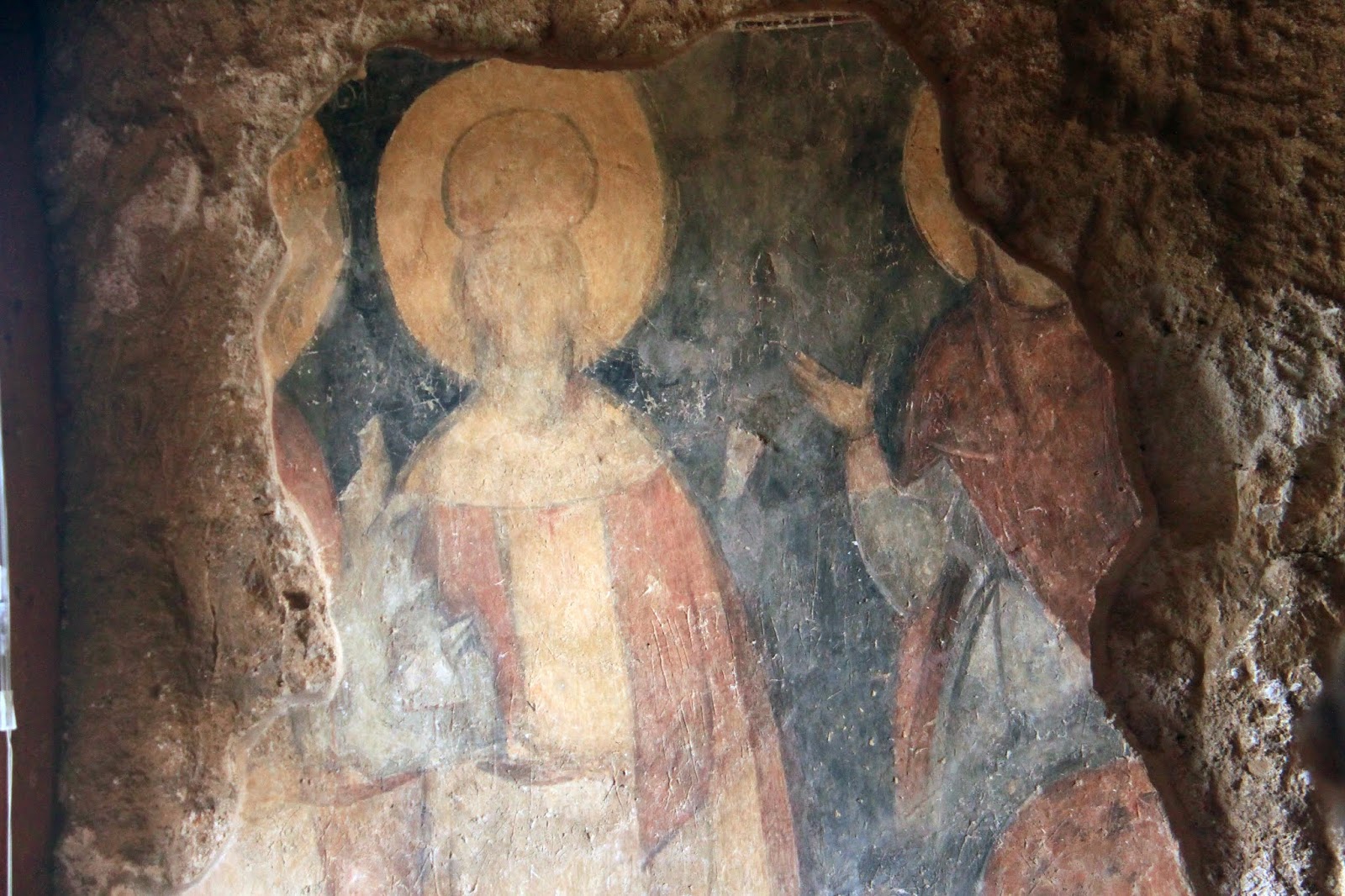
A little further on we come to the rock church itself, dedicated to Saint Michael, the guardian of these high places. There are more than twenty of them hidden among these cliffs and crabs; this is the finest, and the most visited. Like Arbanassi (but tiny, no larger than a monk’s cave), its walls are covered with frescoes of Jesus, Mary and the saints. They take you back to the devotion of these holy men, their willingness to forsake everything for the sake of the gospel that called them into this life of poverty and prayer. There is a little platform outside the cave (thoughtfully supplied in modern times with a railing) on the cliff edge, with a sheer drop below to the valley floor that it’s not good to look down on for too long. I imagine a monk, stylite-like, perched on this space where there is barely room for a human being to stand safely, totally still and silent in prayer, rapt in  contemplative communion with God.

Then I look down at the ground. A metal rail has been inserted across the cave’s opening in modern times, maybe to contain a door or window of some kind. I look more closely at the lettering on the side. The message is unmistakeable, announcing its place of origin. Middlesbrough. The North East has come to Bulgaria. This calls for a photograph.

In the car park an elderly man is selling icons he has created (that's to say, "written") himself. I wish I could l could linger to buy one. But icons are prayers, windows on to heaven, and choosing one will not be hurried. It takes time because in truth, we do not choose the icon: the icon chooses us.  And the coach and the ship will not wait.

But what a remarkable day it has been.

Friday, 12 February 2016

Gravity Waves and God

On the second day of Lent, a scientific announcement made it into the TV news headlines, right to the top. It has to be quite something to dislodge the junior hospital doctors, the EU referendum, the state of the financial markets and Syria. It was of course the discovery of gravity waves.

I'm sure I don't need to explain to the readers of this blog what gravity waves are and do. The question their existence answers is very simple: how is the force of gravity transmitted through space, the force that makes Newton's apple fall to the ground and Kepler's planets to stay in their elliptical orbits round the sun. Einstein had predicted them, but it has taken a century to spot these elusive carriers of cosmic information. It was the collision of two black holes and the colossal energies it released with the consequent distortions of space-time for gravity waves to leave a trace.

No wonder the scientific community is excited. I share it, insofar as I understand these things. I suppose I am a superannuated scientist in that I read maths for my first degree, though it's debateable whether mathematics is a science or an art. I've always enjoyed reading that genre known as 'popular science' to help me wander round the foothills of scientific enquiry and be able at least to ask sensible questions when talking to scientists. When I was studying A-level physics in the 1960s, I learned about conjectured 'grand unified theories' of the universe (GUTs we called them). One of the clues, I remember, was going to be the proven existence of gravity waves. At that stage no-one had heard of 'dark matter'. So presumably we are one step closer than we were to mapping the GUT-instinct of the cosmos. (Sorry.)

I was fascinated in the reaction on social media. It ranged from the excited to the baffled. There was a lot of exhilarated chatter: 'wow! this sounds amazing even if I haven't a clue what it means'. And there was some sighing with disbelief that such things were occupying valuable news time: 'what's all the fuss about?' grumbled one tweeter 'when it cost a fortune, makes no difference to anyone & most people don't understand it anyway'. Or words to that effect.

So here's my take on why all the fuss is worth it.

First, we should celebrate curiosity. It's a fundamental aspect of being human, this instinct to probe and explore and discover. It's inconceivable that humanity might one day give up on pushing back the frontiers of knowledge. When I was a child I had a big and much-cherished book about how the continents were progressively discovered. Each chapter was introduced by a coloured map entitled 'The Unfolding of the Clouds' (or was it unfurling?). The known world as it was down the centuries was mapped in colour with dark grey clouds lapping the edges. By the end of the book, the clouds were gone, banished by the sunshine of knowledge. A classic case of imperial optimism striding out to conquer ignorance? Maybe.

But it left a lasting image. Even aged eight or nine, I could see that it was a metaphor of other kinds of progress: understanding the past, overcoming disease, devising technologies to better the human condition. In the Hebrew Bible, King Solomon is remembered as a man who was curious about the animal and plant life that surrounded him. It was associated with his legendary wisdom. I think that remains true of good science, wherever we find it. And to me, one aspect of scientific curiosity is the very capacity we discover in ourselves to articulate such extraordinary concepts. It's as if we are helping the universe to come to a kind of consciousness through our very ability to understand and articulate its mechanisms.

Secondly, discoveries like this enhance the sense that we live in an amazing universe that is 'fearfully and wonderfully made' as the psalm describes the human person. Every so often, there are breakthroughs that make us stop and think about who and what we are, maybe glimpse aspects of our life that we are normally too much in a hurry to notice. The first man into space was one such moment, the first moon landing another ('one small step for a man, one giant leap for mankind'). For a moment, we saw ourselves in a new way. In some ways these are as significant as the taming of fire and the discovery of the wheel, and a lot later on, depth psychology, relativity, vaccination, anaesthesia, the splitting of the atom and antibiotics. The human genome may be another parallel. The invention of the internet is another likely candidate, as is the promise (threat) of artificial intelligence. Crossing these thresholds changes the nature of human consciousness. Or it should.

But how? Once upon a time, scientific and technological research might be justified in terms of the mandate given to humanity at creation in Genesis: 'be fruitful and multiply; fill the earth and subdue it.' Back to that imperial (not to say imperious) domination of things. But I'd like to think that each threshold we cross as a human race ought to make us more reverent before creation, more humble towards it. Mother Julian of Norwich spoke about 'courtesy' in our relations with the natural world. The more complex the cosmos reveals itself to be, the more we should regard it in this way. That too is an aspect of wisdom, to be able to contemplate the created order and recognise our place in the grand scheme of things. The cosmos was here when we arrived, and it will still be here when we have gone. How many other sentient beings has it seen come and go in 14 billion years?

Of course so much depends how science and technological advance is put to use. I am not so naïve as to imagine that it will inevitably do us good. Science can have a dark shadow as we know from its being harnessed to destructive ends such as the capacity to make nuclear and biological weapons, engage in genetic manipulation, allow digital pornography to enter every home. Nor do I imagine that being exposed to the wonder of the universe makes a person religious (though avowed atheists like Brian Cox do convey an almost mystic sense of ecstatic awe in the face of the beauty of the cosmos and the physical laws that govern it).

But for people of faith, natural science has a religious aspect. The borderlands between knowability and unknowability straddle both science and theology: there is that which is disclosed to us, and that which remains mysterious and hidden whether we are talking about the universe or its Creator. 'Truly thou art a God that hidest thyself' complained the prophet, giving Luther his beloved phrase Deus Absconditus. Yet at the same time, the monotheistic faiths - Judaism, Christianity and Islam - all affirm that God desires to be known as well as remain mysterious, and has revealed himself to humanity in his prophets and in sacred texts. For Christians, the supreme and final revelation is in Jesus, the incarnate Word of the Father in which he utters his decisive Yes to the whole created order for time and for eternity. Ultimately, a theologian believes, the scientific enterprise is a way of honouring that divine Yes.

So to me, gravity waves have a religious as well as a scientific aspect. It's another activity in which faith is always seeking understanding. Which is why this latest penny that's dropped is a moment of recognition in a theological sense. To that act of seeing and knowing and loving God in all his works, the human heart as well as the human head will echo: Amen!

(For an acclaimed physicist's view on science and religion, see Tom McLeish's recent book Faith and Wisdom in Science.)