About Me

My photo
Pilgrim, priest and ponderer. European living in North East England. Retired parish priest, theological educator, cathedral precentor and dean.

Monday, 10 June 2019

Blue Danube to Black Sea Day 1: A Thousand Miles to Go

This is the first episode of my blog about cruising down the Danube. Some of you may recall that I blogged about the Danube in 2014 when we made the river voyage upstream from Budapest into Austria, Germany and then Prague. We enjoyed it so much that we decided that when time and funds allowed, we would cruise downstream from Hungary to the Black Sea. So we did, there and back, an amazing journey of two thousand miles. The previous blog ran to a box set of nine episodes. This one, covering a two week voyage, will run to fourteen (yes, I know...). I wrote it during the cruise itself, if only to make sure I could recall where we were on each particular day before all those Eastern European names and memories of people, buildings and landscapes began to coalesce into one another.

My aim was to try to capture so much that was new to us east of Budapest, not least the culture and politics of nations we'd never visited before. I've now edited slightly and inserted some photographs. But it's mainly as written, complete with errors of fact (please tell me!) and - more important - all the risks that first impressions carry - superficial perceptions, shallow interpretations. These could be misleading in countries that have experienced decades, no, centuries, of alien rule and have also experienced terrible conflict in the twentieth century in two world wars and (in the case of two of them) the Balkan wars of the 1990s following the break-up of the former Yugoslavia.

With those caveats, here goes....


Friday 24 May
The airport is heaving with holidaymakers flying out to Lanzarote, Alicante, Rhodes and similar sunny destinations. The check-in queue snakes around the concourse and down to the entrance. The heart sinks. Why are there so many children and young people not at school on this last day before half-term begins, I ask grumpily? Suddenly the queue starts moving like an unblocked bowel. We learn that the luggage conveyor had stalled but has now been put right. Relief that constipation is over.

Thankfully, we are on a grown-up flight. Many of the passengers look likely candidates for the cruise, though not the cross-dressing young man at the front who is wearing a white outfit with a sash telling the world that he is the “Bride to Be”. The elderly man next to J seems unsure about flying and fumbles with his seatbelt. J is always helpful in these circumstances. We fly along the Danube valley. The river is unmistakeable, curling bulbously through Austria and Hungary, defining the historic empire. We recall our first Danube cruise five years ago when we sailed upstream from Budapest to Passau. Now we are to sail down from Budapest to the Black Sea. As we descend towards Budapest, huge thunderheads tower up on the horizon. But the plane does a 180 degree turn as it comes in to land, so worries about sudden downdrafts and rain squalls are needless. We land gently in Danubia.

It is a 50 minute drive from the airport to the ship. I have to remind myself which side of the river is Buda and which is Pest. My mnemonic is that West rhymes with Pest, but Pest is not West. Buda is where palace, church and Fishermen's Bastion perch on their Acropolis. Our visit there last time is coming back. Meanwhile P is for Pest and for Parliament, whose vast emblematic building stands on the opposite bank. It is late. In the darkness, the grand buildings on either side of the Danube and the bridges connecting them are beautifully lit.

There are arrival rituals: handwashing (for ritual as well as physical disinfecting), passports taken from us (creating a temporary society without nationality on this ship, though the point is to make crossing international frontiers easier to manage), photographs taken at check-in for ID, issuing of key-cards and so on. There is the usual nervous conversation of people who are strangers suddenly thrown together. Michael Argyle’s definition of a “total community” comes to mind, a group that works, lives, eats and sleeps within the same confines such as a prison, an asylum or a boarding school. The social architecture of our cruise ship begins to take shape and structure our existence for two weeks: fertile ground for observation and ethnographical analysis. What kind of people go on cruises? What kind of people have chosen this one? What kind of voyagers will we be? Tourists? Visitors? Guests? Or even pilgrims? Memories from Santiago last week are stirred. I try to remember the content of my addresses on pilgrimage.

It is all very well appointed, this ship. Our cabin (cell?) has everything you could need. But I do not expect to sleep this first night. There has been too much stimulus too late in the day, too much excitement. And I don’t. So I read from the second half of Andrew Beattie’s excellent book on the Danube* that I’ve brought with me. Part one served me well on the Upper Danube cruise we made five years ago. I’m surprised that the ship’s library doesn’t carry any books at all about the landscapes we shall travel through, not even the standard Rough Guide or Lonely Planet volumes on the five countries we shall be visiting. I’m aware of how little I know about Hungary, Croatia, Serbia, Romania and Bulgaria where we shall be setting foot during the voyage, to say nothing of Ukraine and Moldova which we may glimpse across the water.


Saturday 25 May
The evening and the morning of our first day. On this cruise there are no concessions to your long journey the day before or the lateness of your arrival. It’s up bright and early to be on the coach to go and visit the local city of Kalocsa. “My little city” says the bright young Hungarian guide endearingly.

First we visit the Italianate baroque cathedral. It is an enjoyable building, restrained compared to Passau or Melk upstream on the Danube, or indeed Santiago where I was only last week. Our guide waxes eloquent about the part beauty plays in evoking faith. Then he turns to the organ on the gallery. The great Franz Liszt played it several times, he tells us, and loved this amazing instrument. They are excavating medieval remains in front of the west end. The Archbishop's Palace reveals a marvellous library (“one of the twelve best in the world”) which contains priceless incunabula and early printed books, including an early edition of Luther’s Bible (yes, here in the heartland of catholic Hungary, though it is being "rested" at present so is not on display). A steward lurks in the corner to make sure we don't touch anything we shouldn't. I ask about conservation practice in Hungary and am told that it's second to none.
Then across the road to the only paprika museum in the world. There are limits to the excitement I am feeling about this much-trailed visit. The building looks vast. Is there any end to the role paprika plays in the cultural history of Hungary, I ask myself? Much to our relief, the museum consists of only a couple of rooms in the basement. Actually, it is surprisingly interesting to learn how central paprika has been and still is to the rural economy of Hungary. We inspect historic artefacts associated with its cultivation, harvesting and trade. I sense a renewed enthusiasm for Hungarian goulash awash with paprika. Except that we Brits appear to have misunderstood goulash which strictly speaking is a thick broth rather than a stew. We resist the paprika-themed souvenir shop and wander off to explore this intimate little city.
Apart from a pleasant pedestrianised boulevard lined with sculptures of Christian saints and local clergy, there is little to see other than a few once proud, now faded buildings that hark back to the days of Austro-Hungarian Empire. But there is a new museum by the cathedral, only opened three years ago, in which its ecclesiastical treasures are exhibited. It is beautifully constructed, partly out of a refurbished outbuilding of the Bishop's Palace, partly in a new purpose-built space. It seems deserted, but the doors are open. The serious young man at reception seems surprised that we would actually want to visit it, and pay however many thousand forints equates to the 3 euros it will cost us each. Having issued us with tickets, he follows us like a hound into every gallery to make sure we are behaving ourselves. It’s true that paintings, vestments, large items of silverware are on open display and could easily be damaged. J tries to explain that I am a priest (so above suspicion?) but I’m not sure he understands. After all, what would a priest be doing with a wife? 

After lunch we are back on the coach again bound for the city of Pécs. It's situated in one of the wine-growing regions of Hungary. Many of the signs with village place names have a German name underneath as we pass by. Our guide explains that in the eighteenth century Empress Maria Theresa needed viticulturists to develop and care for the vineyards, so Germans from Swabia came here in large numbers. They preserve their language and culture even to this day. All this we learn as part of a lucid survey of Hungarian history as we travel. We're told we shouldn’t think of Hungarians as Europeans but as Asians who migrated here in the early middle ages (Magyars who have nothing to do with Huns). This explains the peculiarities of the language which is neither Romance nor Slav, but related only to Finnish and Turkish. (Looking at the words for “left luggage” and “lost property” while we waited for our bags at the airport carousel has already made me wonder how any non-native speaker sets about learning this characterful but obscure language.)

On the coach some of us get talking about the European Union and Brexit. All the countries we shall be visiting are now EU members states apart from Serbia which has official candidate status and is likely to join in 2025. Our guide joins in. He is clearly one of his generation’s Europhiles too, so I ask him what he thinks about Viktor Orbán's politics. He looks wary and points to his guide’s badge. “While I have this on, I have to be impartial and not venture an opinion” he says. “Once I take it off, then I can speak for myself.” “Then take it off at once” I reply. He laughs. But it stays on. He is official. He is in role.

Pécs is an ancient episcopal city with a medieval university, cathedral and fortifications, a pretty picture in an unprepossessing (and oversized) suburban frame. Can I think of any city that is not let down by its suburbs, I ask myself? As a child of the banlieue, I can’t. We make for the Cathedral, a fine Romanesque building, its towers reminiscent of Speyer. Alongside is the Bishop’s Palace. Nearby in the garden is a statue of Frank Liszt peering up at the Cathedral. For all my love of Wagner, Liszt was never my favourite composer, this Abbé whose music doesn’t so much make the piano sing as suffer under the hammering he inflicts on it. But Hungarians are intensely proud of him (as they are of Kodály and Bartók. You can understand why. Maybe now that I have visited his country I need to listen more carefully. Just maybe.
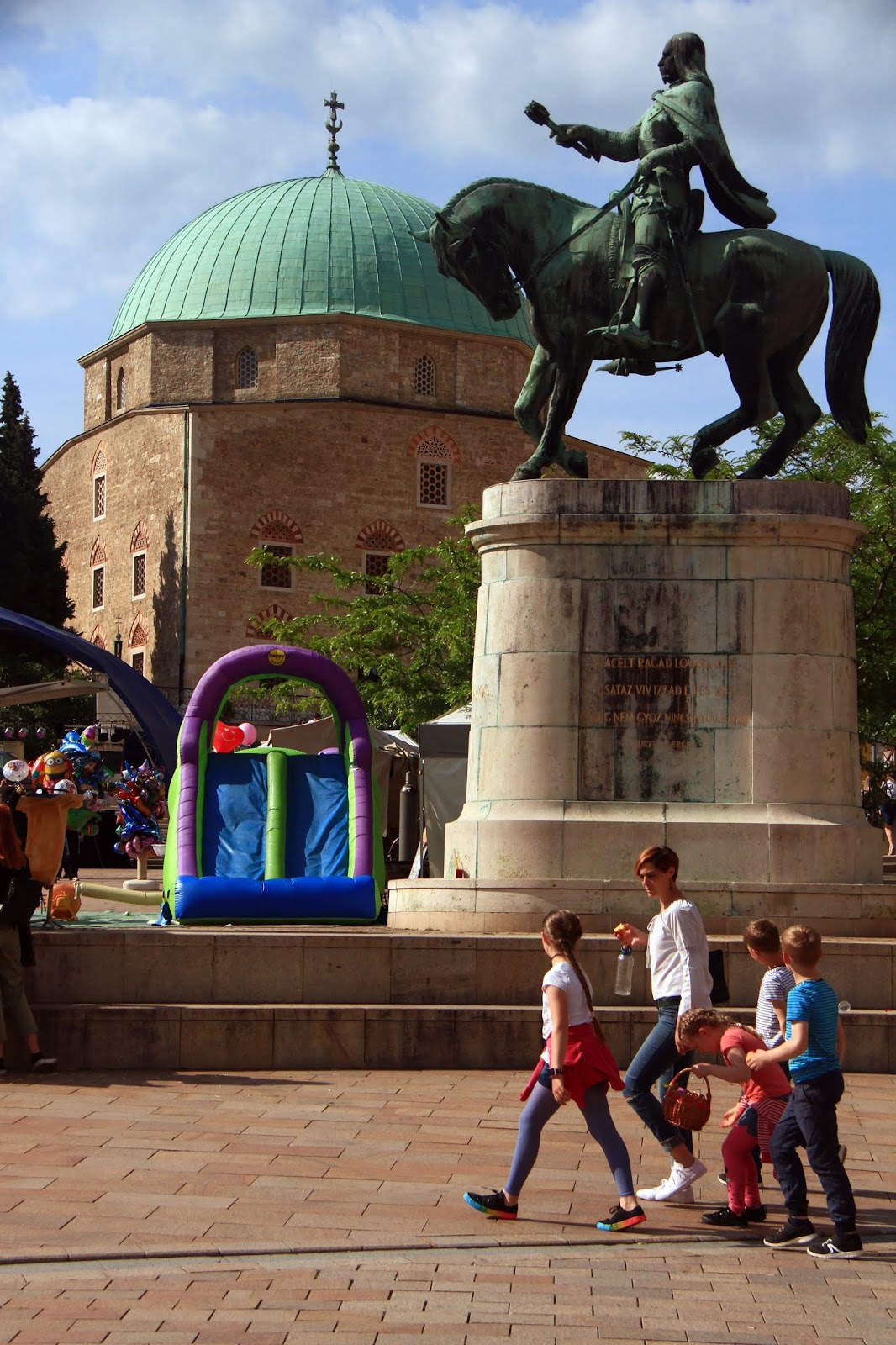
The guided walk ends up in the city's central square. It's extremely noisy as some kind of festival is happening there, and a band is playing on a dais with the amplification turned up to maximum. We have some free time, we walk back to the Cathedral. But it's closing as we arrive. An apologetic steward tells us that evening mass is shortly to begin. “What time?” I ask. At 6 o’clock, we are told. That’s in one hour and a half. Does it take ninety minutes to clear the nave of visitors, set up for the service and invite the faithful in? Not in any cathedral I've worked in. But we can see enough of the nave to see that the Romanesque promised by the exterior is not delivered inside. It is harsh chiselled neo-Norman, heavily painted in dark hues, a style that is so much more unsympathetic than Neo-Gothic. And we would have had to pay to go inside and see it.

But then we have a wonderful surprise. On our way down to the centre of town, we stumble across what looks like an unprepossessing bunker with a half-open concrete door. This turns out to be the World Heritage Site of Cella Septichora, a unique and extensive Romano-Christian burial ground. Our guide had pointed it out beneath our feet just outside the Cathedral complex - you can look down at it through thick glass panels, but it’s impossible to make any sense of it from above. It’s an extraordinary and vast subterranean labyrinth of passageways, burial chambers and tunnels, reminiscent of the Catacombs. It would need several hours and a good guide to make sense of these wondrous spaces, but we are moved by what we see, most of all the fourth century burial chamber named after St Peter and St Paul where there are wall paintings of Adam and Eve, Daniel in the lions’ den, and Jonah in the belly of the fish, all palpably related to the theme of death and resurrection. A Christogram at the centre of the composition pulls it all together around the emblem of Constantine, “in this sign conquer”. Once again I sense the powerful allure of late antiquity, not least in its Christian phases. We love the atmosphere of this evocative and holy place. (While we are there, teenagers on a school outing are listening to a guide explaining it in Hungarian. Some of them are a lot more interested in their mobile phones than in late antiquity. Ah well. They are a bit young to be entertaining thoughts about their distant past, or even their own mortality, as we older voyagers are prone to do in a place like this.)
I wonder why we weren’t all urged to visit Septichora without fail. Maybe the cruise company doesn’t want to encourage people to go to sites where you have to pay to go in, the assumption being that the cruise excursions are all thrown in for free. But for a mere three euros each (reduced tariff for seniors), this must surely be one of the most memorable visits of the whole journey. It reminds us of the importance of doing our own research prior to each visit to make sure we don’t miss out on the must-sees by accident.

During dinner on the ship, we are all summoned to appear before reception to have our faces checked against our passports. This is because we are about to leave the EU at Mohács and cross over into Serbia at Bezdan. The process of checking our names and identities against the passenger list is called “revision”. Two uniformed Serbian police officers are sitting there scanning our documents. I think of the well-known names of their countrymen in my own lifetime, leaders like Slobodan Milošević, surely one of the worst men of the twentieth century for the bloodshed and genocide his policies unleashed on the Balkans. Given its recent history, the very name “Serbia” seems to hold something of the shadows about it. The Serbian river bank is dark and mysterious, obscure, like my knowledge of it. But these policemen are friendly enough, and even give us a smile as they check our passports. Maybe it's not just a case of passport "revision", but revising my own preconceptions about the country we are about to enter?
*Andrew Beattie, The Danube: a cultural history, Oxford, 2010.

Sunday, 9 June 2019

“Grateful Coolness from the Heat”: a rich Pentecost hymn

We all have our favourite hymns, those we can bear to sing more than a few times and imagine that in heaven we might go on singing for ever.  My desert island list is short: How shall I sing that Majesty, Of the Father's heart begotten, Praise to the Holiest in the height, Soul of my Saviour, O worship the King, King of glory King of peace and Come O thou Traveller unknown. And the eighth? It’s a hymn of Pentecost. Come, thou Holy Spirit, come, one of the greatest ever written.*  
Its author was the 13th century Archbishop of Canterbury Stephen Langton, one of the most distinguished thinkers England produced in the high middle ages. He lived from around 1150 to 1228. They were troubled times in both church and state. Out of that turbulent era came the document dear to all the English, Magna Carta of 1215, the Great Charter of Freedoms. As Archbishop, Langton was present at its signing by the truculent King John. He may well have influenced its content. He was tireless in reforming the church and raising standards of clergy education and conduct. He was a passionate advocate of the new learning represented by the liberal arts including, of course, theology, at that time burgeoning in the recently-founded universities of Paris and Bologna and soon to flourish in England at Oxford and Cambridge.  One lasting legacy of his biblical scholarship is his division of the Bible into chapters, for he was the first to divide up the text in this way. 
So much for the author. What of his hymn? It’s known as the Golden Sequence.  Sequence refers to the position hymns such as this had in the liturgy of the mass. No-one is sure why this sequence is Golden, unless it is a comment on the beauty of its poetry and the profound spiritual insights of its prayer, for here, poetry and prayer are wonderfully married to each other.  It is an invocation of the Holy Spirit to be sung at mass on this feast of Pentecost and in the week following.  Some of the poetry is lost in translation, so listen to the Latin of the first verse: 
Veni, sancte Spiritus, / Et emitte caelitus  / Lucis tuae radium                                        Veni, pater pauperum / Veni, dator munerum / Veni, lumen cordium.  
That fourfold repetition Veni, veni, veni, veni - ‘come' is matched by a fourfold repetition of another plea in the last verse Da - ‘give'.  So the repeated cries of come and give frame the hymn and give it its intense poignancy.  And this coming and this giving respond to our deepest needs, for the hymn knows the complexity of the human soul and names it: poverty, sadness, emptiness, woundedness, weariness, barrenness and guilt.

Langton's skill is to pile up a rich array of images of the Holy Spirit that answer these needs.  They are all drawn from the scriptures, for Langton was a devout biblical scholar.  It's an extended commentary on the vision of one of the Hebrew prophets: ‘a new heart I will give you, and a new spirit I will put within you; and I will remove from your body the heart of stone and give you a heart of flesh.  I will put my spirit within you....'  For how life is changed when the Spirit comes! Faith is restored, hope reawakened, love renewed; all beautifully told because authentically lived in the human heart, reverencing the deep mystery of the human person and the mystery of God the Holy Spirit that is deeper still. 
In the first stanza the Spirit is the source of light and radiance, the Creator-Spirit whose energy gives birth to all life.  But he is also ‘Father of the poor', the generous giver of all that is good.  This softens the hardness of the image of brilliant yet impersonal light into a kind, personal deity who is gentle with mortals in their need.  His string of beautiful epithets has the effect of making the Spirit irresistible as the object of our hunger and desire: welcome guest, rest in labour, coolness in heat, solace in pain. It's striking that Langton turns away from the dramatic, perhaps ‘obvious', depictions of wind and fire for more tender images: the cool breezes that refresh in the heat, the welcoming hearth suggested by ‘melt the frozen, warm the chill'. It’s a very equable, well-tempered spirituality with none of the overheated rhetoric of the ‘fire of love' that is in danger of losing its currency through endless repetition. It’s what it means to call the Spirit Consolator: ‘Come, of comforters the best', the word used in the upper room when Jesus speaks about going away and sending the Holy Spirit. The poet recognises that the Greek word Paraclete can mean so many different things: comforter, consoler, encourager, strengthener, helper, counsellor, advocate.  It is one of the richest words in the gospels. 
The third stanza returns to the theme of light: O lux beatissima, ‘O most blessed light'.  The thought picks up the movement of the first verse from the light of God's being to lumen cordium, the inward illumination of God's faithful people through the Spirit.  For human beings owe everything to this light within, as the Latin makes clear.  Without it, without this heavenly light to redeem us and make us new, we are nothing.  So the next stanza becomes a prayer that the Spirit may do a divine work in us: healing and forgiving, imparting life and goodness, ruling and guiding us wayward souls in the path of holiness, melting and warming our cold hearts into loving God.  And in the final verse we reach that fourfold prayer that beseeches the Spirit to give what we who confess Jesus Christ need: the reward of virtue, a happy death, and salvation at our journey's end.  
The last word of the hymn is the clue to all of it, for it's to that word that the whole poem has been leading.  Gaudium, ‘joy', ‘happiness', ‘contentment'.  Each word at the end of every third line ends with ium.  You sense that gaudium was where Langton began, and that he needed nine other words to rhyme with it: solacium, fidelium, and in the last verse the wonderful seven-fold word septenarium.  The prophet Isaiah enumerates them in his vision of the coming Messiah who will embody them: wisdom, understanding, counsel, fortitude, knowledge, piety, the fear of the Lord.  
But gaudium embraces them all, for these joyful virtues make us happy in the profoundest sense of that word: if we want lasting joy, then only the Holy Spirit can bestow it.  Only the Paraclete can answer our longing for fulfilment, our hunger to be happy.  We may look for it elsewhere, and do.  But it’s a false trail that turns us back into ourselves.  Only in God's Spirit, Lord and Giver of Life, will we find lasting satisfaction and contentment.  Only in the very heart of God will we find this healer of wounds, this light divine, this shelter from storm and heat, this fount of goodness, this kindest and best of comforters.

When we pray “thy kingdom come!” as we have done in these days between Ascension and Pentecost, all this is what we have been praying for, life as it is transformed by the gift of the Paraclete - in our world, our society, our churches and ourselves. On the Monday after Whitsunday, ordinary time begins. What are days for? To feel after God and find him, then to live in the light of that renewed vision of human life as we glimpse when we are touched by the Spirit of God. What better words to inspire such a vision than this ancient and beautiful hymn we call the Golden Sequence?

******

*Here is the text of the hymn.

Come, thou Holy Spirit, come,
and from thy celestial home
shed a ray of light divine!
Come, thou Father of the poor!
Come, thou Source of all our store!
Come, within our bosoms shine!

Thou, of comforters the best;
thou, the soul's most welcome guest;
sweet refreshment here below;
in our labor, rest most sweet;
grateful coolness in the heat;
solace in the midst of woe.

O most blessèd Light divine,
shine within these hearts of thine,
and our inmost being fill!
Where thou art not, man hath naught,
nothing good in deed or thought,
nothing free from taint of ill.

Heal our wounds, our strength renew;
on our dryness pour thy dew;
wash the stains of guilt away;
bend the stubborn heart and will;
melt the frozen, warm the chill;
guide the steps that go astray.

On the faithful, who adore
and confess thee, evermore
in thy sevenfold gift descend;
give them virtue's sure reward
give them thy salvation, Lord;
give them joys that never end.


Based on a sermon given in Durham Cathedral.

Monday, 27 May 2019

On a River Cruise: pleasures and perspectives

We are back on the river again. 

Five years ago my wife and I took a river cruise on the Danube. We travelled upstream from Budapest to southern Germany. I wrote a blog charting our progress day by day. We enjoyed it so much (and learned so much) that we decided to make the journey downstream from Budapest to the Black Sea one day, if we could. Retirement has given us that opportunity. So here we are on board the MS William Wordsworth gliding seawards. Once again, I’m writing a blog about the voyage as we make it. I’ll publish it soon after we get back when I’ve had time to process my thoughts about the cruise, tidy up the writing, correct factual errors, remove actionable comments and include some photographs. 

Meanwhile, I thought I’d reflect briefly on the experience of river cruising. This is now the third time we’ve chosen this pleasant way of taking a holiday. The first was the Danube voyage I’ve just mentioned, and then, two years ago, a Rhine cruise from Cologne to Strasbourg and back. There’s lots that’s really enjoyable about it. Compared to cruises by sea, river cruising is small-scale and intimate. The company is convivial and the conversation often lively. The ships carry no more than 100 to 150 passengers (fewer on this cruise) so it’s fine for introverts, believe me! And unlike sea voyages, the scenery is changing around you all the time. The river does all the work. You only have to unpack your suitcase once and you only have to sleep in one bed. 

It’s hugely relaxing to sit on deck or in your own cabin watching villages, towns and landscapes drift past. The excursions to places of interest are tailored to the particular theme of the cruise and participants’ likely interests. On this cruise, we have seen two Hungarian cathedrals, several museums, and visited an extraordinary late Roman underground Christian burial site. We have walked round the capital of Serbia, Belgrade, not a city on many people’s bucket list but fascinating for its long and troubled history from the Roman Empire to the Balkan Wars. We have sailed down the spectacular Kazan Gorge through the Iron Gates, once the most dangerous stretch of the entire river for its treacherous shallows, rocks and cataracts. 

At its most enriching, travel will be both enjoyable and inspiring. But it also needs, I think, to be ethical and to offer new perspectives. I’ve suggested what’s enjoyable about river cruising. When you’re as well looked after as you are on a cruise ship, what’s not to enjoy? But that in itself raises ethical concerns. Tourism that entails air travel (which this trip does) at once poses questions about environmental sustainability. A river cruise ship, however modest compared to its huge ocean counterparts, still adds to my carbon footprint. What’s more, our ship is a bubble of luxury and privilege compared with most peoples’ lifestyles in the countries through which we are sailing, all of which are taking decades to recover from forty years of communist rule. It’s true that none of these ethical challenges is unique to travel. We face them at home on a daily basis. But travel at its best heightens them by making us more aware of our context and more sensitive to it. Like so much else that we enjoy, it’s a case of discerning how to find pleasure in principled ways, with integrity and conscience, never taking any of it for granted.

Inspiration, too, seems to me to be an essential ingredient of the good journey. I mean by that the capacity of travel to stretch our horizons, make us see the world and ourselves in new ways, be genuinely touched by what we experience and enjoy. All this happens, I think, when we make the decision to travel not as spectators but as participants. “Those who never travel think mother is the only cook” says a Bantu proverb. A couple of weeks ago I was in Santiago de Compostela with a group of clergy from Wales. I’d been asked to lead four Bible studies on the theme of pilgrimage. The central insight I wanted to share was that the difference between tourism and pilgrimage is that while tourists observe, pilgrims join in. To me, this is fundamental to travelling ethically and with a good conscience: trying whenever we can to engage with local people and their culture, allow ourselves to be enriched and inspired by what we encounter and join in with. You can read my blog about our pilgrimage to Santiago here.

Which brings me to my final ingredient of a good voyage, which is that there is that aspect of it that searches us, interrogates us, asks us how we might be changed as a result of what we discover and experience. Again, in my pilgrimage talks in Spain, the theme of transformation was central. We should not go home from our journeys the same as we arrived! In the case of Eastern Europe, I am finding that I am being challenged about my awareness of modern European history, especially the ordeals the Warsaw Pact countries went through under communism. On this cruise we are visiting places in former Iron Curtain countries Hungary, Romania and Bulgaria as well as Serbia and Croatia, part of the non-aligned communist former Yugoslavia. Many of the ship’s crew members come from these countries. Some of them are glad to share their experiences of life in nations with recent histories that are so different from ours. 

For example this afternoon we listened to one of them give an illuminating talk about growing up in communist Hungary in the 1970s and 80s. He described what life was like in those bad old days - acknowledging, he said, that times were nowhere near as bad then as they had been in the 1950s and 60s. The uprising of 1956 and its brutal repercussions are seared on the corporate memory of Hungarians of all ages. It’s good that a cruise can make room for potentially uncomfortable content like this so that we can be intelligent guests of these countries rather than mere voyeurs. It’s to be hoped that one of the benefits will e to make us not only better informed but more curious. The best travellers are surely those who are excited by a sense of curiosity. Isn’t that what makes us want to travel in the first place?

This cruise has made us think of more recent events too, the Balkan Wars that brought such misery to the nations of the former Yugoslavia. Serbia had a central role in those conflicts. People like me who are champions for the European Union often say that thanks to the EU, our continent has enjoyed seventy five years of peace. That’s true of the EU nations. But not of the Balkans. It’s sobering to see in Belgrade, for example, ruined buildings that were bombed by the NATO allies in an attempt to call a halt to Serbia’s aggression in the wars of the 1990s. (But the very fact that I state it in that way perhaps betrays my own western assumptions about the causes of those conflicts in the first place.) On the return journey we shall stop at Vukovar, a town that suffered terribly when it was on the front line of this desperate conflict. It will no doubt be a searching experience, and very possibly a troubling one. 

We set out on this journey on the day the UK voted in the European Parliamentary elections. (We voted first, then headed for the airport in case you’re wondering.) Today, we have been digesting the results of the elections both in Britain and across the EU. It seemed nicely symbolic to be afloat in central Europe while the outcomes were being analysed and debated, with an EU country on one side of the Danube (Romania) and a candidate EU state on the other (Serbia). Lively conversations about the elections are taking place on this ship too. So I’m grateful that this cruise is not simply about having beautiful experiences, but is posing real questions to us about the politics of Europe east and west, our European identity, and more broadly, our vision for the good society. What could be more important? Or necessary? And, I want to say, stimulating too. That’s a big part of the enjoyment.

Friday, 17 May 2019

A Pilgrimage to Santiago

I am writing this blog on the train, heading homewards from Cardiff. I’ve spent this week with clergy from the Diocese of Llandaff. Not in Wales, but in Santiago de Compostela in Spain. Bishop June Osborne had invited me to travel with her group of over one hundred people who were making this pilgrimage as their clergy school. It was part of the Diocese’s preparation for the Year of Pilgrimage that begins next year, when the Church in Wales marks the centenary of its disestablishment.

My brief was to offer a daily Bible reading on the theme of pilgrimage. You can read my four addresses at http://northernambo.blogspot.com. I decided to draw on St Luke’s Gospel to help us make connections between pilgrimage down the centuries and our lives today. The first address was on “Pilgrimage and the Offering of Life” where we looked at the child Jesus in the temple. The second, “Pilgrimage and Truth-Seeking” was based on the story of the temptations in the wilderness. The third, “Pilgrimage and Pain” drew on the journey Luke describes Jesus as making as he “turned his face towards Jerusalem”. And the final address on the Emmaus Road resurrection story explored Jesus as our contemporary who, known or unrecognised, walks with us on pilgrimage.

The great thing about the week was the freedom the Bishop gave us to engage with Santiago in our own way. What mattered, she said, was to be together. There was daily worship of course - bilingual Welsh/English, echoing the bilingual culture of our Galician hosts where they speak both Spanish and Gallego: I loved that. There were shared meals enjoyed together (including, on the last evening, a conference dinner in the legendary Parador opposite the Cathedral). There were sessions with visiting speakers on pilgrimage in Wales, pilgrimage with children and resources for promoting pilgrimage in local churches. And many memorable conversations. And lots of laughter. But much of each day was deliberately kept free: to walk (if you wanted to), explore the city (if you wanted to), read (if you wanted to) or simply benefit from a gentler pace of life away from the pressures of “ordinary time”.

It was not my first visit to the great pilgrimage city of Santiago. Jenny and I had been there in 2006 when we drove slowly and reflectively along the entire length of the Camino from one of its traditional starting points in France, Vézelay. And back again, along a different route. We’d stopped at the churches and shrines, said our prayers and lit candles. We’d met other pilgrims on the Camino and listened to their stories. We’d enjoyed each other’s companionship - such a rich word, that, literally “bread-sharing” - and felt a sense of contentment for so much that was lovely in our lives. It was a beautiful experience. 

I shared some of this with the Llandaff clergy. I wanted to emphasise that pilgrimage is not about the means of transport we use to make the journey, but the spirit in which we do it. With the biblical texts to inform us, we looked at different ways of understanding pilgrimage. A journey with a purpose was one. A journey that led to transformation and change was another. A journey that moved us from being observers to becoming participants was a third. The important point is that we bring the whole of ourselves with us. And although we can never know how until we do it, it’s going to make a difference to our lives. To fly by jet from Cardiff to Compostela may not offer the romance and hard work of walking. But that doesn’t make it any less of a pilgrimage. What matters is why we’re making the journey in the first place.

I was keen to deepen my understanding of Santiago as a pilgrim destination. So I spent a lot of time walking round this beautiful granite city (and photographing it - for me, an indispensable way of paying attention to its sense of place). The historic centre is one of those rare places where every building seems right, from the great churches, palaces and monasteries that cluster round the Cathedral, to the more intimate charms of the pedestrianised arcaded streets and squares and alleys within the line of the ancient city walls. 

The museums were especially good. Outstanding was the Museum of Pilgrimage close to the Cathedral. The interior of this classical building has been brilliantly reimagined as a sequence of contemporary spaces in which artefacts relating to pilgrimage are beautifully displayed. I learned a lot about the history of the Santiago pilgrimage, not least its political role in the Reconquista, the seven centuries it took to re-Christianise Spain and drive out Islam. In the galleries I saw many depictions in art and sculpture of St James Matamoros, the “Moor-Slayer” brandishing his sword for Christendom and trampling down the Muslims. It was sobering - painful actually - to see these representations of the Son of Thunder (which you find all along the Camino) in the light of the history of relations between Christianity and Islam and the tensions we are acutely aware of in today’s world.

I’d recommend any pilgrim in Santiago to visit this museum. Not only does it shed light on the Camino and how the Cathedral at Santiago developed into the world-famous shrine it has become. It also explores pilgrimage as a spiritual concept, why people of all world faiths undertake it, what aspirations and ideals it represents. And as you move from floor to floor, the museum’s striking architecture opens up to offer glimpses of the Cathedral towering above you across the square, and to remind you where you are, and why. 

The Cathedral itself is the high point of any visit to Santiago. It is undoubtedly one of the most important Romanesque churches in Europe. This year, essential conservation work means that it is heavily scaffolded and access is severely limited. In particular, we couldn’t climb the steps at the west end and go in by the celebrated Portico of Glory, one of the most marvellous creations of the twelfth century anywhere in the world. (An exhibition on the Portico in the Bishop’s Palace next door does go some way towards helping the visitor at least imagine what it looks like.) But we could still visit the crypt shrine to honour the reliquary of St James, and we could also go up the steps behind the high altar to hug his statue, a traditional act of greeting by pilgrims as they arrive in the Cathedral at the climax of their long journey. 

It’s too early to frame reflections on this unforgettable week. There has been a lot to think about. But I do want to pay tribute to the clergy of Llandaff Diocese for the way they engaged with the pilgrimage. It was clear from my conversations and from social media posts how much colleagues were getting out of the experience. Being there together with their Bishop was a big part of this, the sense that this shared journey to Santiago symbolised the hope-filled journey the Diocese itself was making as it approached the centenary. It was heartening to see the Bishop and her clergy so much at ease with one another. There can’t be many bishops who get a standing ovation from their clergy!

Speaking personally, I’ve not often spoken to a group of clergy who were more attentive, more responsive to what I was trying to share with them or more appreciative. A surprising number of people chose to take up themes from the talks over walks and drinks and meals, or simply wanted to tell me that something I’d said had touched them, or resonated in their own experience. On the final evening one priest, intrigued by my presentations, asked me about my aims as I’d set about preparing my addressses, the chief influences on my thinking, the theologians and spiritual writers I most admired, the part literature and the arts had played in my formation. I wasn’t expecting to be asked those thing, but I love the kind of candid conversation that fellow-travellers get into on pilgrimage. So I asked him the same questions in return! It made me aware of how privileged - and humbling - it is to be entrusted with a part to play in the spiritual development of colleagues in ministry. 
As always happens, I found myself deeply enriched by what fellow-pilgrims were giving back to me. Perhaps they weren’t aware that they were doing this, but I want to thank them all the same for such a generous “time of gifts”. And for the warmth of their hospitality, and for the best possible companionship on this pilgrim-adventure we shared together. 

And now that we’ve reached the time of homecoming, we know that our pilgrimage continues as the risen Lord walks alongside us in our ordinary days. He will keep alive in us the same joy and hope and companionship that we experienced in Santiago. Inspired by our memories of this week we travel on, thankful for all that these days together have meant for us. Ultreia! 


Thursday, 2 May 2019

Photos at an Exhibtion: Don McCullin at the Tate

In Holy Week, I was preaching each evening at Southwark Cathedral. There was time during the day to benefit from being in London. So I went to see the retrospective exhibition of Don McCullin’s photography at the Tate Britain.

To me as an amateur photographer, he is one of the greats who has influenced me the most – though the effect of gazing on these powerful images was to wonder how I would dare ever to take a photograph again. McCullin is famous for his photographs of some of the most terrible conflicts of our time. His name is indelibly associated with images of the Congo, Biafra, Vietnam, Cambodia, Beirut, Northern Ireland and Iraq. Even if you don’t recognise the name, you’ll have seen his work, for example that famous photograph of the shell-shocked US marine in Vietnam, staring blankly not at the camera but through it, beyond it into a personal void that is beyond imagining.

I’d read McCullin’s autobiography Unreasonable Behaviour where he speaks memorably about his work in these calamitous war zones, his exposure to the worst human beings can do to one another. He writes: “Seeing, looking at what others cannot bear to see, is what my life as a war reporter is all about… Our knowing matters. These are sights that should, and do, bring pain, and shame, and guilt.”

He talks about the need to bear witness. “You cannot just look away.” And about the  pilgrimages he has had to make to record terrible things as part of his own journey of truth-seeking and to help us with ours. “I don’t believe you can see what’s beyond the edge unless you put your head over it; I’ve been right up to the precipice. That’s the only place to be if you’re going to see and show what suffering really means.”

The Tate was busy on the day I visited. But I was struck by what I can only describe as a kind of religious hush in the galleries where the exhibition was. You did not want to talk in front of these images, so filled with human darkness and pain, so powerful in their capacity to move us to tears. In Holy Week, it was like progressing slowly and prayerfully along the Stations of the Cross. It was to be brutally yet compassionately exposed to the suffering of Jesus in his people.

I knew I needed to say something about this in my Holy Week address in the Cathedral that night. The theme was how Jesus was crucified as a result of political decisions made by people in power, how the crowd got swept up in violence that resulted in the execution of an innocent man. That seemed to me to be true of so much I was looking at in McCullin’s images. I saw once again, as clearly as I have ever seen it, how religion, if it has nothing to say about suffering, has nothing to say, whether it’s suffering caused by natural events, or by man’s inhumanity to man. And I wanted to ask where hope lay amid all this cruelty and pain.

McCullin himself to some extent responds to that question of hope, or at least the question of how we come to terms with the brutal realities of the human condition, whether in conflict zones far away, or in the deprivation of people nearer to home in our own communities. Truth, he says, is better than falsehood and illusion. Infinitely better. That's why "bearing witness" matters so much. You are told precisely this when you visit Auschwitz, or the Holocaust Memorial of Yad Vashem in Jerusalem. To bear witness even to the worst atrocities imaginable is to stand against them and the lies that spawn them to begin with. Truth-seeking is a sign of hope and the possibility, if we have the will to put it into practice, that "never again" will be more than merely words.

In old age Don McCullin has taken to concentrating on landscapes. He says that while he can never “unsee” what he has witnessed, and does not wish to, his work is now largely to calm his spirit. The relics of classical antiquity have long been a favourite theme. Sometimes, an image like the ruins of Palmyra (as they used to be and as they now are, following Daesh’s destruction of what had survived), evokes the violence of our own times as well as of previous ages exacted on the remains of an ancient civilisation. He has some fine photographs of Hadrian’s Wall here in Northumberland that make a similar point, though less sharply.

But you sense that he finds artistic and spiritual solace most of all by photographing the Somerset Levels where he lives. He does this to beautiful effect. It feels healing in a gentle and life-giving way. The images are still printed dark, with high contrast and lowering skies, as if he is still haunted by the chiaroscuro, the light-and-dark journeys he has made during a lifetime. How could he not be? You have to wonder what the personal cost of his remarkable career has been. But he seems to chuckle as he reminds us that rural Somerset is not altogether a retreat from suffering, He muses that even the hills and hedgerows and waterways have their dark side, the “skull beneath the skin” where “nature red in tooth and claw” is the law of survival. Maybe it’s the insight of old age that there is, in the end, no escape from pain and death. Mortality is part of life and a spiritual task of ageing is to recognise it.

Yet there is something of resurrection about these late photographs too, eucharistic even. Photography isn’t only about being present to the way things are, noticing, paying attention, recording and interpreting, though these are necessary for any practitioner of the art. It’s also about being alive to possibilities, whether glimpsed within the composition itself or implied beyond the frame. There can be hints of transfiguration in even the bleakest of images. Which is why McCullin’s exhibition, shattering though it was to experience, did not leave me feeling hopeless. Images like his, like the Stations of the Cross indeed, have the potential to sensitise us, purify our perception of reality, alter our conventionally superficial responses to events, and thereby make us better people who can in turn build a better world. Perhaps that makes them redemptive?

“Waking up today” he writes “to a morning of birdsong, and stepping out of my back door, I spot the antlers of a deer emerging from the mist in my orchard. The light breaks through the cloud, striking the Iron Age hill fort like the fingers of God. And I find myself saying: ‘Thank you…whoever you are’.” And I find myself echoing: Amen. And even: Alleluia.

Don McCullin is at Tate Britain until 6 May.