About Me

My photo
Pilgrim, priest and ponderer. European living in North East England. Retired parish priest, theological educator, cathedral precentor and dean.
Showing posts with label Rhine. Show all posts

Tuesday, 6 June 2017

A Cruise on the Rhine Part 5

Friday
Our final day on the Rhine. Brilliant sunshine once again. We take the bus to Cologne. We were due to moor there but because a berth wasn't available our ship was forced to remain at Bonn. (We had a letter about this before we sailed. It is a tremendous pity. To have arrived by river and be berthed in this great city, to be able to walk from the ship to the Cathedral and round the old town, all this would have been unforgettable. And convenient.)

Köln is Omummy's city, my grandmother. She was born here in the 1890s (nobody is quite sure exactly when) and only moved to Düsseldorf when she married my grandfather. I recall that she spoke proudly of her home town, even though by that time it had been flattened by allied bombing. (Memorable quip from a fellow cruiser later on: "Yes, the Cathedral's very fine, but there's not much else to see or do in Cologne: Bomber Harris saw to that!") I think she regarded it as a cut above Düsseldorf (Cologne being a Roman town, a centre of the Holy Roman Empire, the seat of catholic Germany and all that). She may even have thought of it as "trade" though it was precisely a successful upper middle class trade family she had married into (Otto Leyser owned a factory that made leather goods).

The Cathedral is a huge black apparition which, when you have once set eyes on it, you can never forget. It dominates the skyline for miles around, these two enormous spires fingering the sky. Although it suffered in the war, Bomber Harris deliberately spared it, not out of love for medieval gothic architecture but because it was such a useful landmark on the river in guiding his air crews to their destinations. I doubt if the stonework will ever be cleaned up (though the sculptures are being conserved): the blackness of Cologne Cathedral is part of what gives it its emblematic quality. I had not realised that it was only completed in the nineteenth century, after a pause in building operations of a full four hundred years. The medieval crane remained in position on the unfinished north tower throughout those centuries, and there was discontent among citizens when this endearing icon of their cathedral was finally removed when the towers were being finished.

Crowds swirl about inside, but unlike at Strasbourg you can sit quietly in the nave to take in the immensity of this building. It is extraordinary as a masterpiece of soaring gothic. The light streams through the clerestory windows picking out people sitting in nave and imparting to them a transcendent beauty (or maybe I mean binging out the beauty they already have as human beings). Artists have long noticed how human hair acquires a striking delicate translucency when lit by direct light against a dark background.

There is so much to notice and admire: the sculptures on the piers, not only exquisite in their own right, but positioned at exactly the right height to accentuate the scale; the altars; the tombs, the glass, the paintings, the shrines, the stalls in the quire. The shrine to the Magi behind the high altar is a rare treasure. There is an exceptionally beautiful fifteenth century sculpture of the Blessed Virgin on one of the piers that you could spend hours contemplating as you recite the Glorious Mysteries and sing Regina Coeli. Everything here is magnificent, nothing shoddy or second rate. It ranks with the very finest of the gothic cathedrals of northern France. Indeed, modelled as it is on Amiens, you could say that Cologne is an outlier of that great French tradition, as Westminster Abbey is.

Then we visit the treasury. This is one of the most important cathedral treasuries in Europe, like Sens, and it should not be missed. It is built into the Roman and medieval fabric that lies underneath the cathedral, not only its own foundations but the Wall of the Roman city as well. That already makes it a remarkable space in its own right, two entire levels beautifully yielded up by the substrata to create a museum that it would be hard to equal among cathedrals. In it there are vestments, episcopal insignia, sacred vessels, shrines, monstrances, stones, sculptures and manuscripts. I suppose that if you didn't know what all these artefacts were for, you might find it a trifle perplexing, but even so, there is exquisite beauty everywhere and it would be a dull soul who was not inspired by it.

We go back into the Cathedral. Stewards are clearing the nave because a midday prayer service is about to begin. The announcement tells us that we do not need to leave if we wish to join the service. I am sensitive about how people are handled when religion and tourism collide. It is not managed badly here, though it's a pity that a thousand people all leave just when a service is about to begin. I wish we didn't have to be among them. But we have a bus to catch back to the ship. We walk round the outside of this great building. Rounding the east end we come across the railway station with its beautiful wrought iron train shed and the great Victorian girder bridge that carries the railway across the Rhine. This exciting proximity of a great station and a great cathedral, the intersection of the technologies of different eras is hard to parallel anywhere else (though Newcastle is another example, and I suppose St Pancras is also an attempt romantically to imagine medievalism in the context of a railway). I remember that I once changed trains here on my way to Bavaria. I only had an hour and recall how I wished I could have gone inside the Cathedral to have a look. Now I have, and it has made a memorable climax to the cruise.
 
After lunch I walk along the river to Bonn's "Museum Mile". The Museum of the History of Federal Germany where I am first headed is closed. So I go on to the fabulous Museum of Modern Art. Before I even step foot inside the place I know this is going to be a great experience. It is housed in a building of real quality and power designed by Axel Schultes and completed in 1992. It's a beautiful succession of spaces and artfully placed stairways and corridors that create a real sense of unity in diversity. The interplay of light and shade is wonderfully managed as the different rooms flow into one another; and on this sunny day, the effects are especially magical. I just can't stop photographing this building (which is allowed without flash).
 
There are hardly any visitors. Museum staff in uniform stand to attention as soon as I come into a room, and follow me round at a discreet distance. There is no eye contact: in this silent, quasi-sacred space, visitors are regarded as contemplatives who must be left to themselves to experience the museum in our own way. There is something quaint about their studied but watchful politeness, their wish not to get in the way while at the same time being aware of each visitor's every move. Maybe all Museum attendants, like cathedral vergers, are educated in this art, but I've not seen it done to such perfection before. One man looks for all the world like Einstein with his hair cut. I long to photograph him but it would be obtrusive.
 

So I concentrate on the art instead. The top floor is avant garde, much of it interesting and enjoyable, but it isn't where my heart lies. That is on the first floor where there is an impressive survey of Rhineland expressionism, including a large body of paintings by August Macke. He was the leading light of Der Blaue Reiter (the Blue Rider) movement, a friend of Kandinsky, Klee and Marc who lived much of his life in Bonn. He was killed at the front in 1914 at the tender age of 27. Such a loss - what might he have produced if he had lived another 50 years?

We enjoy our last supper and start saying farewells. We spend an hour on deck as the sun sinks. A Victorian brick church on the opposite bank glows fiery in the Pentecostal light. The river is ultramarine. Upstream the tall twentieth century buildings belonging to Bonn's era as capital of the German Bundesrepublik throw a reflected light on to the wine dark Rhine. Youngsters throng the promenade enjoying a Friday night out. A breeze stirs and the air is suddenly cool. We are not as young as all these teenagers. It is time for bed.

 
Saturday
Up at dawn and ready to disembark at 7 o'clock. We get to Brussels with over two hours to spare. We check in, go through security and sit down for a coffee and a final chat with some of the people we have got to know on the cruise. Soon our train is rushing towards England. The sun continues to shine.

A Cruise on the Rhine Part 4

Wednesday
I don't have high hopes of
Rüdesheim. But we make a good beginning at the Jacobi Church. It was gutted at the end of the war but has been beautifully rebuilt in a contemporary idiom behind the original facade. Original sculptures have been reinstalled in this new setting and it works to perfection. We are struck by the contemporary bronze stations of the cross. This is a pilgrim church of the Camino and it feels well used for prayer and reflection.


By contrast, the rest of the town (almost) has sold its soul. In the Drosselgasse you can buy cuckoo clocks (real and fake), hear Edelweiss pumped out of loudspeakers (this song beloved by the Austrians in defiance of Hitler - see The Sound of Music), buy lederhosen, marzipan and Riesling, be served beer by a girl in peasant costume, and at either end, board the ubiquitous Noddy trains. We stop for a drink. Coffee and tea for two costs us nearly €9. At the far end of the town things improve with a ruined castle, a wine museum and lovely views up to the vineyards. But Rüdesheim did not require a stopover. I doubt we shall ever come again.

We enter the Rhine Gorge. Here it is fairy tale Germany straight out of Wagner, the Grimm brothers and a thousand scenic postcards. But while the risk of parody exists, this is an undeniably beautiful stretch of the river with pretty villages, churches and castles at every loop of the river. You feel you are the centre of both history (the Holy Roman Empire) and - in the strict sense of the word, myth. We pass the rock of the Loreley and I imagine Rhine Maidens playing beneath our feet. It calls for the opening of Rheingold to be played through the ships loudspeakers. A fierce northerly wind is funneled through the Gorge. We arrive at Loreley Stadt (is it really called that?) and St Goar. After lunch we board the coach again.

It doesnt turn out as planned. We are promised a trip to the Loreley rock. When we get there we find ourselves put through the "experience", i.e. a visitor centre complete with an audio-visual presentation. This consists of a stereoscopic film featuring the Rhine in its various guises. The film is fuzzy, the stereoscopic spectacles are irritatng, the light levels of the film are too low and there is no commentary. Is this a grumpy old man speaking? Anyway, we learn nothing about the Loreley myth, how the poet Heinrich Heine elaborated it, and how romantic writers and painters latched on to it. We are ushered into the cafe for tea and cakes. Then we are told that because the normal path to the rock is impassible owing to big development works, and the alternative route will take half an hour, we won't be able to visit the rock after all! This is a big disappointment as the Loreley was billed as a highlight. I was looking forward to indulging in Wagnerian thoughts about the Rhine and its gold. This experience feels like an enacted parable of tourism-in-our-time. You go to the visitor centre, watch the presentation, enjoy your cake, and hey! - theres no need to see the actual attraction at all!
 

We drive on to the Niederwald which we have seen from below at Rudesheim. The monument is a celebration of the unification of the German Reich after the Franco-Prussian War of 1870. It is on a huge scale, full of imperial rhetoric about pride in the fatherland, the virtues of taking up arms for your country, the heroic ideals for which we should live and die. The enormous figure of Germania dominates the composition while the personifications of War and Peace that have placed her on her throne are depicted at her side. It strikes me that like the Loreley which we did not see, this heady nationalism is directly inspired by romanticism. Archaic and absurd it may be, but we mustn't underestimate the hold nationalistic ideas have on people today. The unification of Germany has been an immensely powerful idea and cast a long shadow over European history ("Deutschland über alles" meaning "stop thinking provincially or city by city. Think Germany, think the Holy nation before everything else.")

We dock at Andernach where there is a wonderful sunset over the river. Yet again my camera falls for it. Then we go for a walk in the pretty medieval town and enjoy meandering among its medieval walls, towers, bastions, houses and churches in the gloaming.

Thursday
Ascension Day. We explore
the ancient and interesting city of Andernach on the right bank. It is an intimate place with a strongly enclosed feel thanks to its walls and bastions. The town is silent, Ascension Day being a public holiday. We visit the Romanesque Cathedral, climb the Round Tower, wander the streets enjoying the old buildings and the churches. The city authorities have taken a lot of trouble to interpret their history to visitors. There are information plaques in three languages at all the sites, and maps to guide you from place to place. It is exemplary.

The bells of the Cathedral and of the Protestant parish church ring out for services on this feast day. We go back to the ship through one of the medieval gates. We look up and there, above our heads, are two hives with bees buzzing round them. It is not a place to linger. But we recall the story of the medieval baker boys who, when invaders were at the gates, dropped bee-hives from above the gate on to the luckless enemy heads.

We glide down the sunny river to Bonn. We join the walking expedition into the city-centre. Our guide is fluent, knowledgeable, knows how to condense information into digestible chunks and above all, keeps us moving. After a tour of some of the principal locations, we go to Bonns great shrine, Beethoven's birthplace. It's moving to know for a certainty that my grandmother will have brought my mother here in childhood from their home downstream in Düsseldorf, possibly many times. She (my mother) always used to say when I was young that Beethoven was her favourite composer. Perhaps she felt an affinity with him because of their common Rhineland origins. Later on she turned more to Mozart and Haydn, but she never lost that first love.

The house is the only one of several associated with Beethoven in Bonn to have survived. It's a fine museum that displays many key documents, paintings and artefacts associated with Beethoven such as his pianos (one is an early Broadwood, so we have that in common), his manuscripts, the letter in which he confesses to his brother that his deafness is driving him mad and he intends to commit suicide, and his ear-trumpets and other devices with which he desperately tried to stave off his deteriorating condition. We see his life-mask as well as his death-mask, his will and a painting of the crowds who gathered for his memorial service in 1827. It is impressively done and touches me deeply in much the same way as visiting Haydn's mausoleum at Eisenstadt in Austria did.

We leave the group and go round some of the principal churches. The former Jesuit church is now Old Catholic whose bright cheerful interior speaks of a church that is loved and prayed in. The Münster is a grand Romanesque church with rather too much baroque furnishing and decoration inside, but is still a noble building. The church has a lovely pure Romanesque cloister with a fountain in the middle, a bit like Fontenay in Burgundy, but more intimate. Then we go to Saint Remigius, a church of the Friars Minor, where we see the font at which Beethoven was baptised in 1770.


J goes off into town for a walk. I sit on deck for a while and then decide it's time to listen to The Archers on the iPlayer.
.

Sunday, 4 June 2017

A Cruise on the Rhine Part 3

Monday
We have the day to ourselves in Strasbourg. We start with the Cathedral, red and magnificent rising sheer out of the haphazard old houses clustered around it. Of exceptional beauty are the medieval windows, especially the Rose Window in the west wall and the sculptures both outside and in. The Pillar of Angels is a highlight. The south transept is always full of people but they are there to enjoy the antics of the astronomical clock, a curiosity rather than a thing of beauty. What they should be gazing rapturously at is this exquisite late gothic column, so delicate, so touching, so humane. I also love the East Window. This is a fine piece of modern highly coloured glass set in the Romanesque apse. It was commissioned by the Council of Europe and depicts the Madonna of Strasbourg. Above her head is the circle of the European Unions gold stars. Surely this glowing window would melt the hardest of Brexit hearts?
 
However we are unimpressed by the Cathedral's presentation of itself. Nobody minds their bag being searched - that's just common sense nowadays. But half the Cathedral is roped off or inaccessible, and you are tramlined around it by officious notices telling you that this way, not that, is the "sense de la visite". In particular, it is not possible to sit down in the nave - always the best place to compose yourself in a great church to pray, meditate or orientate yourself. But you can't do that here. All the pews are roped off on either side, so you go round Ikea-wise. This is the last way you should treat a public space. The contrast with Speyer is total. There you can walk where you want, sit where you want, linger where you want. And that was in Germany! Here there may be égalité (the ropes exclude us equally) but not much fraternité let alone liberté.
 
Jenny has a drink in a cafe in front of the Cathedral while I climb up to the platform at the base of the spire. For €5 you get an extraordinary close up view of the gothic fabric as you ascend and descend like an angel on this Jacob's Ladder. This makes it worth the fee before you even glimpse the view from the top. The filigree gothic opens up around you as you clamber up the spiral stairway, so you have the unnerving sight of distant roof tops receding between your legs. The view of the nave pinnacles and flying buttresses is an education in the construction of a late medieval cathedral. The view is closed off by the Black Forest to the east and the Vosges to the west. Although I've visited the Cathedral many times, this is something I've never done and am glad late in life to have put that right.
 
It is getting hot. We escape the fierce sunshine and go to the Palais Rohan to visit the Musée des Beaux Arts. This is another Strasbourg site I've never been to. It is full of A-list paintings by old masters - El Greco's beautiful Mater Dolorosa, Tintoretto's Bearded Man, a Venetian view by Canaletto, a Giotto crucifixion showing how he was beginning to appreciate perspective, a couple of Zurbaráns (shouldn't these portraits be hanging in Auckland Castle?), Raphael's Portrait of a Young Lady, a Dante Gabriel Rossetti (rather extraordinary to find that here) and many others. Then there is the intriguing Belle Strasbourgeoise by the city's portraitist Nicolas de l'Argillière. And the 16th century Venetian painter Bernardo Strozzi's St Anthony holding the Infant Jesus that captures the utter devotion of this young man as he looks tenderly on the Holy Child. Our visit is much enhanced by an audio guide (in English) that describes and interprets the masterpieces. Well worth it.
 
We buy sandwiches and eat them in a quiet little square where jets of water trace out parabolas underneath the trees. Schoolchildren run in doing a project on Strasbourg. One girl hands me her question sheet and points to the question about the trams. What colour are they? asks the sheet. I have peered closely at the city's elegant trams and while many are silver, some are green or yellow. So I hazard "yellow", explain I'm a foreigner and apologise if I've got it wrong. My private view is that it's a badly formed question. But it reminds me not to forget to mention the trams in this blog. They arrived here in the 1990s, long after I had stopped visiting Alsace regularly. Unlike some UK systems, this one goes all over the city, even reaching out towards the dock where our ship is berthed. It shows how forward looking this city is. But then, as the home of the European Parliament, it perhaps felt it needed to show its mettle and rise to some grand projet.
 
Which brings me to the map of Strasbourg we were issued with on the ship. Not only is our berthing place not shown on it, but a big star locates the European Parliament in altogether the wrong place. We go in search of it near La Petite France where the map shows it to be but all we find are quaint Alsatian black-and-white houses, coffee shops and canals. And of course this great contemporary building is several kilometres away from where we are. It's ironic that of all sites worth visiting, this is the one that has got misplaced. Clearly it is a mean Brexit plot specially designed for any Daily Express and Daily Mail tourists who may be on board.
 
We stroll round the charming Petite France and visit the Protestant St Thomas's Church. The showpiece by a master of 18th century French heroic sculpture is a huge memorial to a Marshall of France at the east end where the High altar should be (and once was). More worthy, I suspect, is the great reformer Martin Bucer who was pastor of this church in the early years of reform and who influenced Thomas Cranmer in his writing of the 1549 and 1552 liturgies. Touching too is a modest exhibition of art work focusing on the "Two Brothers", i.e. not simply the Prodigal Son but his loyal but grudging elder brother too.
 
J goes back to the ship. I decide to walk the towpath right round the island on which the city-centre of Strasbourg sits. This isn't as far as it sounds as the historic centre is tightly enclosed by its rivers and canals. But away from the busy streets and down by the waterside it's a different, and cooler, world. There are a few walkers with their dogs, and lovers in the shelter beneath the bridges, and young men fishing, and an artist or two. But although I can hear the city with the incessant hum of traffic and the bells of its trams and its churches, I am entirely alone among the trees and plants that flourish down here in the lung that encloses this wonderful city.
 
After dinner we go up on deck to enjoy the evening sunshine. The ship enters a lock, always a big event on a cruise. You realise when passing through how big these cruise ships are and how much water has to flow in and out. This lock is different from many others in that the gates slide up and down alongside the road that crosses it. Which means that when we pass through we get a drenching from the water still pouring off it. The captain has his umbrella ready. I have left my iPad on a table so it gets a baptism too. Luckily it was closed up so no harm is done.
 
Tuesday
We 
wake up to the news of the Manchester bombings last night. A terrible event. Somehow gliding down the Rhine on this beautiful morning accentuates the horror of it, as if we exist in a detached world, a time capsule where we are insulated from such things. I did not know if other passengers have heard about it. No one seems to be talking about it at breakfast or on deck. But social media have gone into overdrive about the  Manchester Arena. The Bishop and the Dean have called on us to pray as best we can. The new mayor Andy Burnham tells us that his city is strong and will come through this. Heartachingly, people are tweeting about relatives and friends at the Arena, wanting to know if they are safe. And all the while we are in this parallel universe where the sun is shining and the river sparkles and people are happy to be on holiday. I feel utterly conflicted.
 
We pass Speyer again. The Cathedral is an amazing and beautiful apparition on the skyline. We did not see it in this way when we docked here. I watch it glide by and recede round a curve in the river. It disappears like an old friend you fear you may never see again. Truly one of the Romanesque wonders of the world. I would gladly visit it once more, a hundred times more. It is not just one of those sights/sites to tick off on my bucket list. Here is a building that has extraordinary spiritual magnetism as well as aesthetic power. I don't know when I last visited a church that has left such a deep impression apart from my beloved Durham Cathedral. Conques maybe? Vézelay?
 
We pass an immense power plant on the right bank. It is coal-fired and belches a huge cloud of artificial cumulus into the atmosphere. It makes for interesting photography, not least with foregrounds showing some of our sunbathing fellow-travellers as if cruising Soviet-style with the wonders of a planned economy and heavy industry to marvel at from your sun bed. So this must be near Mannheim. It looks like a city is having into view. On an artificial beach (if not a "seashore of endless worlds") children are playing.
 
We sail past Worms. On the skyline is its Romanesque cathedral with four corner towers, just like Speyer. On a cruise branded "Castles and Cathedrals of the Rhine", how can we not be visiting this great church, said to be in the same class as Speyer and Mainz? Given its place in the history of Germany, not least in the Reformation era thanks to its famous Diet, we should be docking here. I'd willingly sacrifice olde-worlde black and white houses backed by vineyards for a look at this city. (And while we are about it, why not sail beyond Strasbourg to see Colmar and Neuf Brisach, Vauban's great fortress that surely qualifies under the "Castles" rubric of this tour? I suppose because humankind cannot bear very many castles and cathedrals. So they will have to wait for another day.)
 
We arrive at Mainz. It is hot and sultry. The riverside is full of sunbathers. We walk along it and head for the Cathedral whose profile crowning the city we have admired as the ship came in. It is vast, impressive, noble but - I'm afraid - unlovable. It lacks atmosphere or much sense of spirituality, and doesn't come anywhere near Speyer or Strasbourg. How do you define such elusive qualities, you ask, this capacity of a building or a painting or a piece of music to touch you in some deep place within? I don't know, except that you recognise it when you see it. It would take a Hans Urs von Balthazar, the 20th century catholic theologian who made a study of these things, to explain the relationship between a spiritual aesthetic and its ability to move you let alone "bring you to your knees". I feel I need to move beyond "I like or even love this" and "this touches and moves me" to an appreciation of what is going on theologically when I experience deep spiritual attraction or distaste.
 
Mainz Cathedral has eastern and western sanctuaries, like at Nevers. I know that this is a very ancient arrangement but also have a sense that double sanctuaries attenuate a sacred space rather than focus it - for which is meant to be the true climax of the building? Also like Nevers, we find modern stained glass of insistent - and indifferent - quality. The monuments to the Archbishop-electors of Mainz are very impressive, some medieval, some baroque. But you can hardly see them, so sombre  is the red sandstone gloom. Actually, I like my cathedrals to be dark and mysterious ("Churches are best to pray that have least light" says Milton). But that effect is enhanced no end with skilful lighting to draw attention to detail, and then you feel the huge darkness looming all the more powerfully around. Here there is nothing to help you see what there is to see. Any photography is a lost cause without a tripod.
 
Outside the Cathedral are two statues. The first is of St Boniface, the Saxon missionary from Crediton who was bishop here. The other is of Johannes Gutenberg, the inventor of printing, who was a son of Mainz and of whom the city is intensely proud. Mainz stuffed badly through allied bombing, and it shows. This is one German city whose main thoroughfares, largely pedestrianised, could be Coventry, Plymouth or Southampton. But as we head up the hill to see another church, things become more tranquil. St Stefan's sits on top of a hill in the old town and is the principal church of Mainz apart from the Cathedral.
 
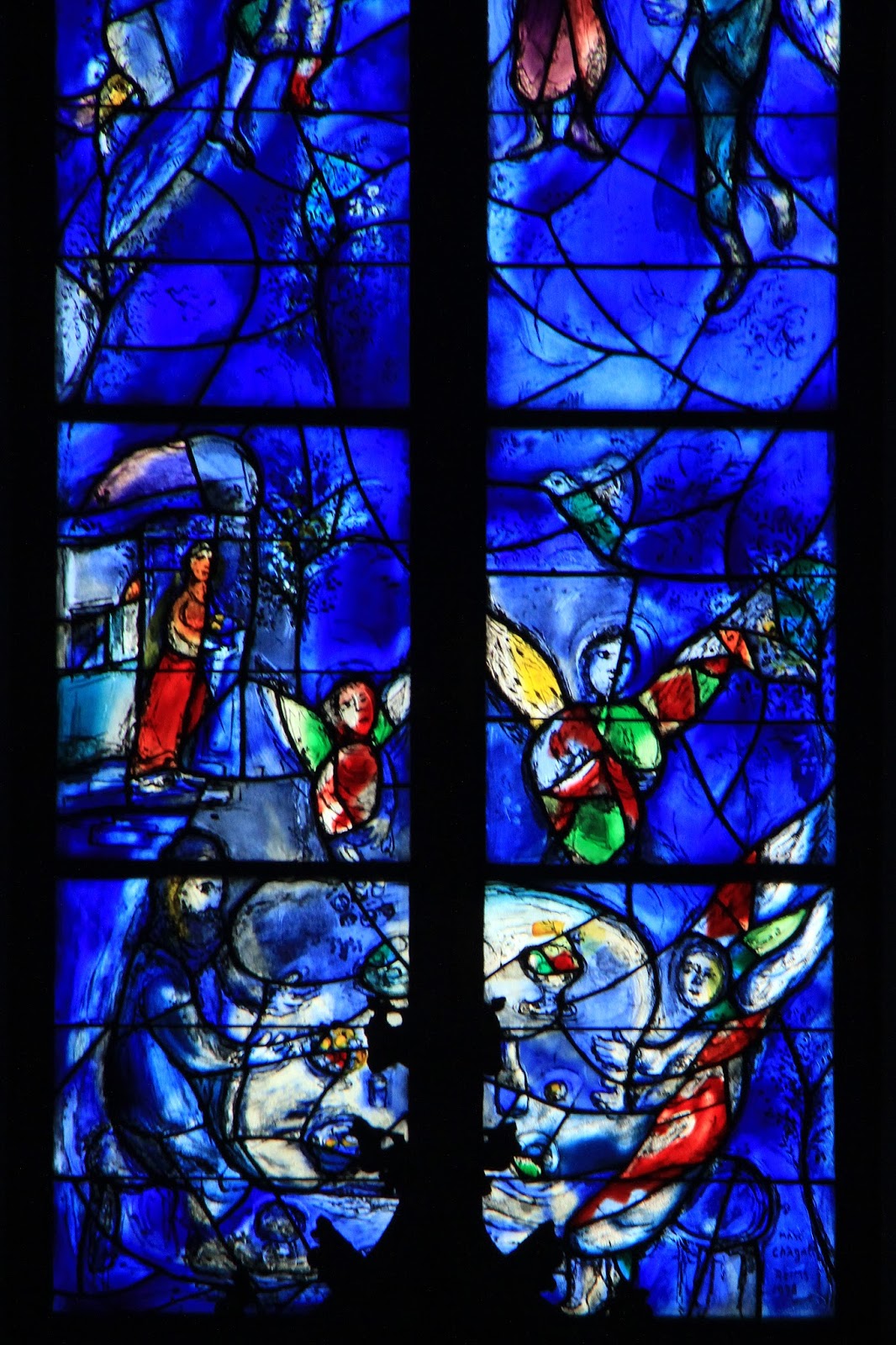
And here we find a sacred space that feels entirely that - holy, loved, a church to pray in. St Stefan's is much visited for its Chagall windows in the quire. They are truly magnificent: colourful, playful, luminous, yet presenting serious reflections on Old Testament themes. We can't get very close to them because the quire is roped off (as it always is in French and German churches as at Strasbourg and Speyer, the Cathedral had roped off large sections of the building which are often where the most interesting things are to be found). The rest of the church is sensitively glazed in a translucent blue that sets off the Chagalls splendidly without competing with them. There is much else to enjoy in this lovely church including medieval and modern sculptures, and a wonderful little cloister.
 
On the way back to the ship we call in at the Cathedral once again, not to visit the nave but to see the cloister. Here the Cathedral redeems itself. It's a gorgeous space, every inch what a medieval cloister should be. There are trees, shrubs and colourful flowers in the garth with a fountain in the middle. I notice tombstones marking burials of Cathedral clergy. In the alleys, the golden sunlight plays through the decorated tracery throwing sculptures and reliefs into a most beautiful chiaroscuro, a gift for a photographer. This is how I'd always envisaged Durhams cloister should be, a place to linger in and be refreshed, a garden enclosed within a city, a symbol of all that is lovely and redemptive in life.
 
We sail on to Rüdesheim at the entrance of the Rhine Gorge. Across the river is Bingen, where Hildegard came from. At least six other big cruise ships are already berthed here. We take a postprandial evening stroll along the Rheinstrasse to the little town. It's world famous as a wine shrine; apart from that its focus is tourism which it does to a spectacular degree. About two million people come here each year. I wish this year that there had been two fewer - us. The river front is a strip such as you would find at a seaside resort with down-market cafes, souvenir shops and entertainment of various kinds. The famous main street is called the Drosselgasse and runs up the hill. Genuinely quaint and faux-quaint buildings jostle for space along this exceedingly narrow gennel. It is crammed with souvenir shops, cafes and restaurants, and also with people, for this is the Place to Be. Mercifully the little train that scatters pedestrians across the other streets in this town can't get up this one.
 
Every cliché in the book is here in this self-conscious town that has sold its soul to us the tourists. Here is picture book Germany - black and white houses strewn across the town in playful chaos; vineyards stretching up the hillside with dark forests beyond; fairy tale castles and turrets, church spires...and we all fall for its seductions. But we are taken in if we do. It's not the real Germany we're experiencing but a "Germany" that belong to fantasy, and which has been cynically exploited in order to grow its tourist industry. It's not their fault - it's we the consumers who drive the economy of this and every other theme park, whether it's Disney, Cotswold villages or Sydney Harbour. Even cathedrals are not immune from this cheapening of our heritage. It is one of the most intractable problems of our time.
 
We have tomorrow morning to spend in the town. It may be a challenge to fill the hours. But we could try to be ethical tourists who at least bring an attitude to the place that is capable of asking questions and engaging in a conversation about what tourism really is and how we stop it eroding the very thing we have come here to experience and enjoy.
 
More to follow