Dear Frans Timmermans,
Thank you for your letter about Brexit that was published in the Guardian on Boxing Day. I was touched to read it. It’s as if you’d bothered to write to me personally with a generous, kind Christmas message. I’m sure a great many other British people were heartened too. And I don’t simply mean Remainers like me. I imagine fair-minded Brexiters will also have appreciated your affection for our country, your sorrow at this parting of friends, your hope that despite everything we continue to be good colleagues, partners and, yes, family members of this continent of Europe that is our common home.
But I’m only speaking for myself in what follows. As this year draws to a close, I am more than ever aware of my deep personal relationship with continental Europe: of my debt of gratitude for the ways our continent has formed and shaped me, and therefore of an intense sadness at the loosening of the ties that bind us together as Europeans. You’ve told us about your own past that has given you your love for Britain and the British. Let me tell you a little about mine.
The day your letter appeared in the Guardian, 26 December, was my grandmother’s birthday. Omummy, as we called her, would have been 125 or thereabouts - she never admitted to her age, only that she had been born in the early years of Kaiser Wilhelm’s reign. For she was German, born in Cologne, brought up in an assimilated middle class Jewish family in that Rhineland city. She married a fellow liberal Jewish man from downstream Düsseldorf, where he owned a factory that produced quality leather goods. They bought a large nineteenth century house in the Goethestraße and brought up their two children there, my uncle Karl and my mother Dorothea.
I needn’t tell you what befell my family when the Nazis came to power. My mother and uncle were sent to England as teenagers and made their lives here. My grandparents fled to the Netherlands - your own country - and when the Germans occupied it, were hidden underground in Edam by two devout evangelical sisters who looked after them for three long years. Amazingly, they survived. My grandfather died soon afterwards, but my grandmother eventually came to Britain where she lived to a great age. My mother married an Englishman, and my sister and I were born in London where we were brought up.
So in my childhood, three countries featured strongly in my growing awareness of who and what I was - Germany, the Netherlands and Britain. My mother was fluent in all three languages. We spoke a lot of German at home. My grandmother would sit me on her knee at the piano and play Bach, Beethoven and Schubert to me. Leather bound volumes of Goethe and Schiller lined the top shelves of the living room bookcase (as they now line mine). We often visited Germany and the Netherlands, and later on, France and Spain. We didn’t need to discuss “being European”. It was taken for granted that this was what we were. It belonged to our family’s DNA. It was part of our identity.
When the UK joined the European Union in 1973, I don’t recall great family celebrations. It was simply the obvious thing to do to go with the flow of history. Not only for Britain’s economic benefit but (and you’ll understand why this was so important for my family) to guarantee peace across the continent so that my generation wouldn’t have to face the grim ordeals my parents’ and their parents’ generations had undergone.
In the summer of referendum year 2016, my (widowed) mother lay dying in a north London hospital. Many of the nurses who cared for her so well were from EU countries. We talked about the coming vote. “We won’t do anything so stupid as to leave the EU, will we?” she asked me several times. “I so hope not” I replied. “I think the British have more sense than that.” I was wrong. I could tell how painful the Brexit vote was for her. We didn’t speak much about it. She died three weeks later. I’m glad she did not live to see it become a reality as we shall do at the end of January.
Why am I telling you all this? Because you were kind enough to reassure us that you wouldn’t stop seeing Britain as part of the European family of peoples. I can’t tell you how important it was to read those words. For me, with my personal history, being European is a fundamental part of my identity. I can no more contemplate losing my EU passport than I can ceasing to hold a UK one. It’s not simply that to me, all the arguments point to Britain continuing to be a member state - economic, political, historical, cultural, environmental. There’s a sentient dimension too. It’s a matter of the emotions. To me, the EU circle of yellow stars on their deep blue field evokes just as as much a sense of loyalty, belonging and gratitude as the Union Flag does. I recognise myself in these symbols. My past, present and future are bound up in them. They are signs of the family I belong to.
Or were. It’s hard not to feel profoundly dislocated by the Brexit vote and its aftermath. I won’t deny that the last day of January will be difficult. I’m trying to learn how to live with the inevitability of no longer being a European citizen for a while*. There’s no point in being bitter about it or going on rehearsing the reasons why to many of us, Brexit is such a terrible prospect. We thought we’d made the case for remaining, but it turned out that we lost that argument. Perhaps none of us recognised until it was too late that this was always about much more than merely rational argument. What I’ve explained about my family history perhaps tells you why. For it really feels like an imminent amputation. I reckon Brexiters find that an absurdly overblown image. I find it just as baffling that some people can be so matter of fact about it.
But your generous letter shows us that even after Brexit, we British can, indeed should, go on thinking of ourselves as Europeans. And to be fair to some of my Brexiter friends, this is something they have been saying too. It’s reassuring that on the European mainland, you and many others regard us in this way. Thank you. It means a great deal. I feel profoundly sad that it’s come to this parting of friends. But in case no-one else thinks of saying it, thank you for all the ways in which our decades of EU membership have enriched this country since the 1970s.
So happy new year! And here’s to our continued friendship and collaboration with the other nations of our European homeland in the decade that lies ahead.
With best wishes
Michael
*PS Just to clarify: I’m not entertaining hopes that the UK will rejoin the EU in my lifetime. There are lost causes that even I am learning to accept. I simply mean that I intend to apply for dual German citizenship on the grounds of my mother having been stripped of her German nationality and rendered stateless through her exile by the Nazis. I’m not making any assumptions, but I’ve now been sent the application forms by the German Embassy. They have been extremely helpful in my contacts with them so far.
Reveries and Reflections from Northumberland
About Me
- Aquilonius
- Pilgrim, priest and ponderer. European living in North East England. Retired parish priest, theological educator, cathedral precentor and dean.
Showing posts with label Germany. Show all posts
Friday, 27 December 2019
Wednesday, 6 November 2019
The Berlin Wall 30 years on
In old(er) age I find myself looking back on the times I’ve lived through and how they’ve shaped me over the seven decades I’ve been alive. I was born in 1950, the precise midpoint of the twentieth century. What have been the most significant events of world history that I can say have touched me personally in some way?
Any list is provisional of course. We can’t easily judge what events will prove defining in the grand scheme of things when we are too close to them. Even a lifetime can be too short to make sound historical judgements. There’s too much foreground; things don’t stay in place long enough to see them as part of the bigger picture. We need distance and perspective, and even then the relative significance of historical events and the meanings they carry can be hotly contested by historians. But I believe there are key “moments” in our own lifetimes that have already gathered the flow of history around them and acquired a kind of symbolic, even mythic, status.
So I’m speaking about my subjective experience of world events, those I remember as having a powerful effect on me in the first half of my life. My current seven candidates are these. (I wonder what yours are?) I’ve already blogged on two of them.
1962 The Cuba missile crisis;
1963 The assassination of President Kennedy;
1968 The student riots in France;
1969 The first moon landing;
1973 The accession of the UK to the European Communities;
1975 The end of the Vietnam War;
1989 The fall of the Berlin Wall.
On Saturday we shall commemorate the thirtieth anniversary of the last of these. So let me reflect briefly on the fall of the Berlin Wall.
I paid my first visit to Berlin that very year, 1989. But I was too early to be part of history. It was June. That summer the Kirchentag, the great two-yearly gathering of German Protestant Christians, took place in Berlin. It was an amazing event. I stayed with a family in Dahlem in the then Western Sector. There was a bewildering variety of activities to take part in: lectures, seminars, music, film, theatre, art... and a lot of theological and political debate, not only in churches and lecture halls but on street corners and in pubs and clubs. Here in the UK we don’t have anything quite like this festival of culture and faith that draws tens of thousands of people, not least the young, from across the country for five days of intense engagement and festive enjoyment. I was struck by how much talk I overheard about “our common European home”, particularly of course the aspiration to unite Germany. It was exhilarating. But that summer talk of peace and reconciliation in Germany still felt like a beautiful dream, nothing more.
To gain some respite from all this heady stuff, I needed time to wander round the city, drink in the atmosphere of this extraordinary place. In particular, I wanted to visit the East. I recall a journey on the U-Bahn that took me from one part of West Berlin to another that entailed crossing under areas of the eastern sector and passing through long-abandoned ghost stations. From inside deep cuttings I could look up at the grim tower blocks of the East shielded by intimidating rolls of barbed wire laid above the rail tracks. By contrast, crossing Checkpoint Charlie on foot in either direction did not seem as big a deal as I’d expected, not for a westerner with a British passport. Even crossing back into the West didn’t entail a long wait or a search. It was a very different matter for East Berliners, that was clear. Security around the Berlin Wall did not suggest any lessening of tension at that fault line between the two Germanys, the two Europes and the two worlds of East and West.
Back at Coventry Cathedral where I worked at the time, we continued to pray for peace and reconciliation across Germany. We often thought of the German cities with which Coventry had special relationships, whose great churches had been bombed by the Allies just as Coventry Cathedral had been destroyed by the Luftwaffe raid of 14 November 1940. I’d visited three of them: Lübeck which was (just) inside the Bundesrepublik, Dresden, then in the GDR and Berlin which straddled both. There, I’d attended Kirchentag events in the Kaiser Wilhelm Memorial Church on the Kurfürstendamm, whose spire, the so-called “Hollow Tooth”, damaged by Allied bombing in 1943, served as a much-loved war memorial in much the same way as Coventry Cathedral.
So you can imagine the feverish excitement on 9 November 1989 when the news broke that something remarkable was happening around, and on top of, the Berlin Wall. We were glued to our televisions, in our case a large old black-and-white (read on to discover why this detail is relevant). It was soon clear that not only had the Wall been breached but that the East Berlin security forces were doing nothing about it, watching, a few even smiling, while people took pick-axes to the fabric of the Wall and surged across newly opened gaps. That officialdom stood by and did nothing to stop this outbreak of unthinkable lawlessness is one of the abiding memories of that day. You’ll remember it well enough or will have seen the footage scores of times.
Having been in the city so recently, and given my Anglo-German parentage, I found it immensely powerful to watch these scenes, and extraordinarily moving too. All the more so because we were expecting to commemorate the anniversary of the dreadful “Night of Shattered Glass”, the Kristallnacht of 9 November 1938 that constituted the first concerted, violent Nazi assault on Germany’s Jewish community. Instead, we found ourselves celebrating this magnificent dawn of a new future for Berlin, and Germany, and Europe. If ever I watched an event that seemed to be an image of the kingdom of God, it was this breaking down of walls, this elimination of the barriers of division, this reaching across to fellow men, women and children in peace and friendship and hope.
It felt like one of the greatest moments of my life. It still does. I was back in Germany the following year, in Bavaria this time at a conference of young adults. The joyous hope-filled energy at that week’s gathering in the mountains was palpable. And participants were in no doubt that all of them were pledged to play their part as Christians in the reconstruction and renewal of a united Germany. And not just Germany. “Our common European Home” was back on the agenda in a revitalised way. And the handful of British Christians who were there were enthusiastically embraced as colleagues and friends in that great project. “The Cold War is over. We are all Berliners. We are all Germans. We are all Europeans” we agreed, in the spirit of John F Kennedy’s happy phrase when he came to the Wall on his unforgettable visit in 1963.
In a Wordsworthian way, it felt good to be alive and see this day. Indeed, I needed to do more than merely see it. I needed to bear witness to it because of the story that would undoubtedly reverberate across coming generations. We could not have foreseen how difficult this project of reunification would prove, what stresses and strains it would place on this new Germany that was rising from the ashes. We did not imagine how hard it would be to eradicate the division between the privileged West and the more deprived East, nor the rise of far-right populist politics in cities and towns of the GDR (and not only there). We believed that the European ideal would quickly vanquish old enmities and bring about a Europe that was democratic, prosperous and free. We thought we could glimpse “the end of history” and the emergence of a new world order of peace among nations.
How naïve, you may say, this “first fine careless rapture”. And yet across Europe, people of Christian faith, other faiths and of no explicit faith but immense good will continue to collaborate for the peace and flourishing of Europe and beyond it, the whole human family. My own Europeanism has always been an important part of my self-awareness - how could it not, given my parentage? But as I look back, I now see what an impetus the events of 1989 gave me to commit to my identity more consciously. Hence my profound disappointment and sadness at the prospect of Brexit, not to mention the challenges the European Project is facing in many other parts of our continent.
But on Saturday, we should celebrate all that the fall of the Berlin Wall promised, and the real achievements that have been wrought across a reunited Germany. On this thirtieth anniversary, it’s worth pausing to be grateful for what happened in November 1989 that raised the hopes of millions of people all over the world that oppressive regimes do not have absolute control over human lives. For if the events of that month seemed like an image of the kingdom of God, then we should go on praying “thy kingdom come” with the heartfelt conviction that lasting change can happen and the lives of nations, societies and people be permanently transformed for good. That’s a prayer to make our own during the commemorations that will take place on this weekend of Remembrance Sunday.
What about that black-and-white TV, you ask? It wasn’t long before the East German Embassy in London was closed. It had state-of-the-art TVs to give away. One of them found its way into our home. Not only was it a colour set, but it even had a zapper (aka remote). For our four children, not to mention their parents, Christmas came early that year!
Wednesday, 8 August 2018
"The best things just happen to you."
It was the Viennese philosopher Ludwig Wittgenstein who said
that. I came across it while reading an intriguing book** by the child
psychotherapist Adam Phillips. He is writing about how a lot of learning
happens, not as a result of formal schooling but through hints and nudges. He
means the things that "just happen" to us, inconsequential in
themselves but for the fact that we remember them and find ourselves
returning to them in our thoughts and reflections, even find that our lives
were changed because of them.
He quotes a fellow philosopher who recalls a walk
Wittgenstein and he were on. Wittgenstein "had seen a play, a third-rate,
poor play, when he was twenty-two. One detail in that play had made a powerful
impression on him. It was a trifle. But here some peasant, some-ne'er-do
well says in the play: 'Nothing can hurt me.' That remark went through him and
now he remembers it. It started things you can't tell. The most important
things just happen to you."
I stopped reading to think about that. Is it true, I asked
myself? The most important things Wittgenstein says, not just happy
conjunctions of events that please us but things that really matter, or as we
might say, things of ultimate concern. Bishop Ian Ramsey of Durham, a
philosopher of religion who was much influenced by Wittgenstein, spoke about disclosure
experiences, "when the penny drops". Carl Gustav Jung would never
use the language of coincidences. For him, the fact that we notice them at all,
pay attention even fleetingly to how events have come together in a particular
way, confers significance on them, gives them meaning. There are no coincidences. If they are important and matter to us, there are only synchronicities.
Personal experience has to be the test of Wittgenstein's
dictum. What does my own memory tell me about this? How have the things that
"just happen" been significant, touched my life in some way? Looking
back over six years of blogging, I find I've mentioned some of them. For example: my
love of maths that led me to read it at university; the
part music has played in my life for as long as I can remember; the books
in childhood that influenced me; my lifelong commitment
to the continent of Europe that comes out of my having a British
father and a German-Jewish mother; memories
of Christmas past; and much more recently, the birth
of my first grandson. In that last blog, I wrote about how I would always
remember where I was and what I was doing when I heard that news. Most of us can
tell similar stories about how certain events impinged on us: when our team won
the Cup Final, say, or when we heard the news that someone close to us had
died. Maybe that's one criterion by which we measure the importance that
certain events hold for us, that in an instant, our lives as they were then
seem captured as in a photograph.
But none of those can be described strictly
speaking as "chance". They belong to contexts that up to a point were
already shaped by upbringing or environment. What about the events that at the
time seemed to "happen" out of the blue, unforeseen, unforeseeable,
yet never forgotten? I've had to think about that today, but here are three
I've come up with.
The first is a very archaic memory indeed, probably my
earliest, but it's as clear as anything I can recall. We were in Germany where
my mother needed to travel regularly to sort out her family's affairs after the
war. My parents had found lodgings under the eaves in a back street of Düsseldorf, my mother's
home town. My mother told me once that I could not have been more than just
over two years old when we stayed there. What I remember was seeing the outline
of a church tower and spire out of the window not far away. It was black,
dramatically silhouetted against the sky. That evening, something awoke me. It
was the sound of church bells being rung in that tower - not change-ringing as
in England, but that random tolling of great heavy bells against one other that
every European traveller has heard on a Sunday morning.
To me that sound seemed to penetrate my being from top to bottom. This primitive sound that seemed to batter my heart was deeply frightening, even dread-ful, yet somehow, in a way I didn't yet have words for, enticing as well. It felt as if it mattered. Was it my first encounter with that mysterium tremens et fascinans which is how some writers have characterised religion? That it was my earliest conscious religious experience I now don't doubt though I couldn't have described it in that way for many years. And while it was one of the most important experiences of my life, it did "just happen". It still colours the way I think about the Divine, that as the Letter to the Hebrews puts it, "it is a fearful thing to fall into the hands of the living God". It taught me even at that tender age that religion is a serious business, not a plaything or a hobby.
The second event was altogether happier. I was in my early
twenties, arriving at theological college to begin training for ordained
ministry. This was a few days before term was due to start. My longsuffering
parish priest in London had kindly agreed to transport my books and me to the
college in his Mini-Traveller and help me settle into my room. We arrived and
parked the car. No-one was around except for a young man of about my
age who was busy painting a side door at the foot of a staircase that led
up into the building. With the warmest of smiles he explained that he too had
arrived early and was busy making himself useful. By the end of the afternoon I
was established in a room next to his. Why is that day etched on my memory?
Because the person concerned quickly became my closest friend and has
remained so for the best part of half a century. We still talk about that day
we met for the first time when our friendship was born: a time of gifts if ever there was one. The only
detail that maddeningly escapes me is the colour of the paint on that door. I must
ask him.
My third reminiscence is about my love of photography. By now I was in my fifties. My youngest daughter
had asked for a camera for Christmas, so we had bought her a digital compact. I
had no interest in photography at that stage (so much so that on a pilgrimage
to Israel-Palestine a few years before, I was the only person not to bring a
camera. When asked why not, I pompously replied that for me, images were best
encapsulated in words, so I was keeping a journal instead.) I thought nothing
more about my daughter's camera until she told us that she didn't want a
digital after all, so would I buy it off her so that she could get a
traditional film camera instead? I agreed. It lay around unused for a while. But
then I got to thinking, I've paid good money for that instrument. Maybe
it's time I started using it. Living as I did in Durham's world heritage site
with one of the world's greatest buildings a few yards away across the garden,
I began to realise what opportunities for photography were all around me. The
rest as they say is history. I can't now imagine a life without photography,
just as I can't imagine one without music. And if I'm asked where I learned
what I've been able to grasp as a photographer, I always say: Durham Cathedral
was my teacher.
I think I can say that all three of these stories are about
what "just happened". None could have been foreseen or planned for.
And all three have been amongst the most important experiences of my life.
There are many more, not all of which it would be right to blog about. What
matters is the spiritual exercise of asking the question in the first place. An
earlier generation of spiritual guides like the great eighteenth century French
priest Jean-Pierre de Caussade spoke about how we must reflect often on divine
Providence, discerning how God comes to us in "the sacrament of the
present moment". That's the theme of one of the best English hymns from
the same century, William Cowper's God moves in a mysterious way. Maybe
I'll blog about that one day. For now, enough to affirm that whether in light
or in shadow, our experiences can convey gifts that transcend the circumstances
themselves and, even if we don't know it at the time, prove with hindsight to
have transformed us in some way.
Yes, "the best things just happen to you." But we
must practise how to pay attention and notice them. Who knows
what has passed unnoticed in front of us a thousand times a day with the
potential to give us something wonderful, undreamed of, and we missed it?
That's the question I find myself asking late in life. It's not about regrets
but nurturing a thirst to be more alive, being as fully present to the gift
that I am alive at all as it's possible to be. I am a slow learner, but I can
now add Ludwig Wittgenstein (and Adam Phillips) to the lengthening list of wise
teachers to whom to be grateful.
PS The friend I wrote about above has just read this, and sent me some lines from Mary Oliver:
Let me
keep my mind on what matters, which is my work,
which is mostly standing still and learning to be astonished.
keep my mind on what matters, which is my work,
which is mostly standing still and learning to be astonished.
**Adam Phillips, The Beast in the Nursery, London
(Faber), 1998, p70.
Labels:
Adam Phillips,
bells,
coincidences,
Cowper,
De Caussade,
disclosure,
Durham,
friendship,
Germany,
Ian Ramsey,
Jung,
Mary Oliver,
mysterium,
photography,
Providence,
religion,
synchronicities,
Wittgenstein
Thursday, 1 June 2017
A Cruise on the Rhine Part 1
We
are cruising on the Rhine, upstream from Cologne to Strasbourg and back down
again, some 700km of river for the round trip. The theme is Cathedrals and Castles of the Rhine. I
am looking forward to boarding at Cologne, my grandmother's city, in the shadow
of the mighty Cathedral we shall visit on the return leg. Unfortunately it
doesn't turn out as planned. A catalogue of incidents on the coach journey
between the Brussels Eurostar terminal
and the Rhine delays our arrival until late in the evening. By then our ship, Rex Rheni, has had to leave
the berth at Cologne and begin the voyage. So we join her (him? this is a Rex) at midnight on the
quayside at Bonn. It sounds romantic until you have to do it.
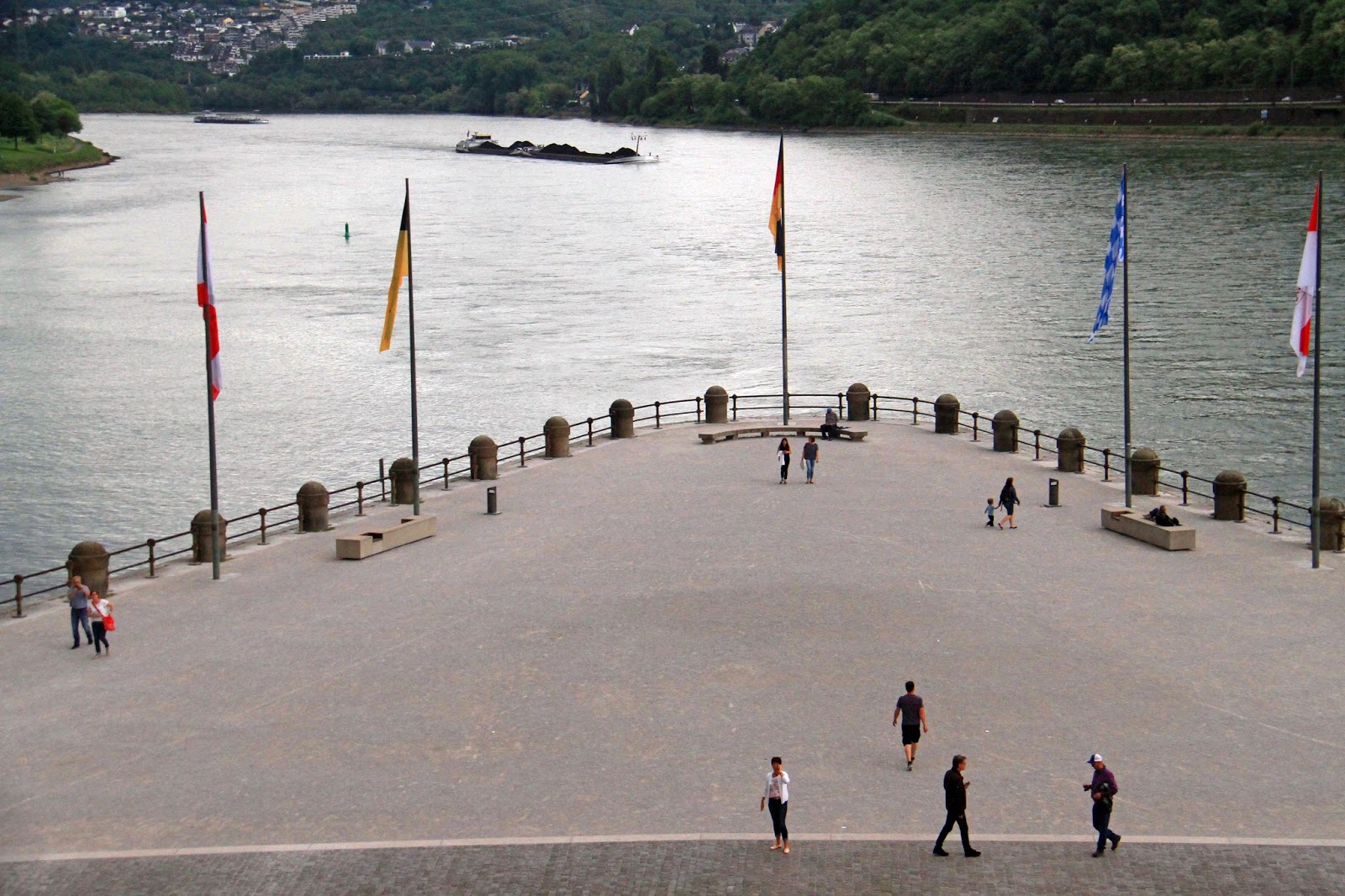
Rearing
up at this "corner" of Koblenz is a gigantic equestrian statue of
Kaiser Wilhelm I. He stands on a monumental basalt temple-like structure with
sweeping stairs rising up to it on both sides. It demonstrates the unbridled
confidence of the unified German Empire energised by the Prussian spirit. In
this heroic monument with dragons and serpents sculpted into its base, there is
not a trace of self-doubt. Later in the day I venture up the staircase. The
interior of the temple is a marvellous grid of basalt columns and narrow aisles.
You peer out of these dark alleys at the framed church towers of Koblenz.
Incongruously it reminds me of the Romanesque crypt chapel of Durham Castle, or
perhaps more in tune with the subject matter, of the pyramids in Egypt. At
sunset, the volcanic stone glows magnificently in the sinking red light. More
associations, this time of the Whin Sill and the Roman Wall that strides along
it. Roman imperialism, Egyptian deification - Wilhelm would have liked that.
Next
morning, it is raining. The ship sets off up the Rhine. This section of the
river, the Rhine Gorge, is exceptionally lovely. I sit in our cabin by the
window, camera at the ready. I can get Radio 3 on my phone so Rob Cowan keeps
me company with Essential
Classics. Chateaux pass by, and below them, villages with
half-timbered houses and church spires. The cloud wraps round the highest of
the wooded summits. Vineyards stripe the hillsides, each one a subtly different
shade of green from the next. Working them must be challenging, given the steep
gradients. At the foot on both sides of the river, trains hurry along what must
be one of Europe's most scenic railways. I glimpse cyclists on the road
entrapped in plastic, heads down against the driving rain.
Then we go shopping. A nice man in an outdoor shop sells me a waterproof jacket and Jenny some trainers. He compliments me on my German (which is all accent with no grammar or vocabulary). And he throws in a pair of socks for Jenny as his gift. We head back to the ship and it rains on and on.
More to follow.
Subscribe to:
Posts (Atom)